Story: 9.5/10
Haibane Renmei is honestly pretty hard to rate. At its core it feels like a moral tale told through its characters, even though in the end only two or three of them really matter for the main story. It is quiet, introspective and slow, and it really deserves to be called a psychological anime.
The show throws a lot of elements at you that at first make you think there has to be some huge hidden meaning behind everything. Then, once they’ve done their job and get “explained”, they turn out to be surprisingly down‑to‑earth. Other things just never get explored at all, not because the writers forgot about them, but because they don’t matter for where the story wants to go. It’s very much a “take what you want from it” kind of experience.
Spoiler, click to viewclick to hide
Rakka’s first dream and the walls made me expect a completely different kind of ending. The series deliberately sends you in the wrong direction at the beginning, then keeps dropping hints until, in the last episodes, Rakka’s flashback of Reki talking to her in the cocoon and asking for help suddenly makes everything “click”. In hindsight, it almost feels too easy. Kuu, on the other hand, is almost irrelevant to Rakka at first, and then her disappearance suddenly becomes this huge emotional weight. That makes sense as a very personal reaction, but it also makes me feel like Rakka should have lived just as intensely with the others too, at least afterwards.Worldbuilding and symbolism: 9/10
Spoiler, click to viewclick to hide
I really like that the show never properly explains how Rakka is forgiven. Was she a bird in her previous life? Was she guided there by the friends she had back then? Something else? The series leaves that completely open, and that worked well for me. The world itself feels like a kind of purgatory with a timer on it: you can’t stay there forever, and roughly seven years seems to be the hard limit. At some point, the Washi even explains that if you go past that, you lose your halo and wings and are forced into solitude – but how he knows that is never made clear. If he really is (or was) a Haibane himself, then logically he should have lost his own halo and wings long ago, yet we clearly see him wearing a wing cover. That little detail makes the whole thing feel a bit contradictory. All of this also makes Reki’s situation even more confusing and gives her choices a pretty clear suicidal undertone, both in her past and in what she tries to do at the end.The setting in general is full of details that look symbolic, but the show refuses to overexplain them.
Spoiler, click to viewclick to hide
The walls, for example, are never properly explored, and we never see what lies beyond or why only one specific “family” is allowed to cross them. The halos and wings are never really explained either, aside from a theory Rakka and another Haibane come up with on their own. It’s all just “there”, half symbol and half in‑universe rule.
Spoiler, click to viewclick to hide
I also wanted to talk about the Toga and the Washi. The Toga feel almost sacred: they don't talk, follow strict rituals and belong to the only group that can go through the walls, but we never find out why, or what their real role in this world is supposed to be. The Washi looks almost like a failed or distorted Haibane, and between what he says about halos and wings and the way he hides his own, you get the feeling that he knows much more than he should. Without the show ever explaining how. You can come up with your own theories (maybe he is a Haibane who never left, maybe something else entirely), but the anime never confirms anything, and by this point the number of unanswered questions starts to feel a bit high.Characters: 9/10
The cast is built like a small ecosystem. Some characters are just there to make the town feel alive, others are there for a couple of specific moments, and a small core group carries pretty much all the emotional and thematic weight. Rakka is clearly the main point of view, but she only works because of how Kuu, Reki and the others bounce off her.
Spoiler, click to viewclick to hide
Kuu’s arc hits surprisingly hard: she starts as this almost background presence, and then her “departure” suddenly becomes a huge emotional shock. It’s powerful, but also a bit abrupt. Reki, though, feels like the real hidden protagonist. Her mixture of guilt, resentment, fear of being abandoned, and fear of moving on gives the finale a lot of its impact.In the second half of the story, new characters are introduced, tied to things that happened in the past. They are relatable enough, and they clearly exist to push the plot and Reki’s arc forward, but none of them really did anything for me emotionally. They work on paper, but they didn’t leave much of a trace.
One thing I really want to mention is how strong some of the dialogue is. Rakka’s lines about the birds, Kana’s comment about them, and Reki’s final words are honestly some of the most powerful moments in the whole show. If you’ve seen it, or if you ever will, you’ll probably know immediately which lines I’m talking about.
Audio: 8/10
For a 2002 anime, the sound effects are honestly not bad at all. They do their job and never really pull you out of the experience. The voice acting is where things get a bit shaky: it’s perfectly fine when characters are just talking normally, but when they have to scream, cry or completely break down, it often sounds fake. It’s not disastrous, but in a show that leans so much on emotions, you really notice it.
The music, on the other hand, is one of the parts that works best. The soundtrack is soft, gentle, and quietly melancholic, and it fits the spirit of the anime almost perfectly. It gives the town this warm but slightly sad feeling, and it supports the mood without ever trying to steal the spotlight.
Visuals: 7.8/10
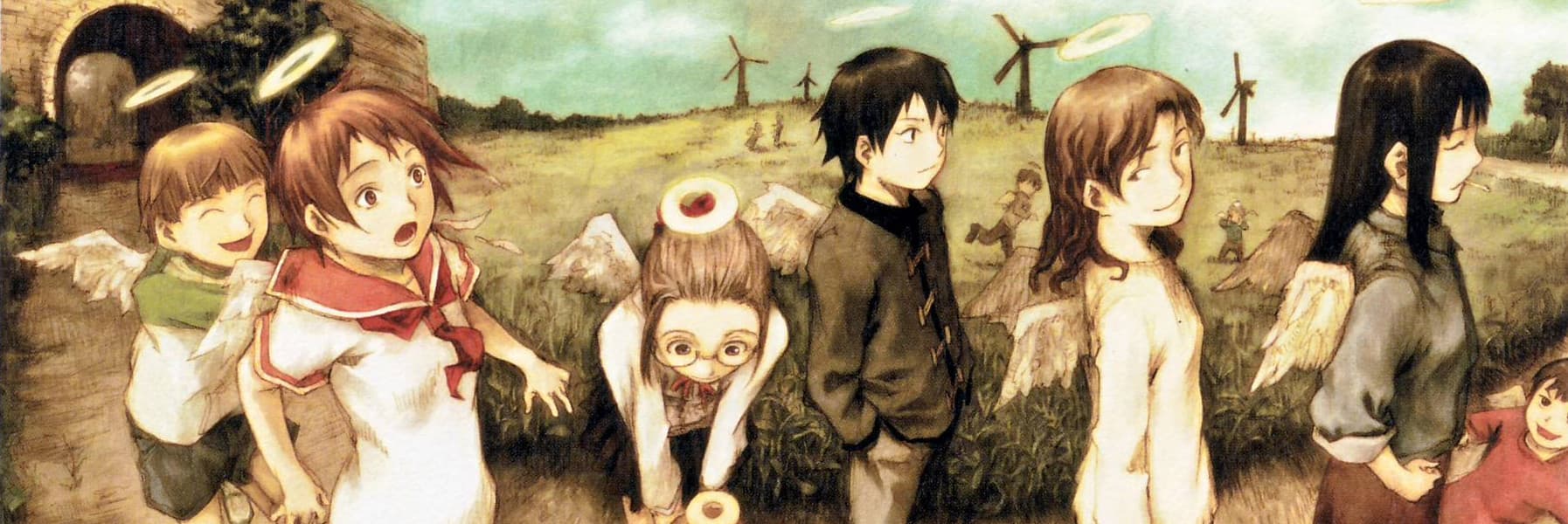
Visually, Haibane Renmei has an art style that I liked a lot. It’s delicate, understated, with designs and backgrounds that immediately give off a calm, intimate atmosphere. It feels like a world you could actually live in, not some flashy fantasy setting.
The problem is the technical side. The linework is rough, the animation is limited, and the overall image quality just doesn’t do justice to how nice the art direction could have looked. It’s one of those shows that really deserves a proper remaster.
Finale: 9.2/10
Talking about the ending, this is where Haibane Renmei came the closest to becoming an all‑time favorite for me.
Spoiler, click to viewclick to hide
Everything the show had been quietly building finally comes to the surface: Reki’s past, her guilt, her anger, and the way she keeps pushing help away while desperately wanting it. It feels like watching someone who has already given up on themself being forced to face the fact that they were never really alone in the first place.
Spoiler, click to viewclick to hide
What I especially liked is the moment when Reki finally drops the mask and shows who she really is. Underneath all the distance and bitterness there is just grief and fear, and the show makes it clear that this is what pushed her to act the way she did. Rakka doesn’t overthink it or moralize: she simply accepts Reki for who she is and reaches out anyway, and that lets the ending close in a way that feels genuinely right.The Old Home itself ends up feeling like a quiet, perpetual cycle. New arrivals will go through their own confusion and guilt, looking for redemption, while they slowly watch the friends who have been there longer find their way out and “leave” one by one. It’s a bittersweet idea, but it fits the series perfectly: a place where people come, hurt, heal as much as they can, and then move on.
In the end, Haibane Renmei left me with a very strange feeling. The kind of anime that keeps living in the back of your mind long after you’re done with it.