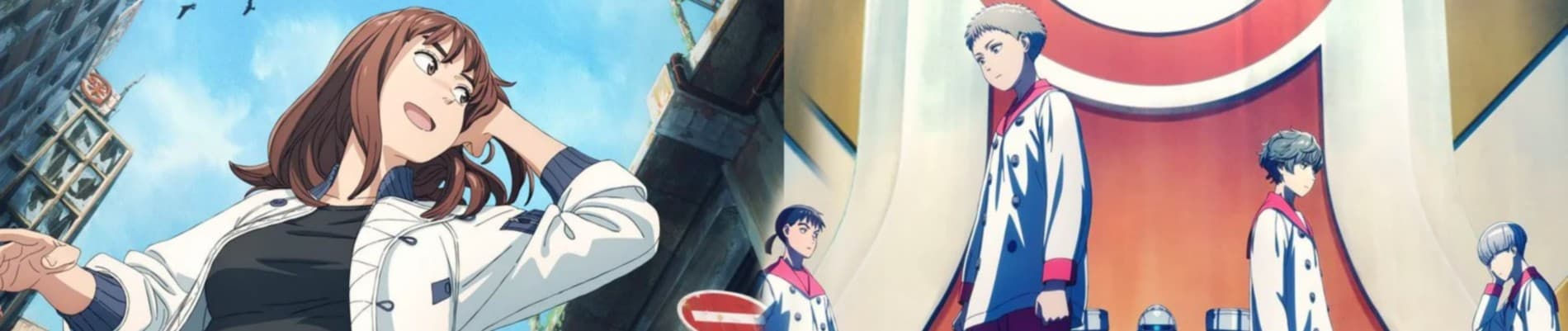
Heavenly Delusion feels both familiar and unconventional at the same time. On a surface level, the story is quite traditional: Kuroko is tasked with delivering the adolescent Maru to his destination, fulfilling a promise to his sister. It’s the kind of plot that could remind you of works like The Last of Us, a post-apocalyptic journey filled with sparse but dangerous landscapes, ruins of civilization, and scattered human clusters trying to survive. But even though it’s conventional, it’s executed in a way that’s consistently engaging.
The post-apocalyptic world itself is both recognizable and compelling. Desolate urban sprawls are overtaken by nature, abandoned buildings hide remnants of a collapsed society, and scattered survivor groups take on diverse approaches to survival, some rigidly political, some opportunistically free. It all feels logical in a world trying to rebuild after a supernatural catastrophe. Yet, the anime also introduces chaos in ways that break the typical rules of post-apocalyptic storytelling, giving characters freedom to live personal stories within this setting. These moments, intimate and small-scale, make the characters’ journey feel genuinely lived-in, and sometimes more personal than the larger narrative.
Ironically, the story’s tendency to focus less on the main plot actually makes plot developments feel more meaningful when they do occur. Side stories and tangents give the world texture while making the central mysteries of the ruined world and the facility known as Heaven more intriguing. Maru and Kiruko’s adventure feels real precisely because the world is alive with its own independent narratives.
The characters are where the show truly shines. Kiruko isn’t exactly who she appears to be. Her mind is Haruki’s, trapped in his sister’s body. This separation of mind and body introduces a fascinating psychological and gender complexity that avoids conventional labels. It hints at philosophical ideas about the distinction between physical form and identity without turning the series into a direct LGBTQ+ narrative. Instead, the show subtly explores gender and identity, letting the character backstories, particularly Kiruko/Haruki’s, carry emotional weight.
The anime’s treatment of gender themes is bold. Roles are frequently inverted or challenged. For example, Juuichi is a male character oppressed by a female-dominated community, yet portrayed with unexpected depth as a father searching for his lost child. The series actively subverts traditional gender norms and societal expectations, creating a progressive take on identity that is rarely seen in anime.
All of this makes the anime artistically and socially impressive, but it isn’t without flaws. The mystery elements, in particular, stumble in the later episodes. Key plot developments happen abruptly, with little setup or logical progression, sometimes resulting in jarring or even upsetting scenes. For example, the final episode contains narrative and thematic shifts that feel compressed, creating confusion and undermining the tension that the series had built.
In the end, Heavenly Delusion offers a rich and immersive post-apocalyptic world, compelling characters, and an inventive approach to themes of gender and identity. Its open-ended and often tangential narrative structure allows both the world and its characters to breathe, making even its side stories feel purposeful and alive. However, the series struggles with narrative cohesion and the handling of its mysteries toward the climax, leaving several key developments unresolved or awkwardly executed. Despite these shortcomings, the anime remains well worth watching for its ambitious storytelling, intricate world-building, and thoughtful exploration of identity, with the hope that future seasons will address the issues left behind by its uneven conclusion.
17 out of 18 users liked this review