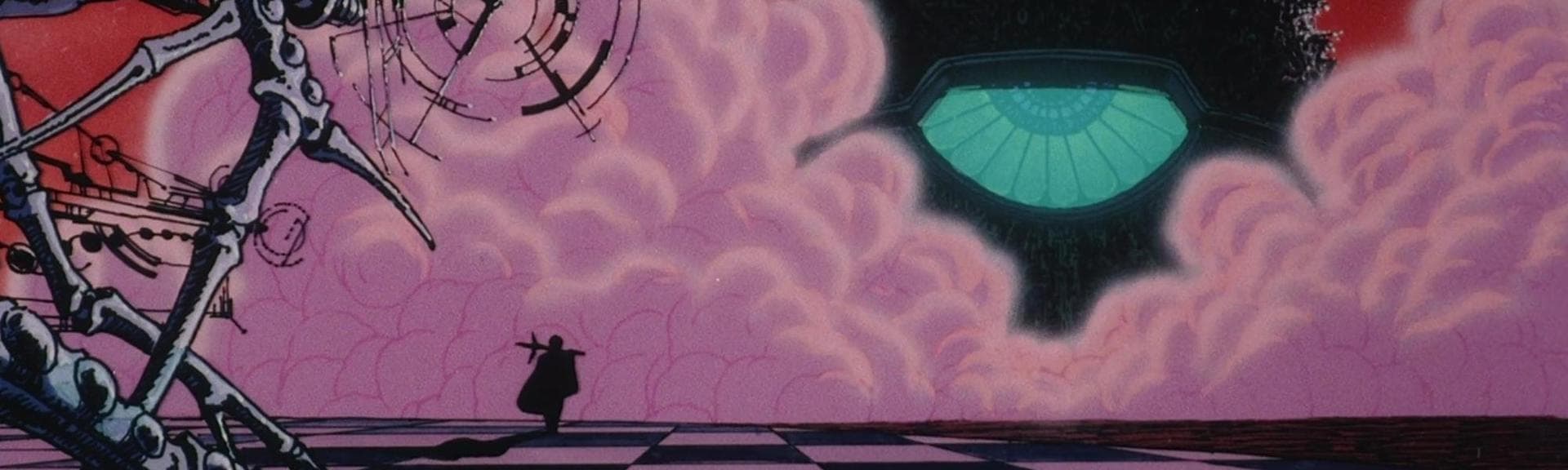
Angel's Egg
a review by palomilla
a review by palomilla
When I was making [Angel's Egg], I was not so much idealistic, rather, I was ignorant and unconscious about film as a form of expression.
Tenshi no Tamago is a beautiful movie, as we can all agree. It has astounding visuals and the songs were delightful to listen to. But that's all there is to it, really, since it's devoid of a coherent story. The scarce dialogue leads you nowhere, the world is completely unexplored, and the incredibly slow pacing finishes hammering this in. Your mind could be somewhere else, completely absent, and when coming back it'd stumble upon the same scene where it had abandoned the movie. Of course, since I am not Christian nor well-versed in the religion, I might have missed a lot of the symbolism that the movie doesn't spoon-feed you, but I did some research as not to review the film and look like a miserable fool.

First of all, I wanted to know what the director of this original movie thought of it, as it's a very important voice, even if we as the viewer can interpret the film however we want. In my search of his opinion, I discovered he has no idea what he has created, and even if he has, that he's simply made a bad movie.
I think that the egg might represent ‘dreams’ or ‘hopes’
is what Mamoru Oshii said on the matter, but, how do you 'break' someone's faith so objectively? There is a very big problem of using an egg as a metaphor for (religious) beliefs, and it is that you can question the empty or alive contents inside the egg as much as you like, but it should be impossible to break it open or to feel what's inside.
You can debate with a believer of anything as much as you'd like. You could completely shatter this 'egg' and show the person the empty shell of their arguments, but you are not capable of making them see the broken egg. They will never say "Please, don't break my egg" because that would be admitting that their beliefs are falsifiable, that they can be completely proven to be false and force the person to truly stop believing in them. That's speaking from my own experience, at least.

The character of the Girl, the protagonist of this world, is the caretaker of the Egg, which she firmly believes has a bird that will hatch at any moment now. I do not have any issue with her blind faith in the contents of the Egg, and I do not find odd the way she critiqued the blind faith of the Fishermen. The Bird and the Fish are very opposite, are they not? They can be interpreted as two sets of beliefs, and the Girl, as many believers, judge other followers for doing the same thing they do, just with a different religion. Seeing it this way, the parallels make sense: the Girl takes care of the Egg hoping someday it will hatch, and the Fishermen ready themselves to try and catch the Fish.
Her room with the bed reminds me of the inside of a woman's belly during pregnancy, for a lack of better wording. The Girl wrapping the Egg in the sheets, the rest of the area empty except for the water surrounding the bed. What I can't find an explanation for, is her obsession with collecting water bottles. Maybe it works like a calendar, where each water bottle helps her keep track of the passing time until the Bird cracks its shell open.
I wanted to show that there is salvation for the girl.
After the Boy destroys the Egg, she wakes up and cries inconsolably, and she looks rather mature before her death, different from her child-like appearance the whole movie had shown us. This was not a deliberate choice, as Mamoru admits not knowing why he chose a little girl to be that character, yet I believe this change in her physique could mean she was able to accept the Egg's contents and 'grow out of it', so to speak.

Another enigmatic character, for sure. The Boy depicts himself as hopeless in mindset, and he doesn't find interest in the Egg, as he knows what's inside: he finds interest in the Girl's devotion to it, and he has no plans on letting her be. Where does he come from and why was he using that weird machinery as transport? We'll simply never know.
We see the Boy carry a Cross, an element of faith, but what stands out is the irregular and imperfect appearance of it, made out of unknown components that look disgusting to the eye. The Boy carries it heavy on his back, and to quote a TikTok I saw: The only moment the Cross is held upright and front-on in the movie, is when it recalls its original purpose. To perform an act of violence in the name of devotion.
He genuinely thought his ideals were better than the Girl's, that's why he went against her explicit wish not to crush the Egg, but why at that moment, when he had had so many chances? The fossil. It changed everything.
The Girl guided him to see the Bird's skeleton, and his eyes couldn't believe what they were seeing. After letting her know what his beliefs were, that he believed in the Ark, but not the Bird, for her to oh-so-casually show him the proof that he was wrong... Well, he felt threatened. He had coddled her beliefs, and it took a personal attack for him to get back at her. He was carrying the Cross, the burden of knowledge, of suffering. He didn't want to pass it on to her until that very moment.

The characters' unreliability makes objectivity even harder to figure out, but we have a semblance of what are X and Y elements and how to interpret them, even if Mamoru desperately tries to make the film unbiased and completely up to interpretation.
In my opinion? The movie is about nothing, the director detaches himself so the viewer can come up to their own conclusions, successfully shifting the blame on the consumer for not understanding what his own creation is about.
That said, what I want to gather from the movie is that it's about a delusional pregnancy, as much as others and even the director may disagree with me. The Girl forming a bond with the Boy, her only rule is for him not to break her egg, but ultimately he betrays her while she's sleeping and leaves before she wakes up to find something that was never there, and hysterically mourns that 'loss' before her death. The Fishermen? Those with unrelated mental disorders, disorders the Girl did not have nor understood. And the Boy? I'm thinking of infertility problems, the flood getting rid of all life and the only one that could explore the world's remains being a Bird which may not have even existed, and the Cross as a pregnancy test... I think those themes could go hand in hand, as unconventional as this interpretation is.
There’s a girl who is always waiting for something, then a certain man turns up and eventually leaves. It’s a story about meeting others and the world becoming new.
[...]
That world in itself was probably something the girl had invented. That world only existed within the girl’s scope.
Sources and works cited:
Interview 1 Interview 2 TikTok26.5 out of 47 users liked this review
