
Death Note
a review by althonos
a review by althonos
This review will contain spoilers. I did not read the manga.
Death Note came around at a time before I started watching anime on a regular basis. But by the time I finally got to watch it, is was considered by many as a classic; you only have to see the ratings to see that. Sure, there is a consensus about the last part of the series being much worse, but even without that part I'd give it about the same score, for I did not enjoy Death Note.

After about the first three episodes I started to spend half of the time sighing in front of the screen, but it took me a couple extra to realise what was wrong. Basically, Death Note attempts to be a serial killer detective show, like the Hannibal live action, but it does so by using a very cheap trick: for its characters to look like geniuses, it relies on you, the viewer, who have both point of views and necessarily more information than each protagonists. This translates in particular into L's findings, who keeps pulling predictions out of his ass that make no sense with what he knows, but that make sense with what you know, so you're expected to just accept it and move along.
Let's take take an example: in an early episode, L analyses the day and time of the killings, and since it is only on evenings and holidays, guesses that Kira is a student; this assumption is then never addressed again. And it's supposed to make sense, since you already know Light, and he's indeed a student. But from L's point of view, this makes no sense: it could as well be a salaryman, or anybody working out there, really. You may think I'm nitpicking, but this happens again, with Naomi later being convinced (without any argument to support it) that Kira can cause accidental deaths, with L detaining Light despite all evidences and the viewer being okay with that only because we know Light is Kira, and so on. This is, perhaps, what made me have trouble staying into the show, since identifying that kind of pattern early made me see it everywhere after that.
There is also the issue of Shinigamis themselves: while Ryuk states that he has no side, he switches to Light's side from time to time, quite ingeniously at first (the camera thing where Light tricks him with apples), but then later with no explanation (him lying to Near, or writing the fake rules). Overall, the supernatural elements of the show are extremely quickly accepted by the people investigating Kira, and I found that a bit cheap as well.
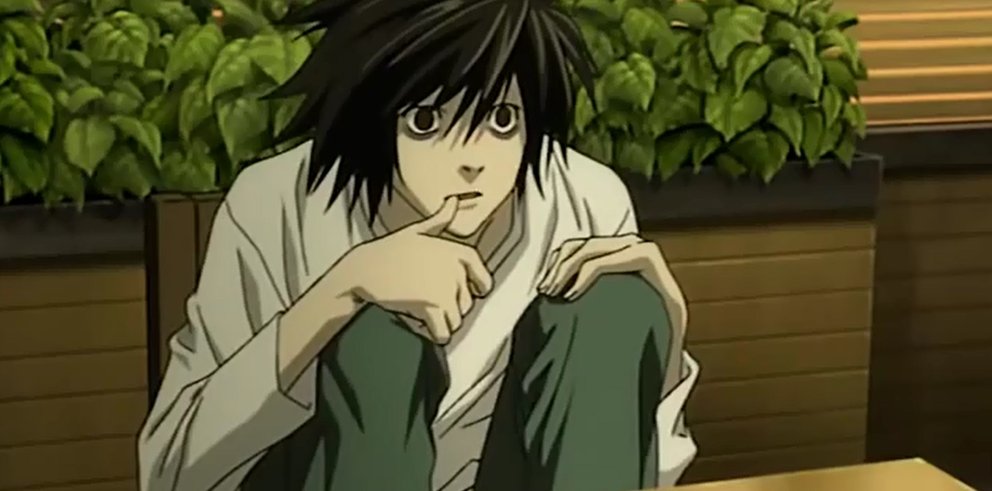
I won't go into a detailed analysis of the psychology of each character here, because I don't care enough and there are other reviews which are doing it a lot better. I tend to think here that I have a personal issue with who the characters are, not what they are supposed to be. Light is an evil genius a la Lelouch, Misa is his tool to use (and the author's only way to do fan service), etc. The show succeeds in making them that way; it is I who didn't find that extremely interesting. Even the task force members, who had potential to be more than pawns, end up blindly following either side all the time, changing allegiance from L to Light and then from Light to Near without really questioning their new master (like, nobody even has the idea that N may be Kira when they contact them, and once again we're supposed to be okay with that because we as a viewer know Near already). I think the only character I found slightly interesting was L himself, not because the show depicts him as a genius (we discussed earlier that it's a hack), but because he's given a bit of character evolution compared to everybody else.
Also, I wish Mello had died of diabetes. Eating chocolate is not good characterization. Even Ryuk eats less apples, and it's one of its character traits.

Even watching this from a Blu-Ray source, the animation didn't age super well; mostly because of that constant numeric grain which was probably used at the time to erase the animation look, but that now looks like shitty MPEG artefacts. The show is not ugly, but not particularly unforgettable either. I also won't comment on the aesthetics or the symbolism a lot, since I have the feeling it was quite something at the time, while it feels a bit out of fashion nowadays. I don't think anyone still thinks bad guy red hair / good guy blue hair is amazing symbolism as they did when they were an edgy teen.

I don't like the openings, I didn't care for the rest of the soundtrack. Some tracks are being used to give an over-the-top feeling to mundane activities, so it's hard to tell if you're supposed to laugh or take things seriously at times.

I think I'm a bit harsh to Death Note because I came to it expecting the masterpiece everybody was preaching about, only to find a forgettable show that was dragging out. I did like some pieces of the L/Light confrontation, but I was almost always disappointed in the outcome. Now that I think of it, it's harder to remember the good moments I had while watching the series, because they are always shadowed by something I didn't enjoy.
My final advice about that show would be: if you start questioning the show after a few episodes, stop. Either stop questioning, and you'll have a mildly okayish psychology series; or stop watching it, because it's not getting any better.
79 out of 129 users liked this review
