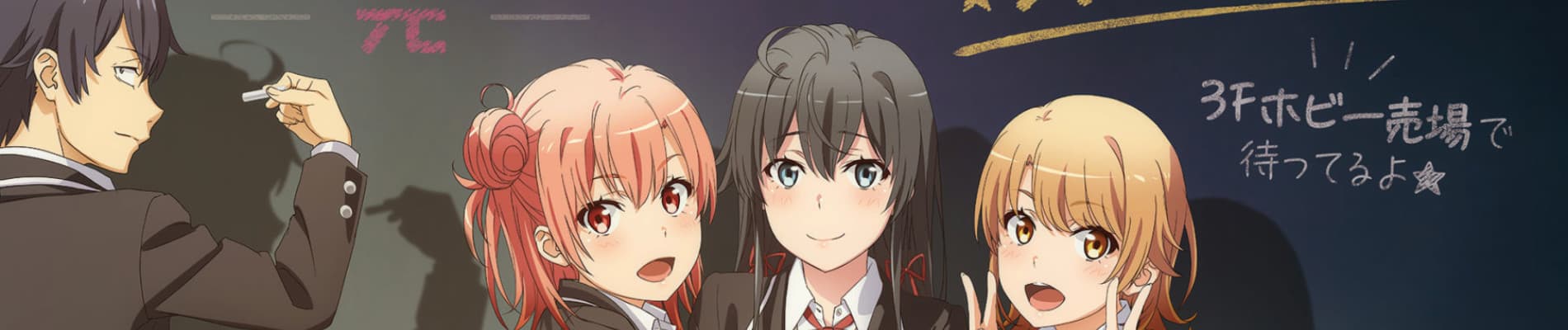

Oregairu’s long-awaited conclusion is hardly noteworthy, going out about as mildly as it could have without tripping over itself. For all Kan could have done with its well-established cast, it does little to even justify its 12-episode length. If you weren’t already a fan of Oregairu or rom-coms in general it’s nothing worth prioritizing.
I don’t suspect many people thought Oregairu would see an anime conclusion after season 2. It thematically closed itself off about as cleanly as was possible, the light novels stopped being translated in most languages, and studio feel. moved on to other projects. Perhaps it would have been better for things to remain that way, because other than structurally concluding the romance, this slow-paced season has very little going for it narratively (and said narrative was the main appeal for many fans in the first place). Kan was capable of bringing plenty to the table, but stuck way too hard to basic rom-com conventions and bungled its clear potential.
See, when it comes to character drama, Kan mostly maintains the prior framework of purposeful characterization and reactive development (or in simpler terms, the characters act pretty darn human). Kan’s new romantic focus benefits greatly from this, as it naturally allows the characters to display their thoughts and emotions when they matter most. Unfortunately, it also makes the stretched, uneventful plot that much more of a problem, as there aren’t enough new meaningful developments for many emotionally developing scenes to come forth. In foregoing the character-focused drama of the previous season to highlight the series’ main love triangle, the plot largely forgets about the characters themselves unless they happen to be a key part of the love triangle’s current development (and sometimes even if they are). There would have been little issue with filling the emptier portions of the season with events following other plot threads, and yet it almost never happened.
Instead, Kan decides that a combination of dragging its feet and reopening old plot threads is the ideal way to pace its story. We already know there’s a love triangle, yet the first three episodes are mainly dedicated to re-introducing it, its players, and its spectators. The likely result of that love triangle has also been quite obvious since the end of season 1, yet such a large amount of time is spent and ultimately wasted on building up a case for the other outcome that it just makes the idea look even more suspicious. There is still ample time left over even with all of this padding, but all Kan can think to do in the name of hammering that love triangle down is to recycle the plot structure of prior Service Club tasks under the guise of a different event and to repeat a conflict between Haruno & the main trio that was effectively resolved last season (and contradicts with the tone of this season).
 What’s that, there’s still two episodes’ worth of time? Dedicate it all to fanservice, what else could people possibly want?
While the previous season was a great thematic conclusion, it left much more than the love triangle open for further exploration, little of which Kan utilizes. Hayato and Haruno were heavily implied to have some unresolved, undesirable, and possibly related social issues, yet the entire potential subplot only sees the slightest sprinkling of loose implications brought up, and only when it ties back into the love triangle. Meanwhile, Yukino’s precarious and mysterious family situation was seemingly being reserved for most of the series, but it barely goes anywhere, even with her mother playing a key & direct role in the plot and her older sister’s frequent appearances. Heck, Yukino herself practically disappears for half of the season, despite events almost never failing to involve her. Even the series’ hallmark witty dialogues and monologues are spread thin thanks to that and Hachiman being strangely quiet in many important scenes, relegating much of the classic bantering to quick jokes and other trivial pursuits.
All of the above, in the name of giving Oregairu a fairly standard rom-com setup. In spite of everything good and bad it had and did, the romance is just kinda okay ~ mediocre for the most haphazard reasons. Oregairu’s standout cast isn’t any less wholesomely developed than it was earlier, so no matter who is on screen or how many characters are absent, there is going to be ample emotion on display, refined by prior developments and well-defined relationships. Typically this alone is all a good romance really needs, but the writing is at odds with such a result. As mentioned earlier, it focuses heavily on just one possible outcome, removing much of the dimensionality a love triangle naturally relies on, but even worse is that it also drops huge hints towards the real outcome throughout, making it look like a twist gone wrong for the unfortunately attentive.
Now, a more casual anime watcher (and I say that in a neutral way) may be wondering why all of this matters, perhaps why someone would want more than tugged heartstrings, silly humor, and raw emotion from a simple rom-com. The answer has more to do with Oregairu itself, as it drew in a lot of people with its thought-out wit and potential for incredibly deep theory-crafting. The simple fact of the matter is that Kan decides that these analyzers are not a primary audience anymore, as it offers far less of those qualities. Such viewers will easily see themselves spurned by this anime if they aren’t satisfied by some quick feels, something someone who doesn’t study their anime is much less likely to be concerned over.
 Despite my earlier statement, the fanservicey episodes may be the best of the season.
This sentiment is further reinforced by Kan’s fanservice-heavy episodes, which manage to give the word a good name for once. In particular, the first and last episodes utilize goofy comedic escapades surprisingly well. The first episode uses its lightheartedness to cool down after starting right where Zoku left off, while the last episode provides an effective buffer for what could have otherwise been a whiplash ending. The light enjoyment of such fare isn’t what everyone wanted, but managing these more simplistic moments successfully is what keeps this season from being a truly bad outing in spite of the myriad of problems someone might see in it.
One last place this anime succeeds is in its production values. While not quite spectacular, it’s beyond what the average rom-com requires. The art style is similar to Zoku’s, but slightly looser, making the whole show less rigid when in motion at the small cost of a few odd shots. The color balancing is also more vibrant and consistent. Combined with some small but nice touches like improved framing and frequent parallax with a touch of character animation during panning shots, Kan is generally pleasing to the eyes. The audio work is quite good as well, with overall solid voicework, some nice callbacks to previous seasons in the soundtrack (even if individual tracks are difficult to recall), and memorable OP & ED songs (though their visuals are the least inspired of the series). Something that was greatly appreciated were the handful of flashback scenes to both seasons 1 & 2, all touched up or even redone to fit Kan’s production standards. While studio feel.’s writers and directors have drawn the ire of source material purists, few could argue the genuine care the artists & animators put into this project.
Calling this season “Climax!” is a misnomer, as the real climax came and went in the previous season. The slow burn to reach that point is mirrored by a slow cooldown here. Despite its shortcomings, Kan isn’t notably bad, other than the fact that there are plenty of other high school rom-coms that tell pretty much the same story at this level of quality without needing two seasons of build-up to lean on. Pre-conceived expectations are the biggest obstacle to enjoying Kan, but does that argument defend it when any other mediocre rom-com would scratch the same itch just as well? Your answer to that question is the answer to whether Kan is worth your time or not.
72.5 out of 120 users liked this review
