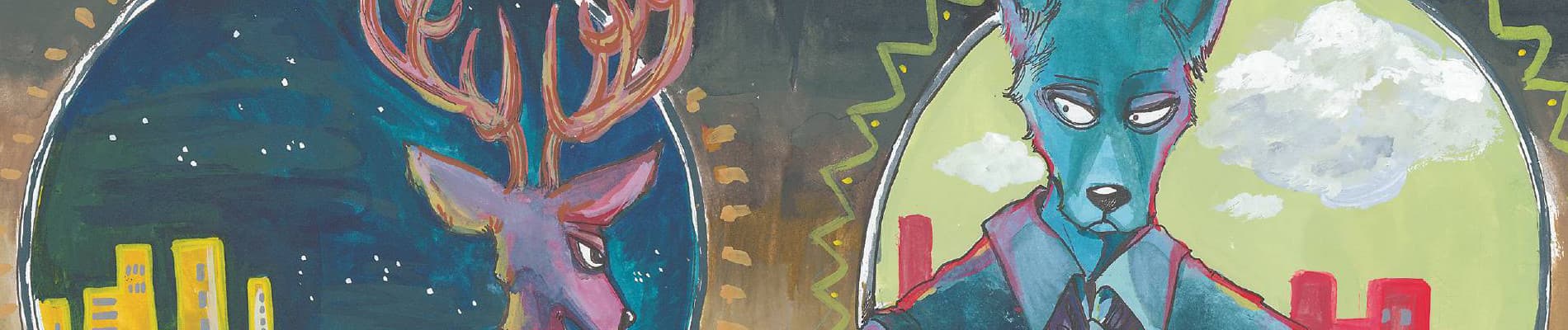
Season 2 of Beastars reminded me just how much I love anime as a medium.
Telling a gripping story about a carnivore coming to realize his place in this anthropomorphous society and going against a fellow carnivore to put an end to the mysterious incident at Cherryton Academy, season 2 of Beastars has taken a huge leap forward in the storytelling department while also still retaining the pros it had in season 1 production-wise, making for a very solid sequel.
Let’s start with the show’s greatest strength: the story. Season 1 of Beastars left off with Legoshi rescuing Haru from the Shishigumi, promising her to become stronger than his instincts. Season 2’s story goes back to the show’s roots, bringing up the murder that happened in Cherryton, an incident which Legoshi attempts to solve while also overcoming his predatory instincts. Legoshi’s story develops into something more of a thriller mystery, where the events slowly unfolding onto his life challenges him until the eventual climax approaches, testing the limits of his abilities. On the other side of the spectrum, Louis’s story develops into a story of corruption as it continues with him becoming the boss of the Shishigumi after season 1, giving the criminal organization a more refined reputation in the Black Market, while also finding a new perspective in the life of herbivores and carnivores throughout his experiences. These contrasting viewpoints come together, creating a juxtaposition of justice and injustice, but manages to coincide by the finale. To put it shortly, the show has managed to tell two opposite sides of the coin, each having their own respective journey and eventually combining as one to create and conclude an emotional, dramatic, and memorable arc.
By now, the story of season 2 has definitely made a huge impact in the character development portion of the main characters. Legoshi, being the awkward and reserved wolf he is, hones himself beyond his instincts while also coming to realize how vulnerable herbivores really are in this unfair society of the hunter and the hunted. Meanwhile, Louis, who generally has a dislike to carnivores, has come to realize just how much carnivores have made an impact towards his life and accepting them. However, let’s not forget the other characters who are also just as important as the main duo: Riz, Pina, and Ibuki. Riz, usually seen as the friendly-looking grizzly bear, is eventually revealed as Tem’s killer, but is also struggling with his own personal problems that eventually led him to killing his best friend. Pina gives the impression of nothing but a playboy, but dramatically reveals in a practice session in the Drama Club that, regardless of his status as an herbivore, he will not cower and falter. Ibuki, who is perceived to be a fierce and threatening lion, protects the people he cares about, hating the fact that people have been frightened by him as he grows. Basically, season 1’s purpose is to give a general introduction, while season 2’s purpose is to showcase great development with its various cast of characters.
Going into the production side of things, it certainly feels like season 2 is just more of the same things we’ve seen and heard in the previous season. Still, that doesn’t mean that it’s a bad thing. The animation and art are great as always, assuring you that Studio Orange definitely cares about the source material. A lot of sequences in how the camera angles are shot reminds me why I love this series so much, as it is able to convey fluid movements in its action and dramatic moments. One moment, in particular, was with the Riz and Tem sequence in Cherryton, where it perfectly encapsulated the beauty of friendship between herbivore and carnivore, as well as the horrific aftermath of uncontrollable desires that followed. Aside from its already-great art and cinematography, the show’s soundtrack and the way it is used is exceptional too, like with the sequence of Louis and Juno dancing in the streets of the Black Market, showcasing a stark contrast between the beauty of dancing in a bleak and dark place. I could go on and on about how the art, animation, cinematography, and soundtrack are so good, but that would make this already lengthy review an even longer one, so to sum it all up, Studio Orange’s production of season 2 of Beastars is nothing short of incredible.
In conclusion, season 2 of Beastars is definitely a huge improvement over its already solid debut season, and it is also a good example of how sequels of already great anime should be done. At the time of typing this review, season 2 isn’t released worldwide yet, so be sure to check it out when it does come out on Netflix (hopefully with the original Japanese dub and the English dub), as it will be worth the watch.
69 out of 79 users liked this review