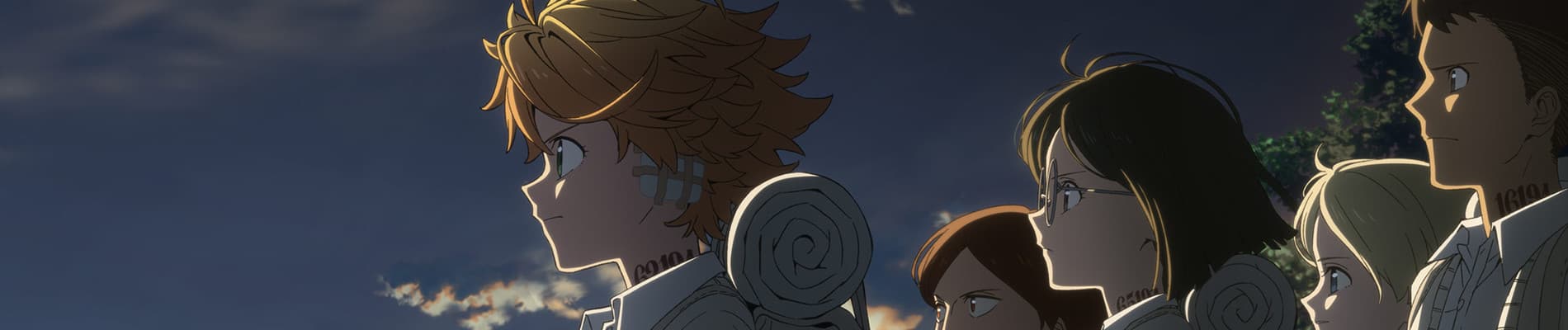
It's a question that's familiar to any viewer of The Promised Neverland (TPN). Season 1 left audiences' jaws agape on the floor with its many shocking cliffhangers and haunting atmosphere. But unlike the anime's many fans, I took this question a little differently. Sure, stellar direction and smart writing kept a great deal of tension going, but there were only so many ways to keep a season revolving around a single farm locale entertaining. So in addition to being left in suspense, my take on TPN's question would be one of anticipation. For me, the best part of TPN was the uncertainty of what lay beyond the walls of Grace Field. Kaiu Shirai proved themself capable of crafting a tight thriller under creative limitations, and our kids' escape brought with their freedom an endless set of possibilities. When I saw our crew finally stepping into the sunrise and staring ahead at an unknown future, I felt that anything could happen.
Hopefully you can understand my disappointment at what they decided to go with.
This review contains spoilers for S1, which is worth watching if you haven't already. Mild spoilers ahead for S2 as well, so skip ahead to my Tl;Dr if you'd wish to go in blind.
Attempting to pinpoint just how TPN fell from grace may provide an infuriating challenge. Luckily for us, many of S2's major faults can be traced to its opening moments. Let's look at this mess from a few different lenses - the three strikes that marred this adaptation.
The premiere's cold open is emblematic of this season's recurring problems. Our first glimpse at S2 involves dramatic shots of Emma and her friends, running in pitch-black darkness. It's hard to miss the ugly CGI arachnid that's revealed to be chasing them, but more subtle is how the animation from these first shots are tacked onto another sequence, near the end of Episode 4. The janky CGI and reused cuts hint at massive problems on the production side of things. Granted, the pandemic posed unprecedented challenges for the whole industry. I hold no ill will towards the animators and fully support their decision to push their release date by a season. With all that said, it'd be fair to expect better treatment for the sequel to Cloverworks' flagship title.
One need not look hard into S1 to understand TPN's presentation at its best. Director Mamoru Kanbe and his staff brought Grace Field House to life, almost as a living, breathing being. Through the effective use of tight spaces, POV shots, lighting and haunting close-ups, the team found numerous opportunities to capture tense imagery. A strong OST and sound design elevated many of the show's sequences while accentuating the impossible choices our characters face.
Cost-cutting occurs in sneaky fashion, as shots are reused far too frequently for a show of TPN's caliber. Also concerning is the repeated reliance on stills, montages and long shots, which demonstrates a desperate attempt at shaving seconds off the production timeline. The blurred forest backgrounds that mimicked anamorphic lens effects were a nice gimmick that got old real quick, making an appearance in nearly every episode. Adding to the drab environments are the copious lack of wildlife in the Demon woods, with all but the CGI spiders and a handful of lifeless animated overlays populating the space. It's quite the far cry from the many possibilities presented after the Grace Field escape, and a dull disservice to viewers' expectations.
Some "Neverland" this is.
Now, bringing up these points is not to chastise TPN's production team, which seems roughly unchanged from the last season. In fact, I'd say that S2 looks OK on the whole. The visuals are mostly appealing, the direction still shows signs of brilliance in certain sequences, and the OST still has its moments (albeit at the expense of shoehorning "Isabella's Sorrow" in at every given opportunity.) However, given that Cloverworks rolled out three seasonals this Winter, it's difficult not to observe this situation with a level of scrutiny. Two of them necessitated recap episodes, and lining up the visually-stunning Wonder Egg Priority against TPN doesn't yield fair comparisons. Quality aside, such recap episodes in single-cour anime (11-13 episodes) is a clear sign of production problems and, in the ill-equipped Cloverworks' case, possible mismanagement. I admit this is a speculatory claim, and couldn't find reputable sources to confirm such troubles. That being said, these observations are worth keeping in mind, in light of the evidence we're given and to set the stage for the other problems we've yet to cover.
The premiere's cold open is emblematic of this season's recurring problems. Our first glimpse at S2 involves dramatic shots of Emma and her friends, running in pitch-black darkness. Animation from these first shots are tacked onto another sequence in Episode 4. TPN gets away with this in large part because its series structure feels so repetitive. For a franchise known for its many twists and surprises, S2's biggest shock is in its lack of variety. Needless to say, I expected far more of the elements and craft which made Cloverworks' flagship show such a mainstay in the first place.
What starts out as patient pacing turns out to be the same content regurgitated throughout the first half of the season. Emma, Ray and the 15 children that escaped Grace Field are left in the woods with little but their wits and a pen from the mysterious William Minerva. His device offers directions, bringing the kids one step closer to liberation from the demons.
With minimal spoilers, here's how the next 6 episodes play out:
Ironically the one aspect of this season that felt distinct was the crew's time at the shelter in Ep 4, which even then felt like an off-brand ripoff of S1's setup in the House. Then it's back to the forest for more scavenging and… that about sums it up, actually. What's sad is that plenty could have been achieved with this setting. More dangers could present themselves in the environment, and the cast could learn more about survival within a realm in which they are not welcome. And it appears that the manga did just that, offering ample variety and developing its story into a bestseller.
Shows that deviate from the source have a track record of going south, and audiences were rightfully concerned about how things would pan out when this was announced in Week 4 of the show's airing. Personally I liked that this reveal was hidden, throwing both anime-onlys and manga veterans alike in the dark. It's a shock that fits in with the nature of TPN's storytelling. Surely this was a creative decision, right? There's no reason for a show with a completed manga source to rush out an abridged conclusion, right? Supposedly the best arc got cut out, but author Shirai themself supervised the script and gave the green light, so that means we'd get something worth the change, right? Of course the show would live up to its name and deliver on its promises beyond the walls of Grace Field.
Right?
The premiere's cold open is emble- OK, look. I'm just gonna jump straight to the point here: just like this season of TV, our characters are in a rush. If you feel that this half-hearted analogy throughout my review could benefit from more elaboration, you may find some serious issues with how Cloverworks butchered their flagship smash-hit.
Resident brainiacs Emma and Ray seem to have left most of their intellect along with Phil and Isabella at the House. Ray proves particularly difficult to read; not through complexity, but through confusion. His motivations were somewhat suspect around the latter portion of S1, and his cunning made it difficult to determine his headspace in any given scene. Not helping matters are the baffling decisions he makes throughout S2's initial episodes, and the fact that these actions are left unaddressed^ makes his character infuriatingly suspicious to watch for little reason. Ray's writing does eventually improve, but seemingly at the expense of TPN's main heroine. Emma is a character defined by her resilience and blinding optimism, stopping at nothing to ensure her family's safety. Her arc actually starts off on a promising note, and Ep 2 teased an exciting new direction for her character - one where she sacrifices her righteous morals for a darker path. Expecting TPN to tap into its potential subplot turned out to be a mistake, as Emma almost immediately reverts back to her hopeful self shortly after. She carries herself with the unmistakable spunk from S1, minus any substantial results. It's hard to call Emma's expedition outside the House walls a success, given that nothing their crew achieves throughout a majority of the season actually gets the other Farm children any closer to being rescued. Ingenious problem-solving, the franchise's bread & butter, is all but absent here, with Emma's few favorable outcomes instead conveniently handed out to her on a silver platter, by no means of her own.
S1 contained plenty of buildup to mysteries and tense sequences, directed capably for strong effect. S2 attempts to make up for its uneventfulness by chucking in poorly-handled chase sequences of our children playing Tag. The first season frequently ended on non-sequiturs, but those anticlimactic cliffhangers get more obnoxious in S2 because of the stale narrative that precedes them. Little attempt is made at slowing down to make each sparse setpiece interesting or distinct, with the writers instead counting on long stretches of exposition to bail them out. Key developments in the plot are revealed too quickly for any meaningful impact, because our cast needs to hike from one setpiece to the next. Brand new deuteragonists introduced in one episode can pull a Bond Villain and reveal their ulterior motives by the next. Of course, these nuances are conveniently never addressed again in subsequent cameos. One of our leads gets a flashback vital to the plot - one that could've easily taken up an entire episode. Yet it comes and goes within 5 minutes, and was made all the more comically pointless^^ since any relevant info was already mentioned in exposition from previous episodes. No time is allotted for any of these moments to sink in, turning threads rich in storytelling potential into merely serviceable sideplots.
The incessant rushing from one story beat to the next, with no regard for development, leads to lean conflict that lacks weight. As a lenient, anime-only weeb, even I could sense that plenty of plotlines were left on the cutting room floor. A handful of memorable characters from S1 return with barely any fanfare; what could have been hype reveals were devoid of excitement due to the small number of uneventful episodes spent without them. That's right, S2 can't even do cathartic fan service right. The central antagonist for the season's second act is a convincing counterpoint to our heroes' hopes for non-violent escape from the demons, not because of compelling evidence provided throughout the season, but the lack of such; Emma had accomplished so little during this time that we have no choice but to side with the villain's methods. Once that heavily-abridged storyline is neatly wrapped up with a bow, the show hilariously fast-forwards to its climactic showdown: a pathetic attempt at making a heist flick, with rushed twists and gaping plot holes that border on parody^^^. The fact that no screenwriter is officially credited for this penultimate episode is rather telling. It's a shame that the same team, who once gave us one of the strongest seasons of anime in recent memory, would even consider disassociating themselves from their own work a mere two years later.
A strong IP with legions of loyal fans, capable staff members, and a source material packed with new adventures to tell - Cloverworks had supposedly everything going for them. But given what we've seen this season, I'd argue otherwise. I believe the mangaka's involvement in the anime-original content isn't to blame, but rather a means of providing damage control for their own story and placating the fans through name recognition. Since S2 already suffered a postponed release date and a recap episode, I'm unwilling to accept the COVID outbreak as anything other than a contributing factor to this dismal effort. The only sensible answer I can come up with is as unfortunate as it is stupid: Cloverworks got cocky. Fans are aware that the manga has diminishing returns after the universally-praised Goldy Pond arc, which would have taken place in S2 if adapted faithfully. The studio may have projected a dramatic decline in interest for the series were that arc to conclude, and perceived the subpar reception of the manga's final chapters as a sign to jump ship. Lesser studios likely wouldn't take the baton from Cloverworks and finish adapting potential subsequent seasons, meaning that they were stuck with the series. But rather than adapt Goldy Pond faithfully and leave the franchise unfinished, along with the countless other unfinished anime in existence; the studio gambled on the hopes that an abridged, but conclusive, ending would yield more success than one that was faithful, but incomplete. Tough luck making that work though. "Trimming the fat" left no meat behind for audiences, and the meager result was bare-bones and butchered. S2 reeks of a studio getting things done for the sake of it. Rather than taking the opportunity to bring in exciting new additions in place of the cut material, Cloverworks mostly prayed that their many exclusions would magically make a good anime. Perhaps Emma's carefree optimism got to their heads, I only wish I could have some too.
Where most sequels would add to or reintroduce the status quo, S2 is defined by what it excludes. TPN returned with less craft, less variety, less intrigue, less surprises and less appeal. TPN bastardized decent ideas and even its own source material, unceremoniously shipping out an abridged final product. Its 4head solution to shaving the runtime of key events is that of wasting all our own, by compressing story threads into the least interesting iterations possible. So much is taken away with this anime-original route, but so little is added. Cloverworks took audiences to a destination, at the cost of a journey. As someone who wasn't very fond of the previous season but saw immense potential for its sequel, all I'm left with are empty promises.
Seeing that Cloverworks had such a hand in ruining their adaptation, I think it's only fitting that a representative of the studio assigns the final verdict. Ai Ohto, care to do the honors?
Well, there you have it. 4/10~
1) Were there two batches of hot-air balloons? Or just one, where the children were mixed along with the decoy bombs? Couldn't tell, the cuts were too fast. Speaking of which, how do you both remotely detonate bombs and control the decoy balloons' flight path while no such in-universe technology was introduced prior? Were you just praying on the timing of the fuses and the wind? Boy, that Lambda flashback would have probably made things clearer... oh wait, that got rushed too.
2) How did the extra kids successfully sneak in next to Phil's group? Do the new Mothers just not know how to do headcounts? Beats me.
3) Were the Mothers just in on Isabella's coup the entire time? Or was Grandma betting on the Suicide-Squad devices malfunctioning during the siege, after which she could instantly convince the others to join her rebellion over the radio? "What are we, some kind of plot magic?"
4) What happened to Sonju's plan to harvest humans in the wild, remember that plot line? Neither did this wack-ass script, 'cause he's suddenly just OK with starting a demon rebellion and mobilizing a nation-wide attack on the compound.
5) Heck, Isabella's actions make zero sense in Ratri's plans. Their plan to trap the children back in Grace Field would only be fully achieved on the assumption that Norman already located Emma's group. But even if Norman's absence isn't a big deal, you still run into some illogical problems. If Isabella already knew about the shelter radio over a year ago, and given that there's no way you could have known about Norman joining them, why wait for this one convenient happenstance before hatching your plan? Surely a convincing lie could have been used in the transmissions, misleading the group into believing that the kids were all getting shipped ahead of schedule. It's all convenient nonsense, much like the plan itself.
Three strikes, and he's out! Now that Cloverworks has buried all that potential, perhaps I can find some new appreciation for what S1 did so well. Anyways, really glad you made it this far along with me. If you happen to like my verbose rants, feel free to check out my other reviews for seasons past and present. I also frequently post writeups under my list updates, so definitely take a peek if you'd like to see me mald over anime as they hit the airwaves. Peace~
377 out of 387 users liked this review