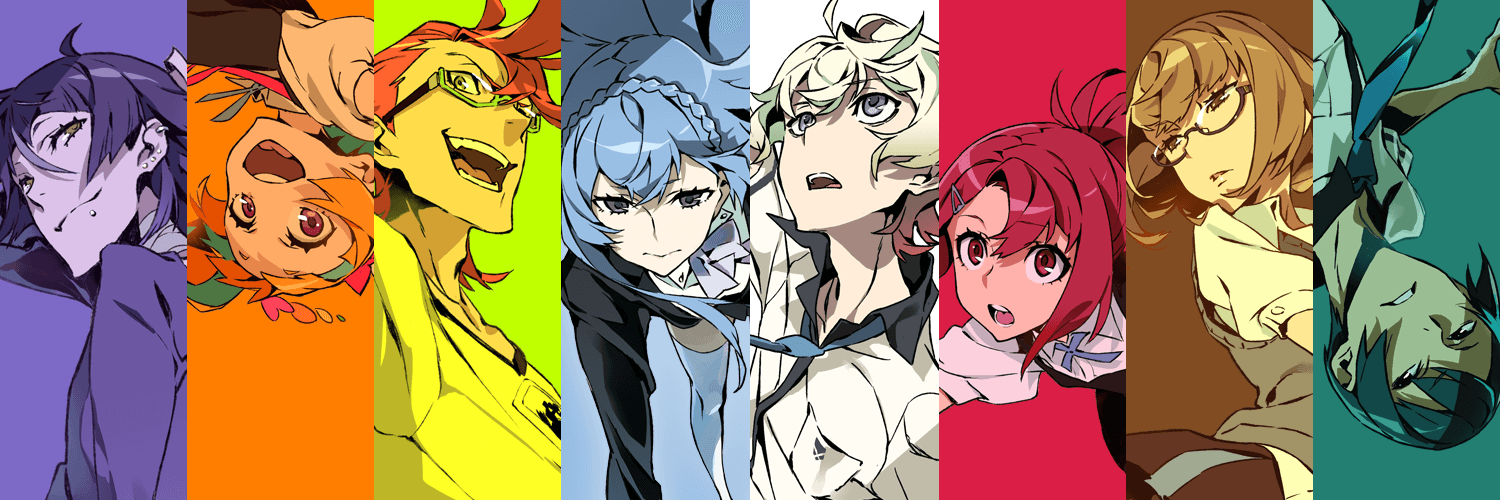
Kiznaiver
a review by mimicodots
a review by mimicodots
Kiznaiver is something of an oddity, even amongst the Trigger catalogue of batshit insane anime.
Penned by the infamous Mari Okada, this was bound to be an experience. Recurring elements in her stories include dramatic characters and excessive pathos.
In an ironic turn of events it seems I'm unable to figure out just how I feel about Kiznaiver. A series who's flaws seem almost intentional.
I'm Mimico and this is—
__

pt 1 • things I enjoyed
Let's go over the good. The character designs. While aesthetic beauty will never be able to pull the weight of an entire show it's definitely a huge part of why I started the series.
Despite the detailed designs the characters are well animated and expressive.
Mai Yoneyama's work here is gorgeous and avoids the same face syndrome many anime fall victim to.
The OP is honestly iconic, and it's a big reason why I find myself thinking of Kiznaiver from time to time.
▶ Videopt 2 • things I that annoyed me
The dialogue and drama often sounds forced, which while literally being the case in-universe—doesn't particularly make for interesting television.
I can't speak to the quality of the sub, but the dub is actively painful to watch at times.
The characters are all based on clichés, and Kiznaiver is pretty self aware of that. The majority of the cast isn't particularly fleshed out or interesting to watch sans Maki.
Basically everyone aside from her expresses how they feel in the most trite ways possible. At times this becomes downright offensive. In the climax of ep 9 the main cast lay writhing on the ground repeating the phrase -
It hurts.
There are recurring moments where characters say things with such vague meaning that it comes across as an attempt at being sly, or insightful. And I watched waiting for these lines to be recontextualized later on so that they would make sense, but this often doesn't happen.
When Noriko learns about Katsuhira being bullied she says.
People can't find themselves inside of you. That irritates them.
What does this phrase actually mean? I don't know. It's entirely besides the point of why bullies target others. They do it because it instills some sense of superiority in themselves and they can get away with it.
▶ Videopt 3 • those bonded by pain
The conceit of Kiznaiver was almost perfectly designed to destroy the concept of character development and viewer investment. This wouldn't be much of a problem if the experiments revealed interesting facets of the cast.
Whatever nuance there is tends to be crushed by the whims of the script. Of course I think just about any idea can be made great with finesse, but Mari Okada doesn't deliver much here.
This quickly becomes overbearing to watch when the conflict of the episode comes out of nowhere, an example being - Nico's crush on Hajime.
Something that was never established, yet through the will of the script can be inserted on a whim.
The Kizna system, as another reviewer put it, is a tool to inject unearned pathos into an episode whenever it's required. There doesn't need to be any buildup, or real sense of tension, it's just something that needs to happen and everyone is forced to participate in.
▶ VideoThe writing is an absolute mess that tries to milk contrived challenges for drama.
Nico is the quirky girl trope taken literally. It's hard to grasp where her motivations come from, if she has any aside from making friends. The choice to portray herself as an airhead never comes up again.
Hisomu is the degenerate masochist, whose existence would be a sin if not for the fact that he's actually quite funny outside of psychical gags.
Chidori is the half assed childhood friend, who as it turns out suffers from the disease of falling in love with MC-Kun.
The more the Kizna system sabatoges her relationship with Katsuhira, the more sympathetic she becomes.
Noriko kind of just exists. For the first ten episodes a lot of her allure is found in her mysterious motivations and aloof nature.
Maki gets her own character arc when several other members don't get any development. The way time was used is strange to say the least.
▶ VideoPeople commonly cite a short episode count being the reason a show comes out half baked, and while that's true for adaptations there's no excuse here.
In episode nine we start off with Chidori yearning for Katsuhira to pay attention to her. A scene where the emotional pain practically drips off the screen, only to be undercut by a gag of the masochist is getting his ass stomped out.
▶ VideoLater on the group are made to watch Noriko and Katsuhira talk with each other in what felt like a metaphor for what it was like watching this show.
pt 4 • mixed emotions
The series' logic basically operates on the assumption that the main cast have the emotional maturity of children. I'm not sure if the show is supposed to be a parody or not.
The writing is baffling. Not because it's complicated, but because it triggers emotions I imagine are contradictory to the intent.
If I'm going to be honest I enjoy this show primarily as a comedy. The character drama is literally unearned, characterization tend to be on the thin side, and the philosophical waxing about pain isn't that compelling.
The romance in this show failed to make me feel anything with the exception of ~~best girl~~ Chidori.
The premise is absurd, and even the researchers themselves know that.
Perhaps the biggest shame is how this concept could've been used to create an amazing character study, or indulging in the series' more surreal and insane concepts, as a dark comedy.
▶ Video15 out of 17 users liked this review
