
So, what exactly went wrong?

Holistically speaking, this season can essentially be condensed into “Any % speedrun: The Anime”. They had all gas, no breaks for eleven episodes straight and at some point, it became quite a spectacle to see each additional episode trying to outdo the combined efforts of its predecessors for said speedrun competition. As such, to say Season 2 was rushed is an understatement. Early on, some viewers had already noted that episodes 1 and 2 had significant pacing issues and this certainly served as a premonition for things to come. Within a few episodes, worry turned into confusion and anger, and very quickly, it became apparent that the developers had no intention of giving us a fleshed-out story adapted from the bountiful source material that is The Promised Neverland manga. Instead, we realised – much to our horror – that they were simply ending the story this very season.

In Season 1, our main trio alongside our major supporting cast were all shown to be highly intelligent individuals with substantial human agency (with the exception of maybe Sister Krone, who had her odds stacked up so heavily against her that her demise was inevitable). Emma, Norman and Ray pioneered their ingenious escape through their individual contributions with Don and Gilda providing intellectual backup. Isabella proved to be a more than crafty antagonist; a seemingly unstoppable shadow over Grace Field who was thwarting our protagonists at almost every turn. Furthermore, Phil’s character revelation was a very clever element for the Escape Arc’s final act, giving both the characters and the audience a sense of reassurance and hope for the safety of those who remained at Grace Field. Yet, in Season 2 none of these characters had any resemblance of the agency and intelligence they possessed in Season 1.
Emma’s character is a mess this season. The only instance in which Emma showed any signs of having problem-solving skills was perhaps when she ventured out into the demon villages with demon disguises. That was it. Any accomplishments she had was thanks to Minerva’s pen or some other form of plot convenience. In fact, Emma’s problematic character writing can be highlighted in a few specific moments:
- In episode 2, after learning that she has to hunt and kill other living creatures for her family in the same manner that demons kill humans, she becomes burdened with the responsibility of sacrificing part of her morality and lies to her family when they ask if she’s ok. This is never properly expanded upon in the anime. What was foreshadowing instead becomes a red herring.
- In episode 4, after the kids catch some unknown fish to eat, she conducts a lottery to test the food’s safety. This is completely out of character. Emma is uncompromising, especially when it comes to her family’s safety and she would never – under any circumstances – allow a sibling to endanger themselves in such a manner. A more believable Emma would have either risked her own safety by trying the fish first or thought of a smarter plan to avoid getting potentially poisoned.
- In episode 5, she momentarily descends into a self-loathing, feeble, weak-minded character questioning her own decisions of having her siblings escape Grace Field. This is a direct contradiction to the unwavering conviction Emma had in Season 1 when it came to protecting her family. Character development? Quite the opposite. This is character regression and an inconsequential scene that adds nothing to the story.
- From episode 6 to 11, she commits her greatest crime – “talk no jutsu” – multiple times (with Norman, Isabella, and Peter Ratri) by appealing to her own underdeveloped sense of morality. Her spontaneous decision to suddenly go against Norman’s plan is both equally bizarre and forced as the scene in which she picks up Vylk’s food by endangering her family. We know that Emma’s kind and accommodating. We know that she considers Mujika and Sonju as friends. We can perhaps infer that she opposes conflict vehemently (manga readers know this for a fact because it was properly elaborated upon in Goldy Pond). Instead, the anime completely denied us any robust explanation and build-up to properly justify Emma’s decisions.
Ray: Despite being listed as a main character for the season, Ray’s character was largely inconsequential for this story and his motivations behind his actions this season were never properly explained. When Emma opposes Norman’s plan, Ray’s decision to support her is backed by little to no rational weight. Instead, his purpose for that particular arc was to serve as a proxy for the audience to explain how horrendously irrational Emma’s “talk no jutsu” thinking was. Nevertheless, he agrees with her anyways for no other reason than plot convenience for the sake of pitting him and Emma against Norman. The cunning, calculating realist that we knew in Season 1? Gone. Reduced to a simple hype man for Emma. Was there a follow-up for the revelation of him being Isabella’s son in the finale of Season 1? No, it was never addressed again. In the grand scheme of things, Ray could have been removed and not much would have changed.
Norman: So, Norman returns halfway through in an anti-climactic fashion. He quickly reunites with his Grace Field family before proceeding into a massive exposition dump about what happened while he was gone. He establishes his plan, introduces his Lambda friends (who served no more purpose than to be hype people parroting Norman’s opinions), attempts to carry out his plan and falls victim to Emma’s “talk no jutsu”. His role in the story? To introduce a conflict and then have it resolved as quickly as it was introduced just so Emma can reunite with Vylk and continue the plot with more contrivances.
Don, Gilda and the rest of the Grace Field escapees were reduced to comic relief and Emma’s cheerleaders. Gilda lectured Emma on being reckless, Don smashed a chair on top of a SWAT solider, Nat played piano. Anna? She spoke. Thoma and Lannion? The “lulw duo” … I guess that was it. Now granted, despite all the complaints about the kids doing nothing and fooling around in episode 4, there is merit in showing us how the kids carried out their everyday lives in what was established as their new home. Yet none of this really mattered. We could have gotten a stronger showing of familial bonding between everyone but all of these moments were quickly forgotten beyond episode 4 since the story never had any intention of expanding upon that at all.
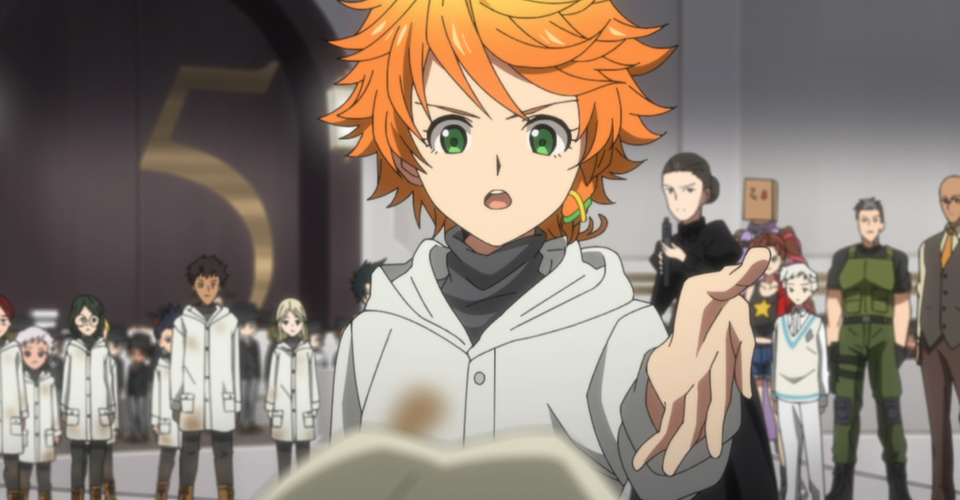
The aforementioned conflict resolution via Emma’s appeal to morality is perhaps the most glaring symptom of problematic character and plot writing this season. When Norman announces his annihilation plan to his Grace Field siblings in episode 6, the kids are ecstatic and fully in support of him. One episode later, Emma states that she’s stopping the annihilation and all the kids immediately agree with her with no opposition – except for Gilda who takes a grand total of a minute trying to convince Emma to do otherwise before changing her mind as well. The same thing happens with Norman. He seemingly demonstrates his conviction to his plan when he has his mountaintop monologue in episode 8, saying “I’m not wavering… I will gladly become a god or a devil, Emma.” Fast forward to next episode, Emma delivers a few lines of dialogue and he gives up with no resistance. His Lambda buddies? Same fate. Heel-faced turns with a few words despite telling us how badly they wanted to see them dead in an earlier episode. Isabella also suffers from her own rushed heel-faced turn but this is of her own volition. With no prior build-up, this poorly done “twist” comes out of left field for anime-only watchers. Then, she is quickly forgiven by Emma and her “talk no jutsu” partner-in-crime Ray despite everything they went through in Season 1. Peter Ratri is the only character immune to Emma’s words but he quickly offs himself before the audience could spare an extra thought for an underdeveloped excuse for an antagonist. We went from having a great antagonist in Season 1 to Peter Ratri. Good riddance.
Granted, Emma’s words are not the only form of ridiculous plot device in the show. We have another culprit who is equally as guilty: that damn pen. Initially, the pen was presented as a fun element to the story – a seemingly neat little puzzle for our protagonists before it descended into our greatest cheat code for the season by conveniently delivering the characters to their final destination. The comical nature of “Pen Ex Machina” is further strengthened by Vylk opening up a whole can of contrivances after he hands Emma the missing cap of the pen that was conveniently given to him by some unknown stranger in a quick flashback. Now, armed with the combined power of both “Pen Ex Machina” and “Cap Ex Machina”, Emma is immediately given the blueprints for the entire layout of Grace Field down to the placement of the guards, wiring, circuitry of the building, and the gate that connects to the human world. They also somehow have access to hot airs balloons that conveniently show up out of nowhere in episode 10. At its core, all semblance of smarts, wits, and clever problem-solving that defined the show in Season 1 disappeared; substituted by contrivances.
Finally, at the show’s conclusion, the kids depart of the human world and all of a sudden, Emma declares that she’s staying behind to make a promise that we never hear about for the rest of finale. We then see the entire story get resolved in a slideshow of thirty-two slides. This part is self-explanatory. There is no need to further elaborate on what happened as this would just be beating a dead horse. The internet has done its job. Though, I will say that these problems were not the fault of the episode writers or any of the staff who had no real control over the creative process. Please do not direct any hate towards them. They were simply doing their jobs and it was very unfortunate they were dealt terrible cards to begin with. In fact, at least one of the writers understood the source material very well considering they worked on three manga one-shots expanding upon the original story. The production committee should bear full responsibility for everything that happened.
Visual Quality and Music
For most of the season, the art and animation were satisfactory. CGI demons did prove to be an eyesore when they appeared but their appearances were far and few between in this season. Throughout the season, there were a number of shots that should have been filled with activity but were instead replaced by static characters simply standing around. There was also a very noticeable drop in visual quality in the final two episodes and characters were standing so still that they effectively became background wallpaper. In the end, the animators over at CloverWorks certainly did have their hands full with Horimiya and Wonder Egg Priority (which had its own share of production issues) and by the end of the season, TPN was most certainly just a job that the animators had to finish begrudgingly because they too knew that this mess was no longer worth their effort. Although, I will say that some of the artwork presented in the final slideshow was very nice. Music wise, the score for the entire season did a fairly commendable job at trying to convey tone for their respectable scenes. There was perhaps an overuse of Isabella’s lullaby and The Promised Neverland main theme but for the most part, this was just a minor gripe. Both OP and ED songs were great too – it is just such a shame that these talented artists now have their work attached to this season.

In December 2020, an unofficial Shounen Jump news source reported that the anime was “going original” with TPN mangaka Kaiu Shirai overseeing “original scenarios”. With this information, some manga fans were led to believe that perhaps the anime would amend the original story by fleshing out issues with characters and certain plot points that plagued the later arcs of the TPN manga. At the time, there was undoubtedly some degree of optimism surrounding this news. Fast forward to now, we can see that we received quite the opposite. In late January (between the airing of episodes 3 and 4 when the anime began to deviate heavily from the manga), the community received news from multiple official sources confirming that the anime was indeed intending do its own story. However, by this point the damage had been done and fans reacted with anger. Season 2 is by no means a proper manga adaptation, but to say that it was an anime original isn’t quite true either. To put things into perspective, the anime completely skips through 4 out of the 11 arcs (Season 1 covered arcs 1 and 2) and loosely adapts vague plot points from the remaining arcs by drastically watering down the plot and characters. All of this is done in 11 episodes.
The reality was, we were deceived.
Perhaps it is safe to assume that Kaiu Shirai never had any substantial input for Season 2 beyond suggesting a few ideas and having them vaguely adapted into the anime. For episodes 10 and 11, his name (alongside the episode script writers) was removed from the credits. I think it is ludicrous for anyone to suggest that Shirai himself was genuinely supporting the developers to sabotage his own story. So please, do not direct any hate towards Shirai because he was just a victim of a terrible production committee (in fact, if you do wish to support him in any way, please read the manga that he poured his love and passion into). If anything, the only reasonable conclusion we can make is that the production committee simply used his name under the pretense of creating this dumpster fire. Considering how the original release date of the anime (was intended to be in October 2020 before Covid-19 delays) was meant to coincide with the release of the manga’s final volume (also in October 2020), perhaps we can assume that the developers simply wanted to make a quick buck amidst all the hype. It is no secret that from a business standpoint, anime is created to boost manga sales (and merch). We’ve seen in recent times how an insanely popular series such as Demon Slayer resulted in incredible success for manga sales. Likewise, The Promised Neverland was no stranger to success. After its successful anime release, manga sales reached an all time high in 2019, making it the 3rd bestselling entry in Shounen Jump just behind fellow juggernauts One Piece and Demon Slayer. Why the production committee chose to give up on this series is beyond our understanding. Maybe it was the lukewarm reception for the manga’s ending and final arcs. Maybe TPN was just never as popular as we believed (this seems to be an opinion shared by a vocal minority – not by me). Maybe it was just a pure sense of apathy from the higher-ups in charge of this production who just wanted to “get this series over and done with” so they could move on. In the end, all we can say is that someone in charge didn’t care about Season 2, and eventually, we stopped caring too.
If you’ve reached this point, I sincerely thank you for stick with me through my very long review. As both a TPN manga fan and a fan of the anime who followed this season’s weekly episode releases, these last few weeks were certainly trying times. For anime-only’s who are interested in reading a far better continuation of the story in the manga, I strongly encourage you to do so. The story continues after Season 1 in chapter 37 volume 5. If you are a manga reader and would like to see my thoughts from the perspective of a manga reader, then I have a compilation of ramblings with manga spoilers in the section below. Otherwise, I bid you farewell until next time. Here’s a happy Emma to send you off:
MANGA SPOILERS BELOW
MANGA SPOILERS BELOW
Compilation of random thoughts:

