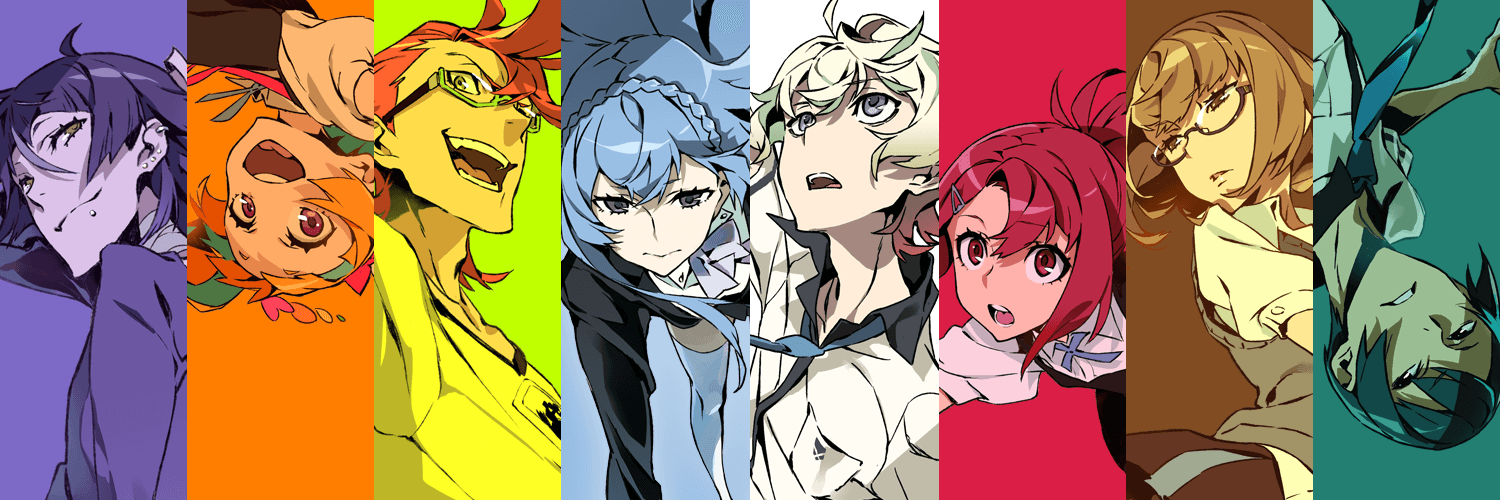

In fact, as far as substance is concerned, Kiznaiver is almost tacky. This is a massive shame. Going into it, I had high hopes for this anime. And as a long-time fan of Trigger’s works it honestly troubles me to say that I’m:

#Seven sophomores walk into a bar
In an effort to create world peace, a deadpan, kawaii as fuck, blunette high schooler has come up with the bright idea of ‘bonding’ seven classmates such that their physical and eventually emotional sensations are shared equally among them; to make them ‘Kiznaivers’. As ethically questionable and as logically dubious this experiment may be, it makes for a unique and alluring premise.
Unfortunately, the end result is not nearly as appealing.
The root of the problem lies with the cast. Practically every character is introduced as an archetype. The most obvious example is with our seven guinea pigs. To list them off, we’ve got: the blank and apathetic MC, the tsundere childhood friend, the macho broman, the lofty loner, the patronising coolfag, the moe crazy chick and a sadomasochist.

This really isn’t an issue. The point of the experiment is to bond seven totally different characters that otherwise wouldn’t normally associate with one another and build some form of empathetic connection between them.
The initial direction that the show appeared to be heading towards was that, in spending time together and interacting with one another, each of the cast would open up and transcend their stereotypes, ultimately coming to a better understanding of both themselves and each other. At least, that’s what I was hoping for.
And this happens, to an extent. To a very negligible extent. Okay, not really.
What does occur is that a single, private foil to each of the characters’ outward personas is revealed, and that’s it. After these revelations, barring some really minor attitude shifts, they simply continue behaving, speaking and thinking as they did before. And that’s the thing; the characters never really go anywhere. They don’t exactly develop, nor do we as an audience come to a more holistic understanding of who they are as people. Sure, they aren’t utterly one-dimensional. They’re two-dimensional, which is only marginally better and quite frankly, unsatisfying.

To say, “oh, the popular fuckboy has body image issues and the reason he acts the way he does is because he’s insecure” doesn’t make for a complex or nuanced character. Why has he never been able to overcome his insecurities? How will the other Kiznaivers teach him to overcome his insecurities? What can he teach the other Kiznaivers from his experiences? How will the experiment change him, for better or for worse? These are questions that should have been, but never were, properly addressed. Sure, he has a more sympathetic side, but is that really good enough? To make matters worse, this ‘characterisation’ is typically presented in a very mundane fashion. This lack of depth applies to majority of the cast, irrespective of their centrality in the story. As such, they never truly succeed in transcending their status as archetypes. To pigeonhole a character with a couple of over-exaggerated, uninspired traits and with only a hazy backstory as explanation makes him/her just that.
It’s incredibly difficult to empathise with characters that are so bland and poorly-fleshed out. We just never receive sufficient reasoning as to why we should care about any of them. This is obviously a huge problem for a show that is essentially a character study. Doubly so for when the central theme is empathising with one another. Consequently, character interactions feel shallow and meaningless whilst the feels fest the series clearly aimed to be was never fully actualised.

#痛い, 痛い
There is one exception. A particular character receives a couple of episodes dedicated specifically to her development and it pays dividends. Her backstory is fleshed out in detail, and consequently we are able to fully grasp her motivations, feelings and behaviour. What was even more rewarding was seeing the rest of the Kiznaivers banding together and facilitating her growth and lasting change. These episodes were undoubtedly the best the series had to offer.

This is perplexing. Trigger obviously knows how to make their characters compelling, so why stop there? Even the primary two are sorely underdeveloped, which led to major complications as far as plot went.
Given that character motivations were vague at best, what was occurring onscreen oftentimes felt confusing, rushed and inconsequential.
Much of the confusion stemmed from how convoluted the Kizna project was. Barring how ridiculous, albeit intriguing, the whole idea is to begin with, many of the systems intricacies are never really explained. Similarly, the dialogue can get excessively heavy-handed. This is particularly the case when characters attempt to express their emotions, where the word choice and sentence construction can become frustratingly circular and awkward. I guess the argument could be made that this reflects the difficulty of expressing human emotion, but it was honestly distracting.

The pacing was very rushed towards the show’s conclusion. As in, things are abruptly dialled to 100. This, coupled with the cast’s general blandness, led to a real sense of disconnect and thus a lack of gravity or feeling of importance. To exacerbate matters, thematic resonance was also lacking. Not only because the messages regarding empathy, compromise and friendship were predictable and unsophisticated, but because they had been tackled far more succinctly, cleanly and effectively in the past.
An example of when Kiznaiver loses its grip is when a love pentagon (that’s right, 5 points to Gryffindor motherfucker) is introduced to stimulate conflict. Not only is this an excessive, cheap and incredibly contrived tactic, it’s so out of place. Why some characters that had barely interacted with each other were suddenly lusting after one another was beyond me, let alone why we should care. The melodrama was straight from a daytime TV soap opera, and even then I’m not sure things get this ridiculous.
And that's the problem. On top of the hyperbolic characterisation, the drama always felt so forced. In the end, it's ineffective and only further distances the audience. Subtlety is not one of Kiznaiver's strengths.

#Light at the end of the tunnel
If there’s one saving grace, it’s Kiznaiver’s aesthetic design. Once again, Trigger manages to capture just the right amount of the surreal and the absurd in their artistic choices. Colours schemes are vibrant and psychedelic, whilst the direction leads to some wonderfully staged scenes.
Character designs are on fucking point. Combined with stunning wardrobe choices, this was a definite highlight.


The voice actors did a great job too, especially given how dodgy the script could get. They alone could often portray more emotion then what was conveyed through the story. Soundtrack was pretty unmemorable, barring some pretty neat stylistic choices with SFX. The OP and ED were outstanding, and worth watching/listening to even if the show itself necessarily isn’t.
Another thing Kiznaiver gets right is comedy, both visual and verbal. This has always been one of Trigger’s strong suits, and they don’t let up here. The gomorins are outrageous and there are plenty of silly one-liners to chuckle at.
#I used to wonder what friendship could be
Kiznaiver was a disappointment. It did everything right to attract my attention, only for things to spiral further and further out of control. Maybe the show would have benefitted from a longer runtime.

Strong, engaging characters are an integral part of any good story, and Kiznaiver stands as a testament to this. To make things worse, the drama was weak not only because the characters were caricatures, but because it was one too. I guess this is what happens when the Trigger formula fails, or at least when it is applied to a more grounded setting.
109 out of 130 users liked this review
