Horimiya
a review by AnimeDweeb
a review by AnimeDweeb
Horimiya is built around this very idea, and I'm not just talking about our titular characters - there's more to this show than meets the eye. As an anime-only normie, this is the one time I've had the pleasure of experiencing the source material before coming into the TV series. Having taken a break from the manga for about 2 years, my excited fanboy self assumed that watching the show would be a simple matter of reliving what I'd already enjoyed in the past. But in the weeks following the anime's announcement my hype went away, and in place came a realization: I had begun to see Horimiya in a different light. Despite the PV trailers hinting at a significant departure in tone, the anime series itself turned out to be a rather faithful adaptation overall. But did I really want the show to stick too closely to its source? In retrospect, the manga carries some nasty implications that I've disliked and criticized in other texts. Whether I liked it or not, knowing what happens later in the narrative recontextualizes even its early stages. Would my perceptions of the anime be swayed by my newfound perspective? If so, could I still enjoy it?
Things are different now, but am I OK with that?
Allow me to try and answer these questions for myself. For the first (and likely only) time, I'll also be looking beyond the anime, expanding the discussion to include some notes on the franchise as a whole. We're still keeping things spoiler-free, but skip ahead to my Tl;Dr if you'd like to go in blind. With all that said, let's attempt to uncover the true side of Horimiya.
and ours begins with a humble webcomic. Hiroki Adachi, under the pen name "HERO," self-published Hori-san to Miyamura-kun on her own website. Under panels of scruffy, crude artwork was an equally-simple, yet undeniable, charm and likeability. It would take a collaboration with artist Daisuke Hagiwara in 2011 to bring the story to a much larger audience. The Horimiya hype-train has since found legions of fans during its near-decade-long run of syndication, consistently ranked as one of the most popular romance mangas in recent years. The franchise also includes a handful of OVAs and, of course, a 2021 anime adaptation. This IP has had a rather long string of successes, growing from humble beginnings to a bestselling phenomenon. But throughout the years, Horimiya's massive appeal can be traced back its greatest strength: Horimiya feels organic.
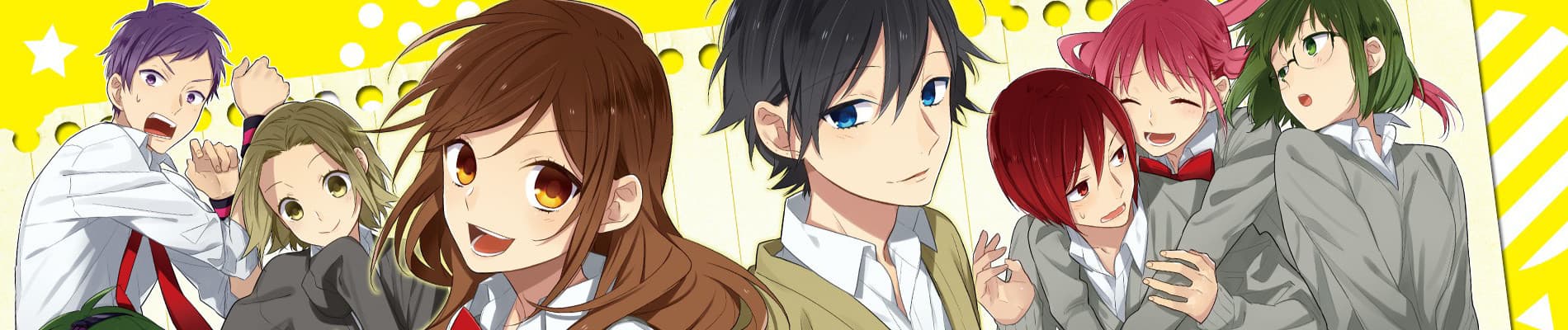
Horimiya's simple and refreshing approach to the genre achieves just that. Author HERO claimed in an interview^ that she didn't keep up with romance manga trends, instead tapping into her past life experiences for inspiration. However, I do think there's more to the story's infectious success than she's letting on. Plenty of Horimiya's writing specifically targets tropes common to romance and Japanese conventions, downplaying them to impressive effect. The biggest example of this lies in the design of its cast and premise. High school students Kyouko Hori and Izumi Miyamura are worlds apart, as far as adolescent social hierarchies go. At first glance Hori seems to be the popular girl, whereas Miyamura is often seen as the soft-spoken class nerd and otaku outcast. However, our leads don't fall neatly into those descriptions at all! Hori goes from social butterfly to hardworking homemaker as soon as the school bell rings. Meanwhile, Miyamura sheds his thick glasses for piercings, transforming his look completely. When the two alter egos meet in a chance encounter, Hori and Miyamura make a pact to be their true selves in front of each other. The lightning connection that develops as their defences come crashing down is more than just a hook for a quick, wholesome read, as this concept of personas allows the central theme of Horimiya to shine. While our masks are necessary for social interaction, it's important to let our true sides get their time in the spotlight too. Horimiya celebrates the simple, underrated joys of being perceived for how we really are. Our leads and most secondary characters demonstrate that philosophy by being spins on popular archetypes. Tropes, like the popular girl or class loner, are accompanied by character flaws, thereby facilitating storytelling rather than replacing it.
Furthermore, the conventions of romance as a genre are subverted as well, with characters often communicating openly instead of beating around the bush with dumb secrets. This enables Horimiya's signature romantic progression, which hardly feels drawn-out. That's not to say that things were constantly introspective and serious, as Horimiya set a lighthearted tone for a majority of its run. In line with the concept of things not being as they initially seem, Horimiya frequently derives comedy from its use of misunderstandings, which usually earns a good chuckle from me. The smart subversion of tropes, natural pacing and lighthearted tone make up the biggest selling point for Horimiya - it just feels right.
Up till this point, my praise has been directed towards the manga. These points are what endeared me to the franchise and got me hyped for the anime. Unfortunately, it's hard to feel that this jump to the silver screen fully leveraged the strengths of its source;
Firstly, let's talk about how the anime handles plot. Having re-read the manga alongside the weekly episodes, I felt that the adapted chapters were mostly faithful to the plot on-paper. However, the stuff that got left out hurt my experience more than I thought it would. Pacing as a whole is incredibly rapid, further accelerating progression that was already known for being fast. Horimiya's anime definitely is fast, but unnaturally so. With several arcs sandwiched into each episode, it's difficult to shake the feeling that Horimiya is rushing through its story beats, without giving enough time to breathe. Cut material lessens the believability of Hori and Miyamura's relationship, because there are a lack of encounters where that budding crush develops. Now, I'm not saying that the cut material is all that eventful from a plot perspective; probably the only "big" occurrence skipped in the first manga arc was a Kyoto school trip, which only lasted for a chapter. It's a tiny exclusion in the grand scheme of things, but my main gripe is that these exclusions stack. As a result their need for each other isn't very convincing, and their feelings toward each other can't help but come out of left field. This results in the anime effectively reaching its climax as early as Episode 5, which is particularly problematic for reasons we'll discuss later. Another big repercussion of the anime's pacing choices is the departure in tone. Jokes and lighthearted sequences are less frequent in the anime, in favor of more serious character beats. A once even contrast between lighthearted comedy and introspection becomes skewed towards the character stuff, which are still compressed even further. During my time with the show, I always felt like I was watching a clone of another episodic romcom, Tsurezure Children. This isn't a bad outcome per se, but means that the end product reveals a different side to the Horimiya I had grown attached to.
Scenes feel off-kilter, as if the show seems unsure of what tone it intends to set. The manga was always comfortable sticking to more traditional over-the-top reactions with its comedy. However, the anime's focus on realistic line delivery means that most secondary characters' personalities take a backseat for more-muted dialogue. Sadly, this balance between the multi-faceted nature of our cast's personalities and realism appears to have been too far out of the show's reach. Out of all the VAs, only Miyamura's is really able to bring this versatility on full display, expressing a variety of tones to match each scene. Everyone else's voice acting usually defaults to a rather "samey" delivery throughout. Ironically, this makes the anime's comedy less animated than its still counterpart, and the show's inconsistent timing doesn't help matters. At times, individual shots are dragged on for just a second too long, while others break continuity as the storyboard eagerly charges through to the next arc. Sound design is also rather grating, especially in the early episodes. A scene can be awkwardly silent due to the absence of backing tracks, while the exact same setup later in the season can be completely drowned out by techno beats that don't quite match the lowkey conversation on-screen. A couple of instances sees several characters incomprehensibly talking over each other in poorly mixed fashion. Look, I really hate to be this pedantic on a technical front, and am usually pretty lenient on these aspects. But as I mentioned earlier, small individual infractions can build up over the course of a series' run. These consistent issues are pretty negligible on their own, but help paint a bigger picture of why a romcom is failing to be funny, and how its overall tone feels so flimsy.
As an indirect response to the somewhat-shoddy OVA adaptations, Cloverworks came in clutch with some gorgeous visuals. If more SOLs looked nearly as good as the anime, I'd be way more of a SOL fan than I already am! The visual direction manages to make rather inventive additions to the manga's templates, enhancing the overall look of the show through shot composition and minor tweaks. The show still retains plenty of its charm and heart, and some character moments do hit hard in spite of a lack of buildup. Several scenes really took me back to my first few encounters with the story, serving as nice throwbacks. However, these reminders did come with their caveats.
Its dose of comedy and measured romantic progression cemented the manga as one of my favorite reads, with a balance that I've grown to appreciate much more in wake of the anime. The first glaring issue with Horimiya's story is that there's a lot of filler. A lot of the main arc is wrapped up within the first 30-40 chapters, which I thoroughly enjoyed on my recent re-read. Not only did the anime's take on things feel rushed, but also dampened my spirits for the season's second half. The anime thankfully handled things much better than my expectations, but the lack of real weight in Horimiya's later arcs is a problem persistent in the source as well. Another weak spot is the dicey thematic implications of "embracing your true side." Horimiya really values this theme, but can take it to rather controversial extremes. Shockingly, we don't need to look much further than the main couple to demonstrate this point. A couple of episodes are dedicated to Hori and Miyamura working through "gap-moe," a scenario where characters act in contrast with their outward appearance, and closely tied to gender (i.e. boys acting like girls and vice versa.) To keep things brief, the show dips its feet into mild sadism, and constantly reinforces the idea that it's not consensual. This is where Horimiya's line between jokes and reality really begin to blur. Making matters worse, violence is constantly played off as a joke, and it gets rather tiring to see characters getting their knuckles bruised over mild disputes. Perhaps it's all due to the manga being based off dated material that was written as early as 2007, but it's problematic nonetheless.
Horimiya is more than it appears, for better or for worse. A rushed anime adaptation and inconsistent execution fail to capture the spirit of a manga series I thoroughly enjoyed. Thankfully, a lot of the heart and charm of the franchise still makes its way into the finished product, as do some of the source's more notorious flaws. Horimiya still manages to make a strong impression, with good overall production values and standout sequences. Still, the manga is a significantly different experience, and well-worth your time if you enjoyed the anime. 6/10~
Can't bring myself to end things like that, so allow me to leave this franchise on a more positive note. Here goes:
Coming back to the quote that opened this review, let's discuss the franchise as a whole. It's a bit of an odd comparison, but I liken my experience with this story to that of a developing relationship. Early stages of infatuation are when love is at its most picturesque, and I was well in love with Horimiya. Taking cues from Miyamura and Hori's secret selves, Horimiya is a series that conceals its dicey implications with heartwarming moments and lighthearted comedy. At first glance, this seemingly harmless show could do no wrong. But now, the smoke has lifted, and mirrors smashed. I still have love for this show, but it means something different to me now.
With all these flaws presented on the table, I have to ask myself, "Am I OK with that?"
And I think the answer, for now, is yes. For better or for worse, Horimiya is unabashedly a celebration of the Weird. Ichirou Watabe is a background character who takes pictures of Hori's beau, saving them in the aptly-titled "Miyamura Folder." And let's not forget that Class 1's homeroom teacher openly admits to being a pervert who fetishises the same underage girls he's teaching. On their own, those characters are obviously messed up. But for every Watabe, Yasuda, or even Hori; there's a Miyamura, a Yuki, a Sakura, and plenty others. Yes, there are parts I'm going to disagree with; gone are the days where I can ignore some of the more "yikes" aspects of Hori's behavior. But this story has certainly brightened up my day with more good than bad, and I'm still very proud of the legacy this franchise has lovingly left behind.
As of March 17th, 2021, Horimiya's manga drew to a close. I'm so grateful to have loved this show - with both the good sides and the bad. Thank you.
OK, that was quite a ride! Tried my hand at really comparing the two forms of Horimiya side-by-side, it proved to be a bit more challenging than expected. If you happen to like my verbose rants, feel free to check out my other reviews for seasons past and present. I also frequently post writeups under my list updates, so definitely take a peek if you'd like to see me mald over anime as they hit the airwaves. Peace~
225.5 out of 269 users liked this review
