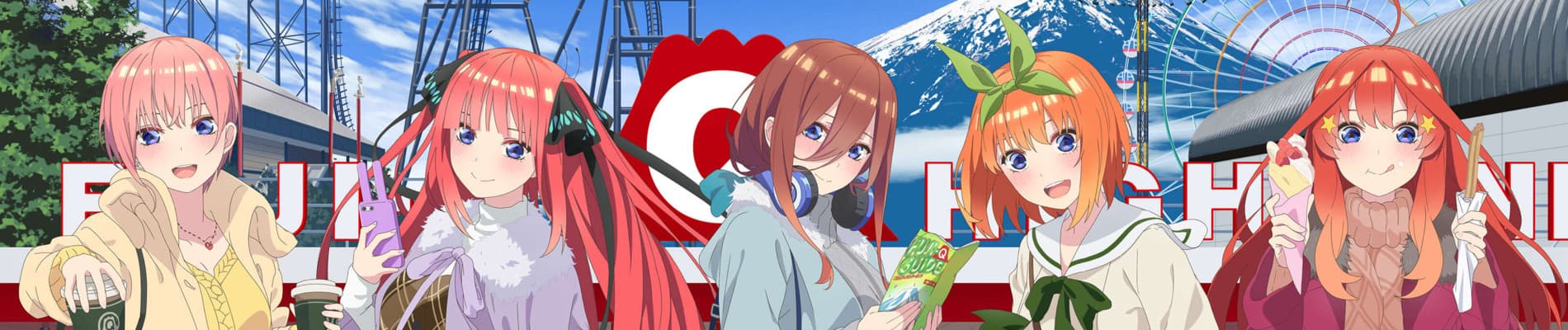
Harem anime have always been seen as those run-of-the-mill generic romance shows, chock-full of repetitive tropes you’ve already seen before. While some harem anime like High School DxD go all in with the direction they want and end up succeeding in their premise, the others are left to fade into the anime of obscurity that the genre harbors. When you think of a harem, chances are that things like Nisekoi, Date A Live, Mayo Chiki, or Familiar of Zero pop into your mind. Those shows are what I would say are representations of what a normal harem anime is like, but which show is perfectly normal? Well, the answer is simple: The Quintessential Quintuplets. Here, I’ll be talking about this from a purely anime point of view, so however I feel about the manga will be irrelevant.
Bibury Studios is taking on the responsibility of animating the quints this time around instead of the previous studio, Tezuka Productions. Before taking on this project, their only seasonal show had been Azur Lane, alongside a few Grisaia films. Considering their short history, it’s great to see how the show actually ended up turning out. All the characters in the show look bubbly and soft, including Fuutarou. The designs aren’t as detailed as they might have been in the first season, but I think the new style still fits in a different way.
The characters themselves are voiced by extremely talented people. Kana Hanazawa as Ichika, who does a kind of soft and at times chilling voice; Ayana Taketatsu as Nino, who’s kind of high and mighty tsundere type voice works excellently for the character; Miku Itou as Miku, who aside from having the same name, nails Miku’s shy and reserved tone of voice; Ayane Sakura as Yotsuba, who does her job as the genki girl of the group very well; and Inori Minase as Itsuki, who’s character voice has the fitting feel of someone immature who desperately wants to be the mature one. Not to mention Yoshitsugu “Harem King” Matsuoka as Fuutarou, who has an impressively wide vocal range.
Both the opening and ending songs for this season, Gotoubun no Katachi and Hatsukoi respectively, are sung by a group known as Nakanoke no Itsutsugo, who are made up of the voices of the quints. Having the actual voices of the characters sing for the OP and ED really adds to not only the quality of the song, but shows how talented they are at what they do.
The premise of this show is as simple as it looks on the outside. It’s a show about a guy tutoring five quintuplets as he gets entangled between their love. Classic harem setup—one even reminiscent of something like We Never Learn. Though, as simple as the premise may be, something I’ve learned from s show like Jujutsu Kaisen is that no matter how basic a premise may be, the execution can quickly turn it from generic to great.
The parts of Quintessential Quintuplets that separates it from others is how it handles its characters and plot in a way that builds naturally, but doesn’t spend its time with filler content that doesn’t really affect the rest of the story. Luckily for us, this second season spends no time wasted on simply building onto these characters. After all, we already know who they are from the last season. The time the show spends that isn’t related to the story arcs is used for expounding and growing the quints’ relationships with Uesugi, making each moment different than before.
The stories that the show tells this season all revolve around the titular Nakanos. The first of five real arcs we’re presented with for the season is the Seven Goodbyes arc, which is also the longest arc in both this season and for the entire series, at the very least in terms of how much content it has. So much happens in this arc, and what happens has major effects on the rest of the season’s events, especially in terms of Nino’s character. We learn more about how the Nakano family used to be prior to Fuutarou becoming their tutor, and that includes the events surrounding the quintuplets’ mother. Though, this arc is all about coming to accept the changes in their lives and the truths that come with it, and that’s truly where the character development and growth come in.
The second arc is the Second Year Last Exam arc, which is used to show us the aftermath and motivations each of the quintuplets have. To save themselves from being transferred to another school, they all have to get passing grades for their exams, but that’s far from their only motivation. Each one of them has their own personal goal that ties in to what they really want. We’re also shown the whole reason why the quintuplets are at that school in the first place, and part of the reason why Yotsuba cares so much more for others than she does herself.
The third arc is where I think things really get into motion, setting up the three characters that affect the season the most: Ichika, Nino, and Miku. In the Scrambled Eggs arc, all five of the sisters are disguised as Itsuki, and Fuutarou has to maneuver his way through the web of feelings this brings upon them. He slowly but surely discovers a way to differentiate between them, which all culminates in a heartfelt ending, but one that closes off in mystery. A sentiment that’s been echoed throughout the season has been that love is the way to differentiate the quintuplets, and it’s here where Fuutarou finally understands the importance of that. It makes the viewer question themselves again: Who is the bride?
The fourth arc is the New Class arc, and it’s a bit of a breather. I said it was a bit of a breather, but that doesn’t mean it’s free from any big moments. It’s here where Fuutarou slowly starts to realize that feelings like love aren’t things he can ridicule anymore, and opens up more to the people around him. He’s stated that he doesn’t tutor them for the money anymore, and only tutors them because he wants to. Though, it seems like he’s no longer just seeing the quints as his students, but also people who he can trust and care for, and will trust and care for him in return. He works hard to not only prove his worth as a student and tutor, but as a person as well. That said, this arc isn’t all about heartfelt realizations and such, as some character moments prove to be truly shocking. This is what I like to call the beginning of the larger Sister’s War arc, where each of the quintuplets is vying for a shot at Fuutarou’s love.
The climax of this season’s version of the larger Sister’s War arc comes in the form of the Kyoto Trip arc, where we’re shown the lasting impact of their actions and the consequences that come with how they choose to achieve their goals. One small action creates such a large impact and divide between the sisters, and even causes Fuutarou to distrust one of them. Though, this all ends well, with everyone reconciling and regaining their confidence again. From here, the Sister’s War still rages on, but taking each other’s well-being into consideration.
I’d like to talk about the characters that the show gives us, starting with Ichika. Ichika is the character this season I see as the most controversial. Ichika actually was my favorite from season one, prior to reading the manga, though, that changed as soon as a certain part came along. Honestly, I think lots of people also felt that way when they reached this part, since it really wasn’t a good move on her part. She represents the major theme of the show to an extreme extent, and that’s being selfish in terms of love. Her redemption arc by the end was very nice to see, showing us viewers her true nature, and her repentance for the mistakes she’s made. Though, the fact that lots of people were so impacted by her actions and how she ends up is a testament to how great the writing of the show really is, at the very least for this season.
Alright, I’m saying it: Nino is best girl. So, that out of the way, I absolutely love Nino’s character. She’s genuinely the best tsundere character I’ve seen in anime. Nino exemplifies the main theme of the show in the best way possible, since she's very forward with her emotions, and will do what it takes to get to Fuutarou's heart, but she still cares deeply for her sisters. Her character growth from a pretty obnoxious tsundere character to a forward, considerate girl that knows what she wants and how she wants to get it. Her scenes in the Seven Goodbyes arc are her biggest moments of character growth, and she finalizes that growth by the end of the Scrambled Eggs arc, allowing her to be in her prime during the New Class and Kyoto Trip arcs. My personal favorite Nino scenes were the reveal of her new look, her bath discussion with Ichika, her working with Fuutarou at the restaurant, and her scene with Miku on the bed. Overall, Nino is a wonderful character, and honestly became one of my favorites in anime and manga throughout the course of the series. From design, to personality, to character growth, she’s done extremely well.
Miku is the real fan favorite here. Her struggles with her shyness and anxiety in the series are ones that the audience can sympathize, and maybe even empathize with to some degree. Seeing her go forward with her desires in spite of her shy nature is one that the audience can all respect, even as fans of other characters. She keeps trying over and over again, but still gets stuck down, and it’s heart-crushing. Her resolve to get Fuutarou to notice her is great to see; she no longer wants to stand by and hesitate. She has many good character moments this season, but one that sticks out to me a lot is her significance in the Scrambled Eggs arc. That ending scene was packed to the brim with emotion, and I absolutely loved it. This season’s Miku is all about how she wants to grow and move forward with herself. This isn’t exclusive to Fuutarou either, since she herself said that she enjoys making things. Miku is a character that gets a lot of attention from people, including people close to me who’ve seen it, and she deserves every bit of it. She’s not my personal favorite of the bunch, but I can still proudly say that she is the most well-written one.
Now, the other two quintuplets didn’t get as much screen time as the previous three, but I still think the moments they had were nice enough. Yotsuba in particular is an interesting one. There are two big reveals when it comes to Yotsuba, and one of them is a reason as to why she’s so considerate to others, especially her sisters. Yotsuba’s biggest scene, though, is changed a bit in the anime due to its placement in the timeline, but I think it doesn’t hurt the scene’s sentiment. Yes, the scene with Yotsuba and Fuutarou. That one is really sweet, especially how Yotsuba sees the city lights and discovers what she really did want from Fuutarou. This quintuplet right here is selfless to a fault. Her character is in contrast to someone like Ichika, since she has the weight of her past on her shoulders, making her want to help everyone instead of being a burden herself. Yotsuba is the character I would say is the most basic, but that means she’s a very down-to-earth and kind person as well.
Itsuki is very important in one of the arcs, and that’s the Scrambled Eggs arc. She’s very important there, but also not really, because while everyone looks like Itsuki, Itsuki herself isn’t all that important for this section of the story. That said, the screen time she does get this time around is still somewhat interesting. Itsuki’s core character is about her and her relationship with her late mother. After her passing, Itsuki slowly became the mother figure of the group, or at least she wants to be that. After the events of the Seven Goodbyes arc, Itsuki discovers her ambition to be her own person. Itsuki takes more of a backseat this season, but she’s there when she’s needed.
You can’t just talk about the main cast of this show without bringing up the protagonist. Fuutarou is truly a good protagonist, and a great one for harem standards. He’s full of personality, but it doesn’t bog down everything that is important to him. He’s written as more than just a character here, since the actions he takes in this part of the story is realistic to both what a normal person would do and what Fuutarou himself would do. His character for these arcs doesn’t ever stray too far away from what’s previously been established, but he never sticks too close to his baseline to the point that he’s generic and boring.
Harem shows usually tend to go down the gutter in their second season, and that’s honestly what I expected from this show. It really isn’t anything revolutionary, but it still works amazingly well. This season is one I thoroughly enjoyed, from characters to story to music to art. I enjoyed seeing each of the characters’ growth, as even if I didn’t particularly like how a certain character did things, or if a character didn’t get as much screen time as I would have wanted, all of the main cast’s antics were at the very least interesting.
The themes this season were also acted on very well, especially with the three main spotlighted sisters this second season. The first season was all about setting up how Fuutarou has to share himself with all five of the quintuplets, but the second season is about how the quintuplets want Fuutarou all to themselves. This can be seen in even the OPs for each season, as the message is very clear when you actually take a look at the meaning of the lyrics. The status quo this season is much different than it was last time, and that’s evident as early as the first arc, which is all about changing and moving on. I also really enjoyed seeing the characters’ growth, them becoming their own them instead of being stuck to the past.
Overall, The Quintessential Quintuplets Season 2 is truly a great series. It does so much of what it does right, and does it in only twelve episodes for that matter. It’s good on an objective level with how it does its technical elements, plot, and characters, but it also does well on a subjective, personal level, since it’s a show that I simply enjoyed watching. I often find myself listening to both Gotoubun no Katachi and Hatsukoi, the latter being one of my favorite anime ending songs.
I’ve never really found myself a big fan of harem anime—they’ve never really been all that great, but not all of them are bad per se—but this anime just hit different, you know? I’ve never connected so much to a harem anime to the point that I find myself caring for the characters on more than just a simple waifu level or anything. If there were only one anime per genre left in this world, it would truly be a sad existence, but I certainly hope that the harem genre leaves behind this show. It truly is the show I would say is quintessential for its genre.
54.5 out of 62 users liked this review