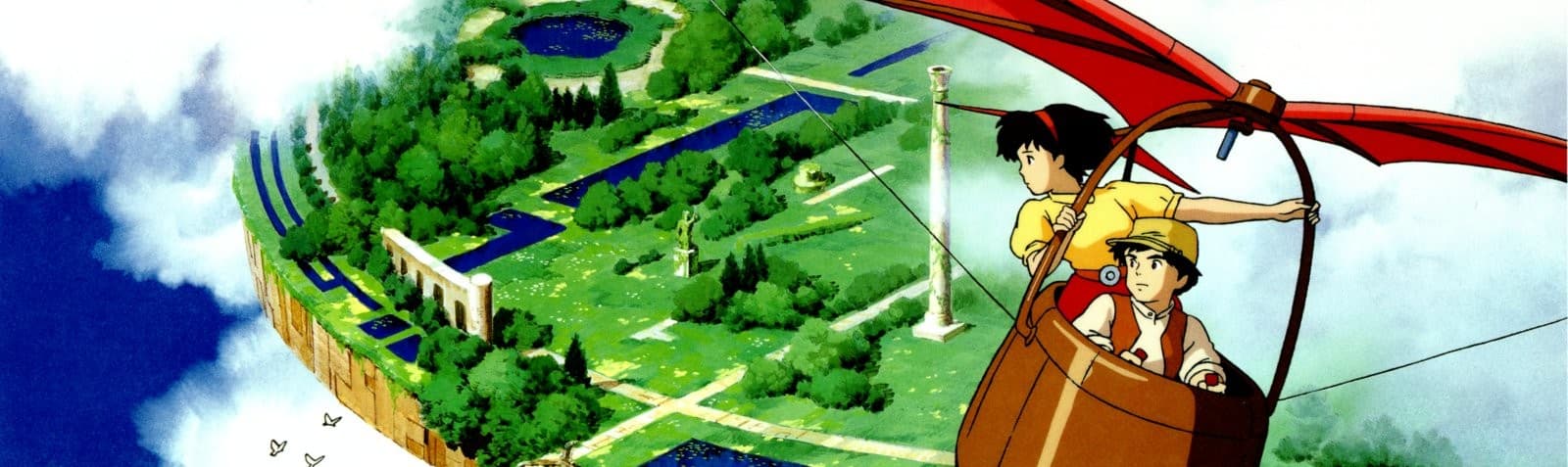

 Artist: Zakuro Aoyama
Even from an early point in his career, Hayao Miyazaki brilliantly showcases his ability to conjure up fantastical worlds into film. Castle in the Sky, deservedly so, stands as one of Studio Ghibli’s most iconic fantasy movies. Of course, from today’s point of view, Ghibli’s whimsical quality has become more of an expectation rather than an exception. Following films like Howl’s Moving Castle, My Neighbor Totoro, and Spirited Away, it is clear to see how Ghibli’s otherworldly yet cozy sense of setting originated in this film.
Worldbuilding and Ambience
These films draw upon a mélange of awe and familiarity to establish its setting. Pazu’s comfortable home greets us with the sounds of a trumpet and joyful birds, juxtaposed by the background of the Slag Ravine’s steep cliffs and steampunk industry. The familiarity of brick houses and a warm breakfast invite the viewer not to view the world presented to them as alien. Even if its flying galleons and hovering ancient cities are entirely fiction, it instills a sense of wonder into the viewer, making them feel enchanted by the film. It is openly inviting them to find this ‘enchantment,’ as Tolkien would have described it, in their own worlds as well, beyond the screen.
I am sure this an observation that can be made of many of Ghibli’s films. But it is appreciated more in Castle in the Sky due to its place in Ghibli’s timeline: at the beginning of the studio’s career. I would say Spirited Away is the film that completely masters this technique of embracing the magical as part of a relatable word. Unlike high fantasy, which often decides to ‘transport’ the viewer instead of ‘incorporating’ the fantastical into the audience’s minds.

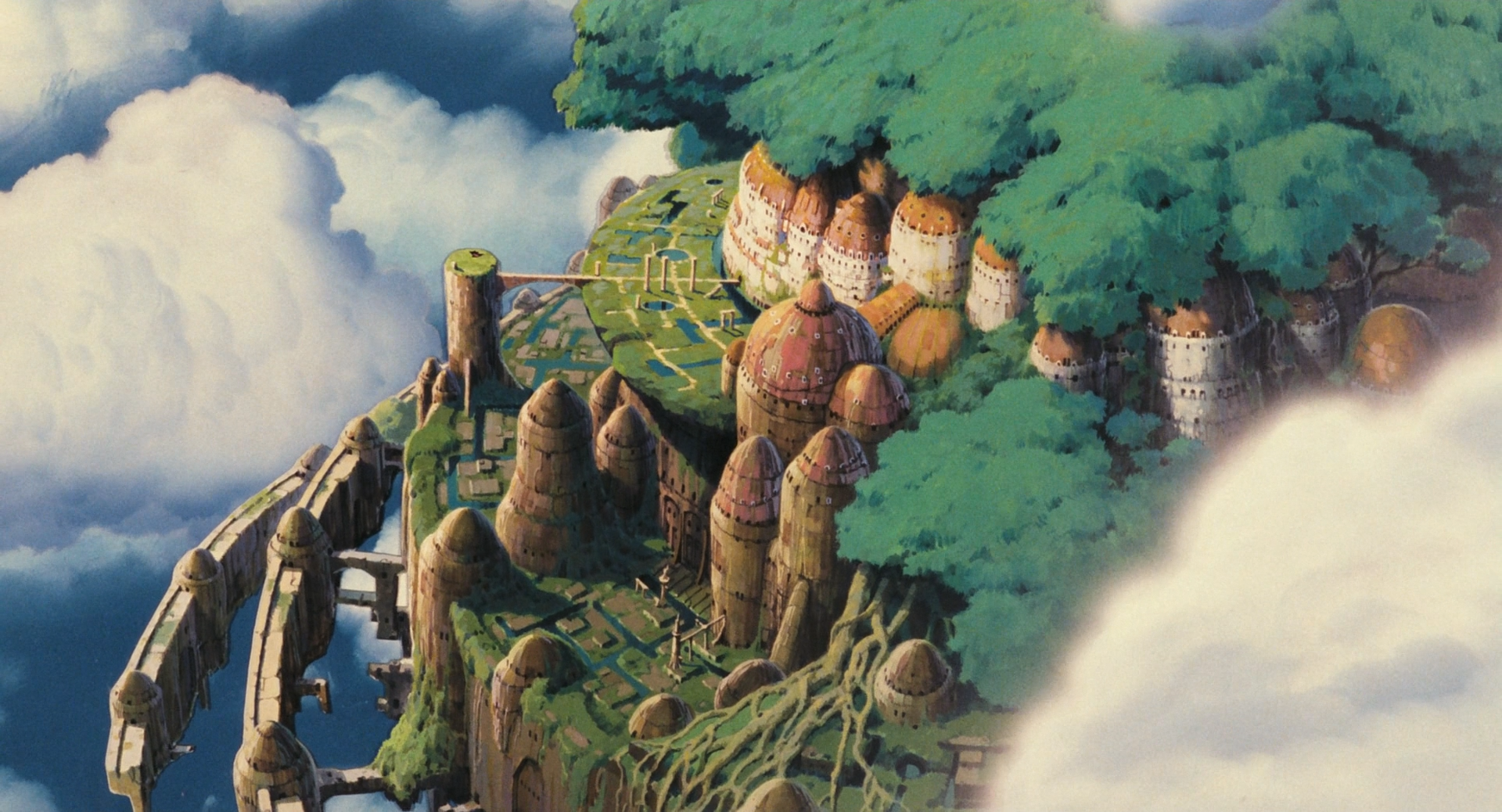
These worlds, which Miyazaki invites the viewer into, use the unreachable to surprise the viewer. The city of Laputa is ingrained into the viewer’s mind the same way a child thinks of Santa. A ludicrous reality which we accept as possible. There is a certain suspension of disbelief not found in many other pieces of fiction. Indeed, Laputa does not exist in our world, but Pazu and Sheeta’s world is so close to ours that we almost believe it does, possibly amongst the clouded sky.
Most notable about Miyazaki’s worldbuilding technique is that which is left unseen; these glimpses that are never expanded upon. I would qualify this as a strength of the film rather than a flaw. These missing components ultimately make the world more mystical—repeatedly making the viewer inquire upon the nature of Laputa’s world and its unexplored aspects. What sort of kingdom do these people live in? What other Seussian machinations have these people invented? How did the robot soldier fall from the sky? All of these questions, leading the audience deeper into the caverns of the imagination, piquing their interest in what’s been shown to them and what they might imagine on their own.
Script
This ‘untapped world of wonder’ serves, not only as a worldbuilding tool, but also as the protagonists’ driving ambitions. The story of Pazu and Sheeta is that of discovery. It is a path of self-discovery and pioneering across the light blue expanse. It is a lighthearted coming of age story of two young teens beginning to experience the world. Pazu’s wish to explore the skies and Sheeta’s determinism towards uncovering her family history combine to tell a thrilling story of character growth. Pazu and Sheeta both demonstrate bravery and wit even in the direst moments: from rescuing others to escaping from danger. Sheeta even showcases to her mentor, Dola, captain of the “Tiger Moth,” that her gender is not a constraint.

The plot is structured like an extended chase scene: amongst pirates and soldiers storming after Sheeta, then Pazu rescuing Sheeta, and then Sheeta and Pazu chasing after Muska. It seems fitting considering the central theme of the movie is ‘to chase.’ The Dola family chase after treasure; Pazu chases after his dad’s lost dream; and the antagonist chases after power. Ultimately the movie contrasts the childlike ‘chase for wonder’ exemplified in the protagonists’ thirst for adventure against Muska’s desire for control. Pazu and Sheeta chase after the wonders of Laputa not because of greed but rather for the adventure laying above.
Verticality resides at the core of the film, guiding both the movie’s art and writing direction. Visually, the film depends on the vertical nature of Laputa’s world. The altitude, presented either through steep cliffs or by soaring the skies, is a fundamental aspect of its action scenes—ultimately engulfing the viewer in awe and suspense, given our association of danger and heights. Nevertheless, in all their bravery and boldness, the protagonists lift themselves into flight (or throw themselves into the abyss), adding to the spectacle of it all. Vertical set-pieces inhabit every scene in Laputa. Even the towns are crafted out of wooden scaffolding, connected through levitating railways.

The script and characters of the movie further explore ‘verticality’ through the context of hierarchies. Pazu and Sheeta are characterized as the social strata’ breakers, defying their assigned gender roles amongst the crew and combating authority. In their entry to the pirate crew, they embrace their identity as rule-breakers refusing to accept their prescribed roles. Sheeta, most notably, showcases wit where Mama Dola would not have expected any from a girl. Furthermore, even as a royalty member, she refuses to utilize her bloodline to govern and conquer; instead, she decides to cast away the city’s destructive power. An apparent act of defiance against the corruption that power provides is the movie’s climax. The film comments on authority and power, deciding to question its intentions, prompting us to cast away any greed and lust for strength to preserve peace and nature.
Moreover, the film praises humility amongst its cast, never looking to shame Pazu for his profession or the ravine for its makeshift buildings. The caves of the underground are not characterized as dirty; instead, they hold eternal charm. Contrarily, the mighty high castle of the army is a sign of fear, not of glamour. The film appreciates the ‘little guys,’ refusing to praise the ‘higher castes,’ the way the antagonist would have wanted others to do so.

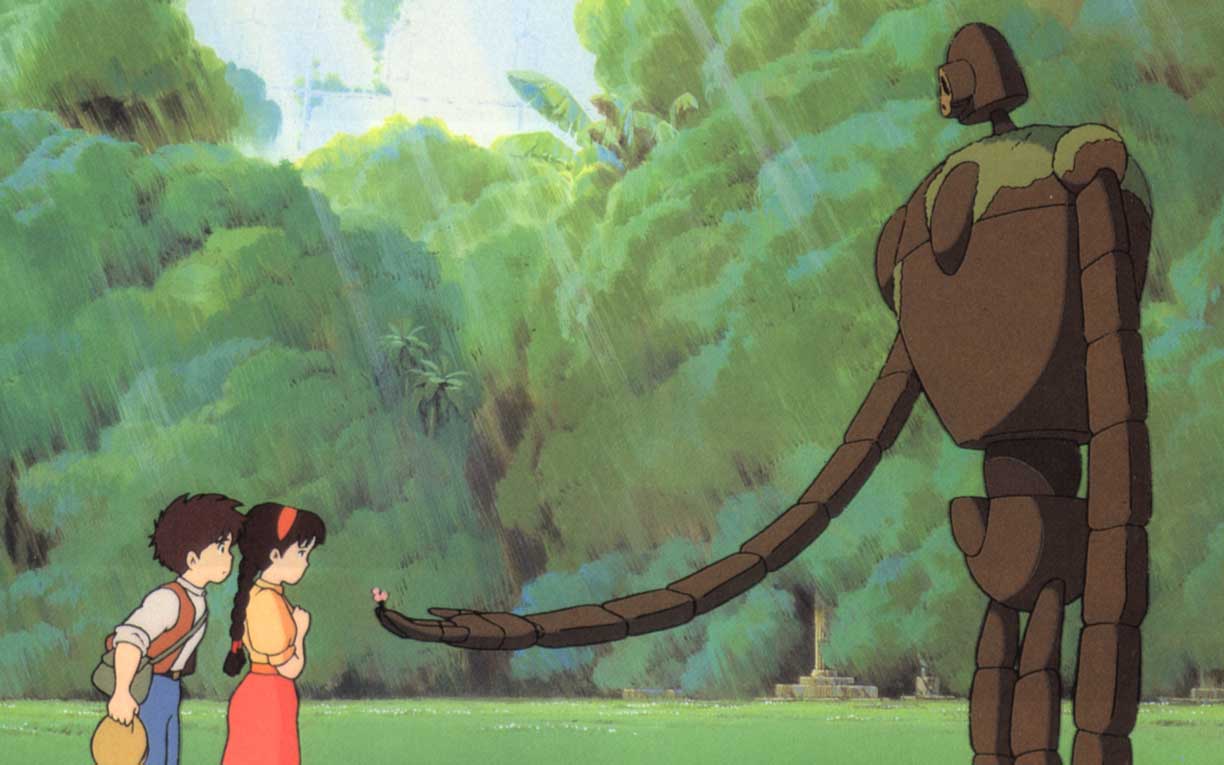
Furthermore, Castle in the Sky paints a compelling dichotomy between technology and nature. There is an evident appreciation for nature in how vines and trees revolt against the aristocratic halls of Laputa—refusing these robots of death to roam free, transforming the city into a sanctuary of life. The way rock and soil are appreciated as a part of life in the ravine and how steel, bricks, and gunpowder are disdained as part of the military. However, technology itself is not condemned, but the way violent actors have utilized it is criticized. After all, the end of the film showcases the atomic bomb imagery, typical of Japanese animation, in all of its horrific cruelty. Technology can be seen in unity with nature, similar to how the gardener robot tends after its remote monastery. Flying machines are part of Pazu’s dreams, and these can be used for the search of wonder rather than the interests of war. To explore the world while in peace with mother nature seems to be the movie’s message.
Conclusion
Laputa: Castle in the Sky presents the viewer with an atmospheric land of enchantment, inviting the viewer into scenic action pieces amongst the clouds. Miyazaki presents a masterful showcase of wonder and color, utilizing every environment to excite the audience. The film uses its characters to draw upon a youthful and rebellious appreciation of nature and peace. It guides its audience members to sympathize with the outcasts, driven by independent journeying, and scorn the institutionalized machinations of force. Castle in the Sky is a high-spirited odyssey of bravery and boldness, inviting the viewer to explore and defy.
