
The Simpler Things in Life
"Ongaku" (音楽) is Japanese for "music". So, essentially, the title of this film is literally "Music". Which entirely encapsulates the film's vision. How? Ongaku is amazingly frank with, well, everything.
The mention of high-school music bands often and immediately strays one's mind to fiercely burning tales of youth, newfound passion and blossoming friendships. Add in Ongaku, and shows like K-On and Beck: Mongolian Chopsquad seem amusingly exaggerated in a Rose of Versailles-esque fashion. That is, Ongaku depicts the offscreen moments of busybody life. The listlessness and lethargy that embodies much of our life is examined through a misfit trio of delinquents; Kenji, Asakura and Ota.
The trio, infamous for their fighting prowess, pass their days playing video games and throwing darts in an empty classroom afterschool, occasionally satiating their boredom with fights and chatting with female classmate, Aya. Kenji is unapologetic in his enigmatic stride. Everything he does seems to be on whim. Picking fights, stealing a stranger's guitar and starting and quitting a band; Kenji's mind follows no concrete protocol. His screen time cherishes several seconds of still frames of his silent, staring expression before uttering a few words. Perhaps he best embodies the mishmash of simplicity and eccentricity in this film, with his bareboned character and inexplicable courses of action. I believe director Iwaisawa himself best explains the nature of Ongaku, during an interview:
"When you think about a story about high school students starting a band, you tend to think about a youthful tale involving friendship, love, or struggles. But On-Gaku didn’t have any of those obvious elements, which is why I especially enjoyed the story."
Ongaku takes wide and relaxed strides in its pacing. Though gentle in its refreshing depiction of a monotone high-school life, Ongaku suffers from tunnel vision and blazes ahead with a strong sense of vision and direction.

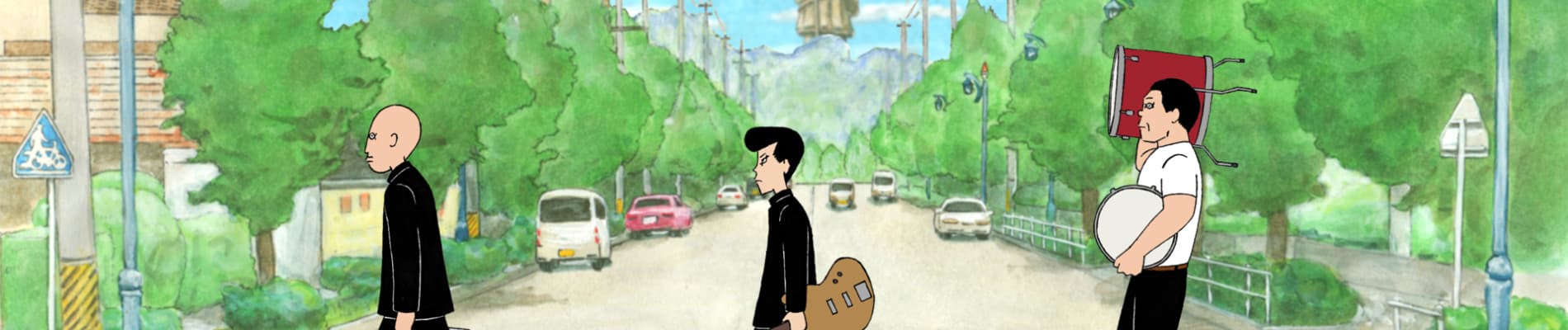
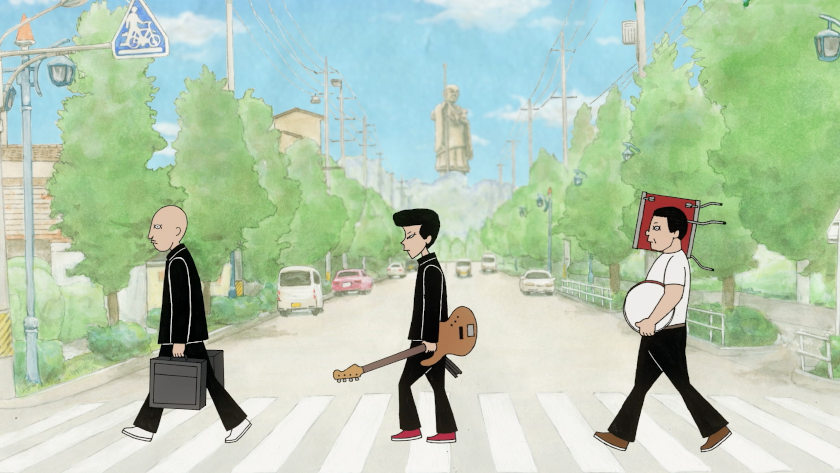
Like a child proudly sticking their nose in the air while showing off their crayon doodles, Ongaku confidently strides by with its bareboned art-style. I mean, Kenji is essentially a mustached Saitama and I'd be less than doubtful if ONE is revealed to have worked on the character designs. In a coalescence with the absolutely nutty animation, however, the visuals in this film are a cut above many. To put it into perspective, Ongaku is an independent film worked on for 7 years and contains 40,000 hand-drawn frames. Perhaps Ongaku's minimalist art-style prevents it from being chimed in during sakuga discussions, but the clear-as-day effort put into the omnipresent fluidity makes Ongaku one of the best animated works I've seen.
Ongaku cherishes and achieves subtlety through its visuals. The characters are rigid with blank expressions and unblinking eyes, and their constant miniscule vibrations lovingly point to the hand-drawn nature. The hefty rotoscoping plasters a smile on your face. It isn't exclusively used in grand climaxes, but generously allocated to mundane scenes, like Kenji and Co. walking down the hallway. However, it does accentuate and elevate the musical portions of the film, such as Morita wildly ripping on his guitar in a public performance and the ending festival scenes. With their balls-to-the-wall eccentric energy and atmospheric ecstasy, they're such a jarringly amazing deter from the usual listlessness of the film.

Conclusion
Thematic isn't sought after in this film. It instead relishes in illustrating a breath-of-fresh-air in the school and music genre. Because of Kenji's humorously arbitrary nature, music is no more than a brief, amateurish stint. In a hybrid genre that often deters lethargy and passivity in favor of trials and tribulations shared together with friends, woes of failure and triumphs of success, Ongaku picks up and embraces them. The passing moments are never the most fulfilling or memorable, but Ongaku damn well made the passing days of a delinquent trio mesmerizing.
The touch of eccentricity gives the film its entertaining flavor. The deadpan character expressions, frequent stretches of silence and the trio's offbeat band sessions stifle a chuckle in your stomach, but leaves you with a grin. The rotoscoping and general organic sense of animation and art breathes unsuspecting eccentricity into the film, offering both the most mundane and most bizarre scenes. Ongaku carries a reminiscent scent of Ping Pong: The Animation and Yuasa's other works.
Despite revolving around a rock-n-roll band with some references to the music genre, Ongaku shies away from the microphone and instead provides ambience of buzzing passerby and muffled background conversations. Though, when it does decide to distance itself from reposeful atmosphere, it goes off unhinged in the downright inanely bizarre and wild musical performance scenes without a hint of buildup. Overall, however, Ongaku is clearly unbothered with music. Just like Kenji, music is simply a device to give abstraction to itself. Music doesn't exactly empower, uplift, colorize or bless meaning upon anything in this film. And that unfulfilling meaninglessness is adolescence at its core.
Ongaku is a surprisingly overlooked gem from the recent times. Perhaps the minimal art-style and fluid animation coalesce into an uncanny sight to some, but rest assured, this short 1 hour, 11 minute film will fly by with a refreshingly mint aftertaste.
