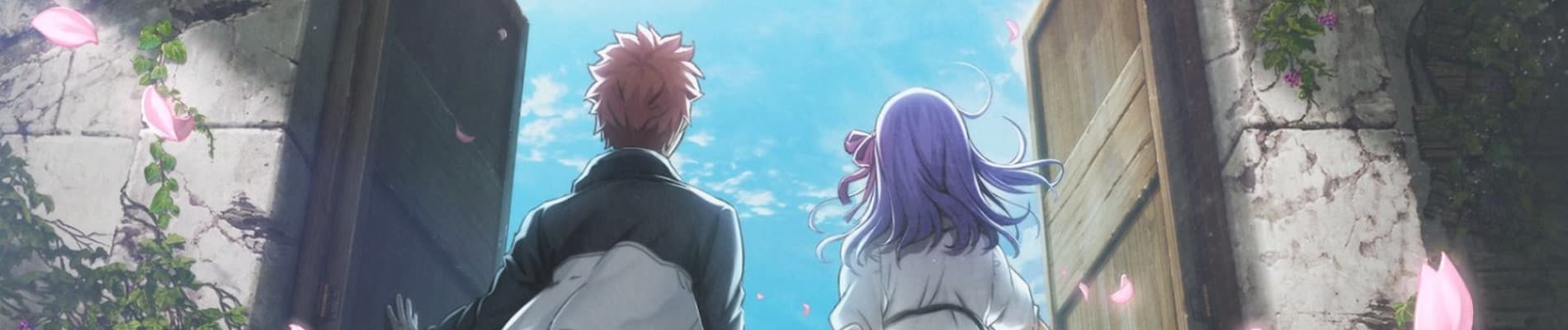
This is effectively a review of the whole Heaven's Feel route as adapted in anime through those three movies. Expect vague SPOILERS from the anime adaptations of all three routes. For those who haven't watched these other routes (or plainly don't know what a route is), I suggest you go through them before Heaven's Feel or this review for that matter. Further, I recommend keeping the prequel series for the last. A sufficient and necessary list of anime titles in the Stay Night Universe, is mentioned below for reference.
- Season 1 (2014)
- Season 2 (2015)
- I. Presage Flower (2017)
- II. Lost Butterfly (2019)
- III. Spring Song (2020)
- Season 1 (2011)
- Season 2 (2012)
The movie trilogy explores the third and final route of Fate/Stay Night visual novel; Heaven's Feel. This route delves into Sakura Matou, a character who was much ignored and taken lightly in the previous routes. A darker and deeper pathway to Stay Night is offered here. Ironically, exactly because of this reason, the initial routes Fate and Unlimited Blade Works feels more tragic than they used to be. The realisation that the hideous realities uncovered in Heaven's Feel were already present in the previous routes, but kept concealed and unquestioned is saddening. Both the characters and the audience were kept in the darkness of ignorance, till Heaven's Feel.
The omnipresence (in all the routes) of obscure hints and tiny details pointing towards the existence of certain facts, that will be revealed only when a particular route is being pursued; this unique style of storytelling is what makes the Stay Night Universe stand out. Very often, these details left buried within the routes go undiscovered until the reality is directly spat into the face, by that certain pathway. Thus, the rewatch value for the titles under this banner is pretty high. Ever wondered why Rider, an extremely powerful Heroic Spirit from the legends, is being portrayed pitiably weak in the first two routes, getting wiped out even before revealing her iconic skill? Why is the mysterious bruise on Sakura's hand, brought into focus and then completely avoided in the former routes? Or why do the said routes brush off Sakura meeting up with the strange blonde foreigner as something insignificant? Rest assured, these details are neither insignificant nor without reason. They act as foreshadowing elements to the pieces of a grand puzzle that's yet to be put together. That's what Stay Night really is; a puzzle that's left unfinished unless each and every possible passageway is pursued and brought together.
The first movie, Presage Flower is built in such a way that the creators expect the audience to have gone through, at least the Unlimited Blade Works beforehand. This is precisely why it's recommended not to start Stay Night with Heaven's Feel. On applying this prerequisite 'condition' the movie initially moves at a fast pace; even compressing few scenes into a couple of image frames. This does feel reasonable from the creator's side, as the same studio worked on its predecessor, and of course since there are limits on contents to be covered in just three movies. Though I, personally would have preferred a complete adaptation. In addition to this, Presage Flower felt a bit too bland in comparison as if, the movie is solely focused on setting an introduction. In contrast, the second film, Lost Butterfly used the foundation provided by its predecessor and dived deeper into the characters, especially Sakura. Lost Butterfly has to be credited for doing a better job in portraying the usual Fate theme; the Trolley Problem as philosophers would call it. Is it even possible for one to save everyone? Is it right to choose which lives to save and in effect, which lives to sacrifice? The third movie, Spring Song further expands this concept by adding, Isn't it evil, to stamp an entity as evil, even before it is born? If the entity is guaranteed to be evil, is it wrong to deny it of its birth and thus existence? Or can that denial be recognized as kindness to the rest of the world? These philosophical thoughts acts as the central essence, turning the latter half of the movie to be a literal clash between ideals. Compared to the journey till then, the destination was rather normal and in a way, disappointing. In short, the climax felt out of place; as if it's written out of a sudden urge for fanservice, in a story that prioritised plot till then. The original visual novel had two major endings for Heaven's Feel; a 'True Ending' that was adapted in the movie, and a 'Normal Ending' which is more tragic but fits the theme more accurately. Choosing the latter over the former may have resulted in something even better.
The characters arguably attained their respective peak forms in Heaven's Feel in comparison to the preceding two routes. Heaven's Feel also brought forth a shift in the sphere of character development; in the sense that the Masters were in the limelight this time, contrary to the usual Fate way of exploring each of the Servant characters. This makes sense as the previous routes already went through almost all the Servants of the Fifth Holy Grail War. And the one Servant that was left behind earlier, Rider, is picked up here.
Throughout the Stay Night Universe, Emiya Shirou was portrayed as a stubborn but admirable man who hopelessly clung to his Utopian ideals of being a 'Hero of Justice', capable of bringing salvation to everyone irrespective of friend or foe. He remained persistent even when he was confronted with his possible future self who went through pain and suffering thanks to the very ideals his younger self nurtured within him. In this final route, however, Shirou undergoes a radical change. Faced with despair, he is forced to choose who to save, thus contradicting and violating his childish ideals. Shirou is forming an independent identity here; one that is different from the 'Hero of Justice' role, he inherited from his adopted father, Emiya Kiritsugu. These tiny faults and errors make him develop further as a character and into a good protagonist.
The exponential growth in character for the route's heroine, Matou Sakura requires a special mention, even though an explanation might be unnecessary. That is to say, she went from a cute little 'kouhai' (~junior) character kept exclusively for fanservice (as in the previous routes), to a character of such depth and a past which makes the viewer feel guilty to have undermined her before. While Emiya is building and transforming his identity, Sakura had already lost hers; along with the voice to express her opinions. Hence, she is always dependent on another person to lead her, even if the destination is not someplace she herself prefers. Ironically, this is somewhat similar to the Matou way of Magecraft which she absolutely despises. There were a few situations where even this 'hollow' girl found a bit of selfishness and thus a 'self' within her; though almost always, she lacked the courage to express it. This is a character who chooses to endure rather than express herself.
The movies reveal another side of the same Tohsaka Rin, someone who sacrifices her personal wishes for another; the polar opposite of the tsundere mask she adorns. Illyasviel von Einzbern reaches a similar destination after witnessing and experiencing more of the world outside that lonely castle. Kotomine Kirei as always, plays an empty man of unbent ideals, keen on observing the chaos. His contribution in elevating the philosophical grounds of the anime can't be left unsaid. At times, even his thought process seems dangerously more agreeable than that of the protagonist. Then there's Berserker who triumphs in escaping his cursed legend and Rider who struggles to carve a path different from her legend, for her Master.
In terms of art and animation quality, Ufotable just went ahead and shot through the roof, they themselves created. That too when the studio here is the same one that pulled off Demon Slayer's famed animation in all its glory. Rapid character movement, often in an unruly transforming terrain, captured through dynamic camera perspectives and transitions that takes the motion right to the viewer's dimension; fight sequences in Heaven's Feel were nothing short of 'godly'. Further, the audience was greeted with aesthetic backgrounds that are hard to digest as hand-drawn, the usual vibrant colour palette that pops the subject out from the dark environment, and a sleek animation that flows like water yet hammers down like a waterfall.
img49%(https://images2.imgbox.com/25/cb/tQvKzeSF_o.jpg) img49%(https://images2.imgbox.com/b4/8a/PSRJLca4_o.jpg)
img49%(https://images2.imgbox.com/40/47/vYi4ZB6L_o.jpg) img49%(https://images2.imgbox.com/fa/e9/IlPbC8Jx_o.jpg)
About the character design department, I do confess that the facial structure felt a bit oversimplified. But that's how the characters were originally designed in the visual novels. Whatever the studio did, they did to make the characters more appealing, without compromising their faithfulness to the original material. Besides these anomalies are hardly noticeable amidst all the other visual treats, Ufotable brought together.
47.5 out of 69 users liked this review
