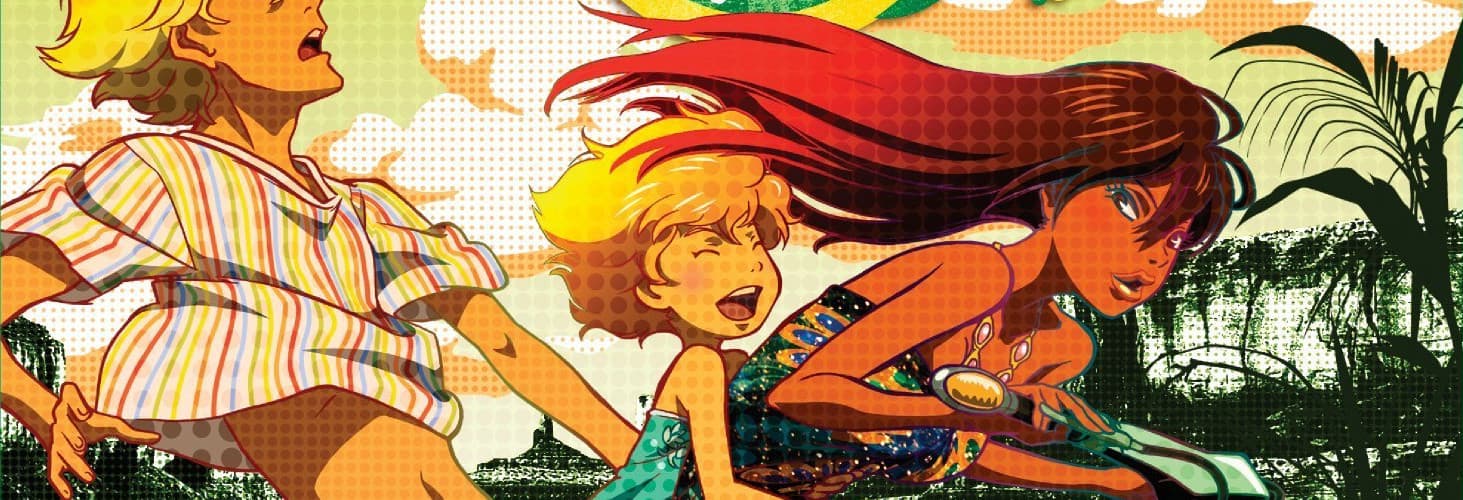
Michiko & Hatchin
a review by Godsen
a review by Godsen
This review is about Michiko to Hatchin, which is an original anime that came out in 2008 from studio Manglobe, which is one of the studios I really like even though they are kind of inactive anymore and also animated some other (in my opinion) great shows like Ergo Proxy and Samurai Champloo.
I know most reviews lately are for seasonal and airing anime but I wanted to show off what’s good about this ‘older’ anime so that I can potentially remind/present people an anime that they hopefully can enjoy as much as me. This review contains almost no spoilers, excluding some things that set the plot in the first couple episodes of the anime.
First let's address the elephant in the room, that I set up for myself even in the title of this review. Michiko to Hatchin is set in a fictional country named Diamandra, which has noticeable cultural influences from Brazil. I will be making a lot of parallels between the two in this review, hoping to not offend anyone that is actually from Brazil.
The biggest difference between Brazil and Diamandra lies in the names of the characters, who use a mix of Japanese and Latin (or other non Japanese) parts to create some unique and charming names (i.e Michiko Malandro, Atsuko Jackson, Hiroshi Morenos).
The whole soundtrack is in Portuguese (we will touch upon that in more detail later) so it’s safe to assume that’s the natural spoken tongue of the main characters in the show, while we hear them talk in Japanese (or other languages it’s dubbed into, specifically gonna mention the English one later)
I am not gonna get too much into it since this is a review and you can find the synopsis anywhere, including the very page this review will be posted on. Basically an ex-convict girl, Michiko Malandro, decides to locate and bring Hachin, a girl that is living with her abusive foster parents back to her actual father which was her ex boyfriend. The two join forces and go through a lot a surreal and action packed adventure towards their shared goal, while developing a bond with one another.
Continuing from my last point, a big part of what makes this show great are the character interactions. Michiko and Hatchin share a realistic bond that resembles a mother and daughter figure but is not quite there. Both of them are still very sassy and independent, which makes sense since they only know each other for a little while.
I could compare their relationship to something like the relationships between the characters in Cowboy Bebop which are of hidden admiration and care between a shadow of pride. Michiko cares about Hatchin and vice versa but wouldn’t sacrifice everything as easily as a real caring mother would, which is also supported by the nature of the way both of them grew up.
They grew up with a lot of hardships which makes them not trust or get too attached to other people easily. Michiko grew up as a troublemaker, which ranged from small crimes to getting actually convicted and Hatchin has been living with a family that barely loves and abuses her on a daily basis.
There are a lot of cool strong independent and sexy women in this anime if you are a fan of that as much as I am. The main girl of this anime ,Michiko Malandro, is actually both my favorite female character and waifu, since I think she is both a good character, really attractive and around my actual age.
I wanna state here that my music knowledge is sub-par at best so take some stuff in this part with a grain of salt. The OST, which is also co-written by Cowboy Bebop’s Shinichiro Watanabe, is in Portuguese, which further complements the anime’s aesthetic of South America and most specifically Brazil. It’s mostly upbeat and funky, including the opening song, which is a primarily musical piece that fits a show that is primarily here to make you have fun. I would even call it a bit jazz-y (if that is a real word), since it resembles the opening song of Great Pretender or Cowboy Bebop’s ‘Tank!’ a lot. Most of the other songs are upbeat but some are different to fit specific sad or emotional moments in the show.
Here are some samples from both claims:
The opening song:
 A less upbeat melancholic track from the OST:
 ***
#
***
#Here are some examples of background art and character art:


 ***
#
***
#71.5 out of 75 users liked this review
