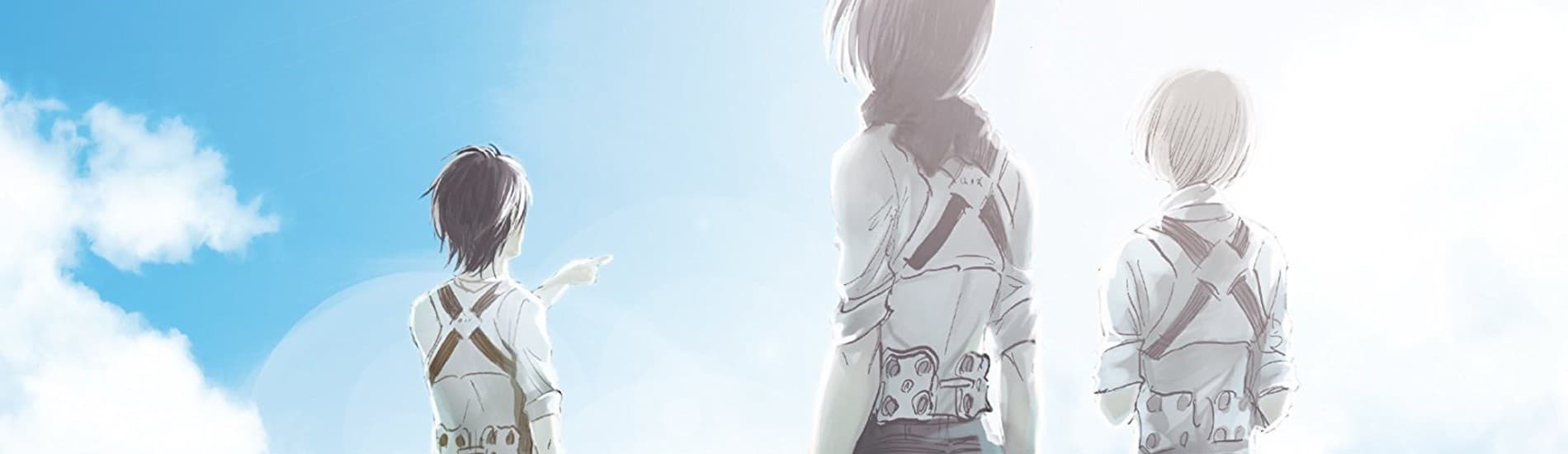
Attack on Titan
a review by Drakmalar
a review by Drakmalar
This is going to be an analysis of Shingeki no Kyojin in its entirety, that is to say: I will talk about both the manga and all the main anime adaptations that have been released to date (and I will probably come back in the future when the series has been completely adapted in its entirety to leave my last opinion on it as a way of giving this review a sense of closure). Ultimately, what I intend to do is give my opinion and perspective on the series as someone who has been a huge fan of it ever since the first season of the anime aired.
I think it goes without saying, but just in case: this review contains spoilers.
I remember watching Shingeki back in 2013 while its first season was airing, it was a gigantic event that many of us were lucky enough to be a part of. Those were episodes full of emotion, energy, sadness, deaths and adrenaline. Of course, at least that's how I experienced it.
Having joined the hype train that was Shingeki so early at the time, I was also one of those who had to wait 4 long years before getting a second season. And I remember both the excitement of watching that first season for the first time as well as spending countless afternoons and evenings after it aired thinking and theorizing about what could happen next. The first season is undoubtedly the one I have watched the most amount of times thanks to this and for that reason I have a lot of affection and appreciation for it, because even though many people criticize it for being perhaps too exaggerated in its style and in the amount of deaths, perhaps too dramatic at times and maybe somewhat weak in terms of substance; I believe that this season cemented some excellent foundations that would later be responsible for giving weight to the events and plot twists that occurred in the following seasons. I love this first season and how already from the very beginning we see important changes in the lives of the protagonists and in their way of seeing the world. And in turn how we as viewers are challenged, inviting us to get into a world full of mysteries that would later become more relevant and important.
It's hard to explain just how exciting it was at the time to ask questions like: "Why can Eren become a titan?", "Who are the armored and the colossal titan?", "Who is the female titan?", "Who is the enemy here, what are these antagonists fighting for? Are they even antagonists?". Even more stupid questions like, "Why is it that the titans have such characteristic faces?". Many of these questions after watching all the seasons to date and reading the manga I'm sure for many (as well as for myself) already seem like stone age stuff, for how long have we had these answers already? I think this is important, as it allows us to reflect on the worth of Shingeki no Kyojin as a work and the incredible journey it took us on over 12 long years.
I have been following this series for 8 years already, since I entered with the hype of the first season back in 2013 as I mentioned before. And this series was an absolute cultural phenomenon of magnitudes that we have seen very few series reach (at least in terms of series coming out of Japan). Even i being Latin American, could talk to people about this series. I had friends who knew it and acquaintances who had heard of it. And this is a great achievement, since in Latin America the most that the average person can get to know about anime is limited to Dragon ball, Pokémon and maybe Naruto. That’s about it for the average person, but Shingeki kind of changed that.
And I know you've probably heard something like this in other places; I remember a video of Gigguk in which he talked about how he had a similar experience although his is much more impressive than mine: since he heard people talking about Shingeki at work, people who may have never heard of anime or even had any interest in the medium, from one day to the next were enjoying this series in the same way we do.
The impact that Shingeki had internationally is undeniable, it has been a phenomenon of titanic proportions (I know I'm hilarious). In December 2019 the manga reached an outstanding 100 million copies sold worldwide, making it one of the best-selling manga of all time. And this figure only refers to the success of the manga itself, imagine how many people must have enjoyed the anime around the world by now.
A series that had a rather cliché but spectacular beginning. I think we can all agree that Shingeki belongs to a very specific group of anime that are ideal to recommend to someone who either wants to enter the medium or if we want them to enter the medium. Something like Death Note, which by the way I feel is a pretty appropriate comparison since I think both works have enjoyed great reach and fame internationally, plus both works have had animated adaptations that were directed by Tetsurou Araki. The man responsible for directing Shingeki from the first season to the second part of the third season, and I think he did a great job on all of them but we'll get to that later.
It was a spectacular adaptation no matter how you look at it, extremely polished and fluid animations that combined 3d in a very clever way to simulate speed in the scenes where the characters used the three-dimensional maneuvering equipment (which is now something we have normalized and something we expect to see in every new season of the anime, those scenes where we see the characters moving in incredible ways through the scenery. But at the time it was something impressive and really unique in my opinion), an incredible soundtrack that kept merging with the animation to give us epic moments that filled us with emotion, and an opening that served practically as an anthem for fans of the series and that to this day we remember with much affection.
The point is that this was a series that reached a mainstream status extremely fast thanks to its quality and epicness, and the weird thing is that they let it sit for 4 long years until the second season arrived. And by the time this season arrived, people were just not as interested as before and many didn't even know what to expect. Even though those first 25 original episodes were very exciting and epic, I doubt anyone would have been interested in seeing another season exactly like that, and that's when they surprised us and started to create this collective idea that we have today of Shingeki no Kyojin as a constant box of surprises.
The series changed, it made a very radical change in which it left the action a little aside to focus more on the tension, the world building and its characters. Characters that had been nothing more than background filler the previous season became main characters, and we began to see something more in this series than incredible animation, epic music and a constant feeling of patriotism towards a fictional nation. We still had action, of course. But I feel that from here on Shingeki gained much more than that, we started to get more and more substance in the form of character development as we were presented with more and more incredible mysteries that we couldn't wait to get the answers to.
And how can we forget the moment when we began to realize that the openings and endings were full of images and symbolisms that we would later return to try to decipher and thus be able to understand the world of the series a little better.
I feel like this was the season where people really started to have fun making theories, and when we all started to get really interested in the world that these characters inhabited and where it could go from here. We were introduced to the idea that inside the walls there were titans, we were also introduced to the beast titan, we were revealed (quite directly and clearly) that Reiner and Bertolt were the armored and the colossal titan, we even started to see hints of the founder's coordinate with eren at the end of that very same season. We met so many characters and were shown so many new things that this no longer seemed like the same series we had experienced 4 long years ago, and I am thankful that the series started to change in this direction otherwise I think shingeki would have died in the explosive popularity of its first season.
I also want to highlight how amazing it is that Shingeki to this day is as relevant as it is. do you guys get what it means that we didn’t had another season for 4 years, and that, when Shingeki came back, it was slowly but surely able to carve out a fame and popularity equal to or even vastly greater than what it originally had? It is extremely difficult to create a work that is able to survive the passage of time in this way while remaining relevant in the process. And Shingeki went even further than that.
We had a third season that was another completely radical change to everything we had had up to this point, with the focus shifting from the titans to the humans. We were involved in a narrative that spoke about the political and social conflicts they faced on the island, and in the process, we learned a lot about the culture and history of the island. As well as getting to know characters like Historia much, much better. Do you remember when we used to know Historia as Krista? Those were some really different times.
And not only Historia, we also had a lot of development for characters like Erwin and Levi, characters that had always been quite interesting and beloved by the community, but we didn't know THAT much about them at the time. And after this season they became or started to become the favorite characters of many (if they weren't before), in addition to the development we had in characters like Eren; A character that we saw break down, cry, doubt everything and become completely unsure of what he was doing. To be brought back to reality right after by a reborn Historia, a brave Historia who was willing to fight for her ideals and her friends. A heroine, and one of my favorite characters in the whole series.
We had 3 seasons that constantly changed their focus and thematic axis, while giving us new pieces of information that completely changed our perception of these characters and the world itself. And the best part is that the quality of the first season was still present, it still looked and sounded just as good. The animations were still some of the bests we had seen and the music accompanied it perfectly.
Of course, not everything is perfect, and nothing ever was. I've seen people complain that some interactions between Eren and Historia that were in the manga for example were not adapted. And the truth is that in that sense maybe certain characters can have a bit more of charisma in the manga thanks to the incredible work that Isayama has done from the very beginning. We're talking about someone very calculating and who never seemed to let anything slip through his fingers. Constantly recontextualizing events from the past and impressing us page after page, I know I've been referring mainly to the anime but everything I've said applies to the manga as well.
I think there's no way to go wrong with Shingeki, regardless of whether you choose the manga or the anime I think you're going to be able to enjoy the work to the fullest and in the same way. Although I do feel that the music, the voice actors, and everything else involved in an adaptation do give new layers of depth to the work that is worth exploring. Although if you want to go in purely for the characters and be able to witness Isayama's skill as a writer, it might be a better idea to go to the manga to get a better idea of how he sees these characters.
Now let’s talk about the pay off and one of the most important narrative points of the show as a whole, the season in which the truth behind the basement is finally revealed to us and the emotions that the answer to this question brought. This season was in my opinion the peak of the series and where everything we had been told and explained so far, either directly or in a more subtle way, started to make sense.
We had one of the best seasons we've had in any series, especially shonen, in recent years. One that gave us great development to virtually every character and opened our eyes to the truths of their world in a way that I can only describe as absolutely incredible. Erwin had a perfect and very satisfying closure to his character arc, Levi as a consequence gained another layer of depth and development, and all in all we had one of the most incredible, sad, exciting and fun arcs. We had fights, deaths, mysteries, we cried, we got emotional, and in the end, we were shown a whole new world that split our heads in two.
Suddenly all those speeches of Reiner talking about the "enemies" started to make sense after the revelations in this season. Suddenly we began to understand who exactly Grisha was, where he came from, what his real goal was. We had access to a whole new world full of information, and through this we were now more than ever able to look back and appreciate Isayama's storytelling genius in all its splendor. And not just his, we were also able to appreciate the almost sickening levels of care and attention to detail that went into all the previous seasons of the anime. We were able to understand many things we saw not only in the episodes themselves but also in the openings and endings, the third ending is literally a grenade of spoilers that were thrown directly at our faces a few years ago and we were completely unable to understand or realize it. The feeling of going back after the basement revelations and being able to appreciate the whole show with a new perspective was one of the nicest and most rewarding feelings I've had watching anime in my entire life. It was the ultimate reward for having followed this series for so many years, Isayama and Wit Studio had made history.
Again, of course not everything is perfect and Shingeki isn't either. For starters in this season we saw a significant drop in quality as far as the colossal titan goes, I understand why they had to use CGI to animate it in this particular arc as the titan was getting smaller and smaller as it progressed due to a narrative reason. And I understand that having to draw a titan of incredible proportions in different perspectives and angles making sure to properly show how it shrinks and how its scale changes compared to for example adjacent structures like houses, while also animating it, is not an easy thing to do. But the colossal titan looked really bad and out of place during this season.
At this point I had already switched to the manga; I was an anime only until I finished the first part of the third season and I was completely unable to bear the excitement and the desire to know what would happen next. That's when I started reading the manga from the beginning, when I really got to see this work in the way that the original author had envisioned. I was able to appreciate the love he had for his characters and the small panels of some characters being charismatic idiots that were not adapted, I was able to see what the original vision of the story had been, and most importantly: I could appreciate Isayama's artistic evolution.
Which I think is extremely important to highlight when talking about this manga and it's something that saddens me now that the manga is over, no one stops to comment on it. This poor man before Shingeki had one hell of a hard time, to the point that he was even made fun of in a contest prior to the serialization of Shingeki, where he submitted a one-shot that supposedly had "the worst drawings ever seen in the history of the contest". It doesn't take a chef to know that a dish tastes bad, or maybe doesn't look the way it should, and it's clear that Isayama's drawings were certainly weak and very lacking in detail at first. But he managed to turn his weakness into a strength, using his drawing style which while not the best helped him in creating the titans as these imposing and genuinely unnerving creatures.
The titans in the manga really provoke emotions of fear and discomfort in the reader, which is perfect since that is exactly the effect these huge, brainless and brutally cruel creatures were meant to cause at the beginning of the manga. I always considered that in terms of architecture Isayama does a very good job, but in terms of anatomy his designs can be a bit stiff. But he didn't give up, he kept working hard and I honestly think he improved tremendously over time. I think it was around chapter 90 or 100 that I started to think: "these drawings look REALLY good", he had a great artistic evolution and he managed to do it without ever leaving behind his characteristic style behind. His style is the same from beginning to end, only much more refined and professional over time, and I think that's worthy of admiration and respect.
I remember when I switched to the manga I read all the chapters that would later be adapted in the second part of the third season like it was nothing, and stopped reading I think around chapter 105-110 as I ran out of chapters and had to start waiting for more while it was serialized. I don't remember exactly around what chapter we were at the time.
What I do remember is the excitement of reading such plot twist, seeing Grisha in Marley, seeing this cruel new world that was clearly a reflection of Nazi Germany during WWII. At the time it was an event that completely blew my mind, it was and is to this day one of the best plot twists I have ever seen in any work of fiction. It had never even crossed my mind that the land our protagonists inhabited could be just a small island, and that their world was just a tiny fraction of the real world. And how these had been completely isolated and were completely ignorant of the workings of external laws and technologies, just like us as viewers/readers.
And I think there is something important to comment on here too: Shingeki does an excellent job in showing us (key word, showing. Not telling us) how their world works, where the food comes from, what kind of food they have, how the society works, even how they are able to move the horses between the walls using elevators. And the skill with which the author introduced us to the world at the beginning of the series is still present in the introduction to Marley.
It should be noted that even though I switched to the manga I continued to watch the anime adaptations as they came out and still enjoyed them. In fact, I always told people that I recommend the anime over the manga because I feel that the adaptations elevate the original work a lot. This recently changed though.
It was announced that Mappa was going to animate the """final season"""" of the anime, which to be completely honest at first I wasn't worried about at all. Even now in retrospect I can say that Mappa did a VERY good job adapting this work and even more if we take into account that apparently the poor workers only had something like 8 months to make these 16 episodes, and unfortunately it shows.
Please, under no circumstances do I want to give the impression that I consider the adaptation to be bad or that I didn't like it, quite the contrary. Anyone who is a friend of mine or close to me could see firsthand how excited I was from beginning to end episode after episode and how I never stopped talking about how much I loved it. But I think it's healthy being able to take a hard look at the things we love and be able to see the flaws without losing our love for the it in the process.
Before going into what I didn't like about Mappa, I want to say something about the harassment I've seen during these past few months online directed towards the director of the last season, animators, Isayama's editor and Isayama himself. NEVER, and I do mean NEVER, there is NEVER any valid reason to harass absolutely anyone and even less people who have worked so hard to bring us a manga and an adaptation with so much passion, love and illusion as Isayama, Mappa and Wit's people before them have done. I find it absolutely disgusting that there are people going for their accounts to insult, annoy, and be very discouraging to people who are just here to give us something nice. People who just want us to have a nice manga or a nice series at the end of the day that maybe entertains us or helps us in our day to day lives. Regardless of how you feel about the adaptation of Mappa, the ending of Shingeki or the Shingeki manga as a whole: you have to show some respect and decency for people who have literally busted their heads for days, months and years to bring us a product that they deem worthy. No one has the right to harass them or tell them absolutely nothing, and honestly these situations make me feel like maybe we don't even deserve this manga and adaptations of such quality at all.
Having cleared that up, I have to say that while I enjoyed the adaptation of Mappa and consider it to be a very good adaptation in itself, this is the first time I prefer a certain arc in the manga over the anime. I liked the adaptation of the first arc in the final season more, I think it was generally very well adapted and spectacular. But the second arc that they adapted, when they return to the island I liked much more in the manga. I think that some musical choices either did not fit very well or were just not really synchronized with the visuals, more like some songs were simply being played on the background independently of the visuals.
And in fact I have to say something that may seem strange to many: I liked the 3d much more than the 2d in some scenes. I consider that in general the 3d of this season was excellent and that some scenes in 2d did look a little weird or static. For example, it often happened that between one cut and another suddenly a character’s design would change a bit. And while it wasn’t an awful difference there were too many instances of this to make me want to mention it here, there was clearly a lack of consistency. But as I said before, remember that Mappa only had 8 months to do all this, so I don't think it's fair to criticize it too much or at the very least, if we are going to do it, we have to take into account the context of this production. But it is indisputable that although we had a very good adaptation in this season, the reality is that Shingeki had always had adaptations that more than being very good, were excellent. And it hurts me a little to think that I may like the manga more than the adaptation in this case, but anyway: Thank you so much Mappa for all your hard work and effort, we should all say it and be grateful for it no matter what.
And since I touched briefly on the subject of designs already, I will use this opportunity to talk about Isayama's genius when it comes to designing characters. I think he did an excellent job with each of the characters and when designing characters that convey their personality through their faces and expressions. And I love the diversity we have in this series, if I'm not mistaken we have an equal or almost equal amount of men and women to begin with and that's something I really like since I'm tired of series where the main characters are men and the female characters only serve to be seen and act like seasonal waifus. This is a series that has no ecchi and does not sexualize its characters in any way, and this is something worthy of admiration and something I would like to see more people commenting on because I consider it necessary to know how to appreciate the worth of being able to have a work that can stand on itself without the need to dehumanize and prostitute its characters. I'm not saying that there can't be sexualized characters in the world of anime and manga, but I feel that many times these characters are implemented in disastrous and senseless ways just to capture the attention of a very specific audience. And I'm glad to see that Isayama really respected his characters from beginning to end and that the studios that adapted his work showed the same amount of respect for his characters.
And I really love the fact that in this work everyone wears the same outfits, there isn’t an outfit for men and another for women. Here everyone is a soldier and everyone dresses the same, no stupid exceptions. And following that line I have to say that the designs of the costumes and clothing worn by the characters look really good and are really memorable and distinct.
I think shingeki has been one of the biggest events we've seen as anime and manga fans in the last decade, and it's not over yet and it's not going to end anytime soon. Since we still have one more season of the anime left and maybe some more who knows. And it pains me to see that after so many years of excellence and excitement people out of nowhere are throwing it all away, calling Shingeki an absolute disappointment, giving it grades of 1/100, and insulting Isayama. I understand that the ending isn't exactly perfect, but are we really going to throw away so many wonderful years, memories and nice moments of the series for a single chapter that we might not have liked at all? That's up to each one of us, of course nobody will ever take away the beautiful moments and memories that Shingeki has given me in the last 8 years and I hope you, reader, won't throw away so many beautiful memories just because you didn't like the ending or the last chapters as much. That's it, Shingeki is over and life goes on. And I wanted to do this review maybe more in a retrospective light to try to remind people why it is that we loved this thing in the first place and why I think right now people are being extremely unfair to the manga and the mangaka of the work. Isayama worked for 12 long years, the guy deserves a decent rest after creating such an amazing narrative. And we have to respect that and learn to enjoy entertainment without getting carried away, if you don't like Shingeki or its last chapter, I think that’s cool. But let's not go to extremes. We can have civil discussions and analysis about why some maybe didn’t like something, but let’s do it while being fair and not forgetting the achievements of Shingeki up to this point.
For me personally, the final chapter and the penultimate chapter honestly made me feel a bit conflicted. While in general I do like the ending, there are a bunch of small details that make me… unsure about how I should feel. In particular the line where Armin tells Eren: "Thank you for becoming a mass murderer for our sake. I'm not going to let this transgression go to waste". My problem with this line is that up to this point, Shingeki to me had been a work that talked about the dangers of war and extreme ideologies. And I feel like in a way Armin is justifying the mass genocide that occurred in the series by the rumble and wiped out 80% of the world's population just because Eren is his friend and "he did it for their sake". Which honestly doesn't sit well with me, and I'm surprised that out of everything I've seen people complain about the final chapter this is the least talked about topic. And It makes me sad, as I think that's the biggest flaw the chapter has. Because depending on how we interpret the dialogue Armin may be sending everything I thought was Shingeki's anti-war message to shit.
In this narrative, Eren is a twisted sociopath who seeks blood and hatred and listens to absolutely no one, he does what he wants as he wants impulsively. Establishing an authoritarian regime, staging a coup d'etat that puts him in the most advantageous position and allows him to be on his way to annihilate the entire world. Racism and segregation are one of the main themes of the manga. In a more subtle way at first, with these humans being cornered and having to live in walls where they have to protect themselves from themselves (we learn this after the revelation that the titans are actually residents of Paradise Island who were injected with cerebrospinal fluid. Those who live in the walls are the descendants of Ymir, who are feared and segregated because of their connections to this long-forgotten girl. Who only survives in the form of twisted legends that have little or no factual information. And then there are the Marleyans who are the ones who segregate ymir descendants out of fear. This is when racism ceases to be a subtle theme in the form of walls and begins to be a prominent theme in the story that ultimately ties into the message of the series that to create a properly functioning society it is necessary to get rid of hatred, and that hatred and segregation ultimately end in destruction and death.
The problem is that I don't know whether or not Armin is exactly justifying mass genocide, and if he is I think this may throw out the window everything I thought was the message of the narrative so far. I'd like to read the exact dialogue in Japanese and see exactly what Isayama meant and if the translation is correct. But I think I should think of this dialogue as Armin rather sickeningly trying to give some last words of comfort to someone as important to him as Eren, while not forgetting the magnitude of the disgusting crime that Eren committed (after all I think we can indeed say that Armin is aware of the horrible offenses Eren committed against humanity. It's just that in that particular dialogue he seems to be justifying it). I mean, it wouldn't be the first time we see characters in Shingeki being there to support others who are special to them despite these being despicable individuals. Ymir was supposedly still in love with Karl Fritz despite all the horrible things he did to her... which I don't know how much I like either, but I'm not going to let a single chapter throw away so many years and chapters of enjoyment. What's 1 chapter versus 138, and despite all of that, the last chapter also had things I liked. Like Levi's farewell and being able to see the surviving cast alive, I'm glad to see someone who suffered as much as Reiner is alive at the end of the show.
Thank you for everything, Isayama, Wit Studio, and Mappa.
98 out of 113 users liked this review
