#Feel no shame about shape
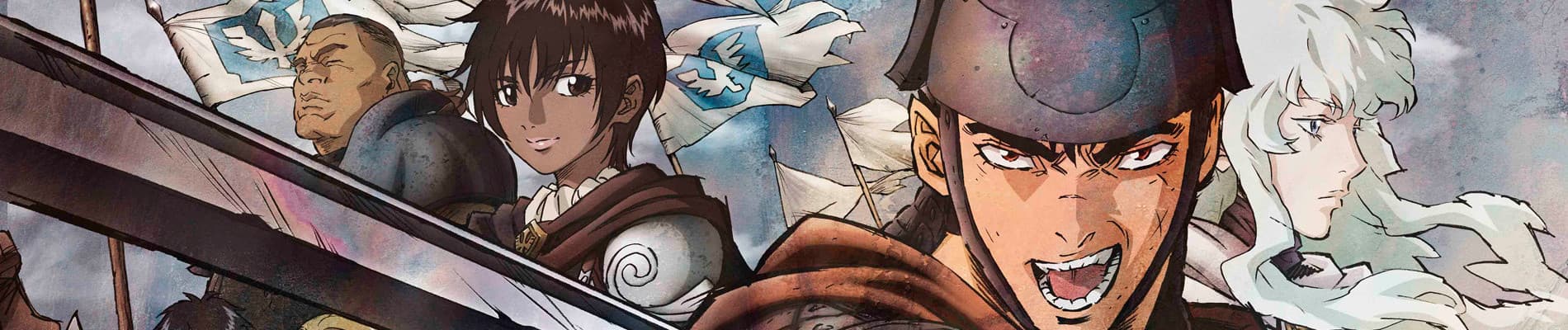
Guts is a wandering mercenary with a big ass sword. Like, the thing is more ridiculous than the Buster Blade. He eventually comes under the employ of Griffith, a charismatic tactical genius who leads a much feared mercenary company: The Band of the Hawk. However, Griffith is revealed to have much larger ambitions.


At first glance, both Guts and Griffith seem pretty straightforward. Guts appears to be a mean, mysterious, buff dude who happens to be an OP swordsman. Griffith appears to be a charming bishounen with a knack for strategy.
They, of course, are these things. And yet, they’re so much more.
Guts’ troubled past had led him to be proficient at a single thing: swinging his big ass sword. He embraces this, but it concurrently traps him. War is, and has been, his entire life. It is something he continuously strives to excel at; otherwise the purpose of his existence is effectively moot. Yet, as the dynamic of the world ceaselessly changes around him, he wonders if he still has a place. To complicate things further, Guts begins to reconsider whether he’s really satisfied serving as someone else’s tool – someone else’s sword.
Griffith is ambitious. His ambition drives his very being, rendering him the charismatic, shrewd and relentlessly determined individual that he is. This very same ambition makes him narcissistic, arrogant and obsessive. His followers are not so much his friends as they are his tools. Servants destined only to satisfy his insatiable desire.
The point is that these guys are surprisingly complex. Although they may look fairly stock standard, they prove to be pleasantly nuanced and compelling. What is even more compelling and is without a doubt the highlight of the show, is their relationship. The paradigm is constantly shifting and you’re never really sure if they’re friends, rivals or something else entirely. The two are like Joker and Batman, Bonnie and Clyde or Luke and Vader. They complete each other and expose all the intricacies of each other’s personalities and thoughts. They both complement and undermine each other. And I love it. It’s mind boggling and ceaselessly engaging.
The rest of the Band of the Hawk are pretty one-dimensional, but fun enough. The central female character, Casca, receives more attention. However, her romantic flip-flopping is a bit trite, especially for a character as ostensibly strong and stubborn as she was. It was a little disappointing to see the fearsome, independent female lead be somewhat reduced in this way.
Everyone else, especially the numerous villains, are typical fantasy fanfare. They can be very cliché and often verge on the point of caricature. With one exception, it’s very obvious that none of them are real threats and thus you can’t take them seriously. It’s more of a matter of how Guts and Griffith will eventually, but inevitably, overcome them. What many of these tertiary characters do contribute, however, is the 'comedy' part of tragicomedy. There are some genuinely funny gags, my favourite of which is the Shakespearean tendency to cut to a couple of enemy of grunts mid-battle to listen in on their conversation.
#So put your grasses on
From a technical standpoint Berserk is questionable. It had a 3am airtime – in 1997 – and it frequently shows its age and budget limitations. There are countless freeze frames and highlights which can make the action sequences especially underwhelming. It also doesn’t really help that anything and everything Guts swings his sword at, man or metal, gets bisected.


The art, especially the character designs, are somewhat dated and at worst can be a little cheesy (particularly in regards to the demons). That said, everyone that matters is pretty classy and well-designed and Griffith looks like a total BAMF.
Visually, what Berserk excels at is establishing atmosphere. Grit. Everything is coarse and unpolished, but this pays dividends in portraying the series as exactly how it is: grim, rough and unsettling. Background watercolours are particularly good in this sense. All the set pieces, although unclean, are eerie, haunting and practically scream dark fantasy.


Usually, the music complements this. Most tracks aren’t exactly memorable, save for the likes of ‘Forces’. Susumu Hirasawa uses these weird electronic tracks that are so stereotypically 90s but actually do a great job in creating an unnerving and unsettling vibe. The OP and ED are contentious, where many argue they do not fit the series. I’m not exactly sure if the cheesy visuals and bad engrish in the OP had their intended effect, but the thing is catchy and it sure as hell grows on you (maybe for the wrong reasons).
#Nothing will be wrong
Structurally, the story is bookended. The first episode is set after the events of the series and so is pretty much a massive spoiler. This can be problematic: you know the ultimate outcome of the story, including the major plot-twist, which inevitably removes a substantial amount of the shock-value and impact. The stakes simply aren’t as high and you may find yourself getting impatient as to find out how it all goes down. I guess the journey is supposed to be what matters, but it just doesn’t have the same effect it probably should have.
In a similar vein, and partially because of the story’s circular layout, the ending feels slightly unfulfilling. There is very little foreshadowing and without spoiling anything, there is a very sudden focal transition from a more political, character orientated, low fantasy story to that where more typical high fantasy elements, and I suppose what is the central theme, seize centre stage. It’s not as shocking as it should’ve been because, thanks to episode one, we know how it’ll ultimately turn out.
This somewhat ties into the whole fate/pre-determination/causality theme that the series kinda tackles? It isn't handled with particular grace, nor is it ever really that compelling until the final act despite the ominous reminder at the beginning of every episode with the God Hand sequence. I wasn’t sure if the show was reminding us that this was supposed to be a thing as much as it was reminding itself.

But, the biggest problem with the ending is more of a testament to the show than it is a criticism. It abruptly ends and just when things are getting really interesting. YOU WANT MORE. The manga is still running, whilst this version only adapts the Golden Age arc. There’s so much unfinished business and we’re left right in the thick of things.
#Too late, it's too late
Berserk is dark, grim and brooding. This is tragedy - and perhaps tragicomedy - at some of its most compelling, with an amazing main duo who have an even more incredible dynamic. The technical aspects and structural choices can be a bit lacking, but ultimately it engrosses and entertains. In the end, the most unfortunate thing about this series is that it leaves you wanting more.
Was the twenty year wait worth it? Probably not, especially given the result.

Regardless, Berserk is a cult classic for a reason. It’s iconic and a damn fun anime.
25 out of 30 users liked this review
