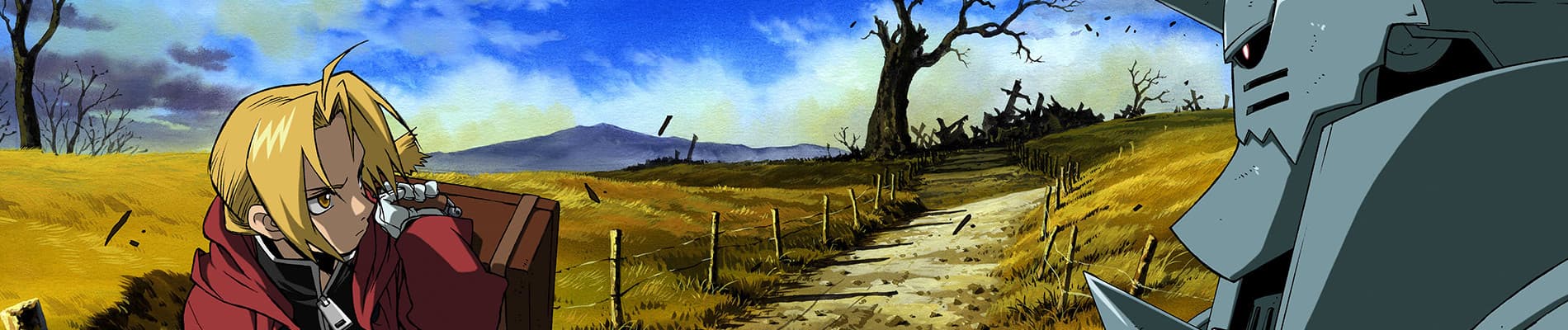
If there's one thing that I can be certain on, it's that Fullmetal Alchemist 2003 still remains a staple of anime classics. As someone who grew up with this version despite preferring Brotherhood, give 2003 a chance and don't overlook its strong sense of character building and atmospheric tension.
This one's a little difficult to come to terms with because after Brotherhood I had originally written off the 2003 series even though I spent years of my youth fawning over this version's greatness before Brotherhood's announcement. Now here I am re-exploring the show and becoming reacquainted with its style and direction only to realize just how well this version stands up. Fullmetal Alchemist is faithful as it can get for a majority of the first little bit, but it does take some big liberties on extending on some seemingly menial plot points. We spend about two episodes in Liore, which is a far cry from the condensed one chapter/one episode version of the same story. Although it might "drag out", it hardly ever feels like that and instead it naturally introduces story tidbits to serve the greater plot. The same goes for a lot of other points from the original manga. Small character moments within FMA are rather abundant, and rather than focusing on the big overarching plot like in Brotherhood it makes the little moments count. There's so much they flesh out and build lots of depth to characters that might not have had the same in the original story, giving shining moments to people who might've not got a chance to. Because of this approach the series barely resembles its shonen routes and its especially true with its lack of shouty "chibi" humour. In fact a lot of the humour is less loud and "anime", but it still is there and it made me laugh a little more than most of Brotherhoods stuff that tried too hard to be manga. The Edward Elric short jokes still get played up a little too much even if the seriousness is balanced better. I might even consider this version targeted towards the Seinen crowd because it just lacks the adventurous nature of one. The seriousness that makes itself apparent is really welcomed, while at the same time having enough light-hearted moments to keep younger audiences interested. It knows when to have its silly moments and keep its serious ones The bigest surprise to me was seeing this as an adult and realizing just how dark the show got.
The series can be downright depressing and barely hopeful and most of the time the more nuanced themes were lost on me as a young kid. I will say that 2003 is not better, it's just chooses to focus on different subject matter, and it's ever present in its soundtrack and directional choices. Looking back I'm almost surprised the show managed to hook me on its slower story, and now I realize just how well thought out some of creative choices were. There's an overbearing brooding atmosphere that makes itself present in the first episode, and it truly is a macabre presentation of how the Elric brothers lost their bodies amongst many other horrific events that happen. These types of moments appear quite frequently, and it walks a fine line between being dark and being edgy for the sake of it. I completely forgot that it was implied that Rose was raped by soldiers and becomes a mute. At the time I didn't really know and now I realize how unnecessary it felt besides making the story dark for the sake of it. For the most part though, it vastly builds upon the story really improves stuff that might've been glossed over quickly. Even some of the camera angles and setups just leave enough to the imagination before "the big reveal" and those kinds of moments happen frequently even in its comedy. The build up to hard-hitting moments is done exceptionally well, and it's all due to a lot of the slow-moving segments that we're both nostalgic and relaxing. FMA 2003 uses its downtime to its advantage in order to build up deaths even moreso.
I will admit, (most, not all) the filler is really well done and does some fantastic worldbuilding. That said, most of the time it just seems distracting from Ed and Al's overall journey without adding anything to the quest to find the philosophers stone; most of them boiling down to pointless side-adventures where brothers are almost in reach of the Philosophers stone only for it to be a fake of some kind. The 4th episode I'm split on because it happens so early, but the one about the Thief and the Lupin III Zenigata clone got a laugh out of me back then, and again on my rewatch because I kind of forgot about it (people dislike it, personally I found it fun). A lot of the filler was hit or miss, but most served their purposes a "anime canon" for worldbuilding. I've complained about how fast the pacing over Brotherhood was in its first 13 episodes, but if we were to actually compare the two they actually line up pretty closely and they only really "pad" and stretch the original story beats. Upon the rewatch it actually made me realize how little the 2003 series had originally so they had to weave in random side stories until it was time to adapt "manga canon". The fake Elrics are actually a welcome addition even if it seems out of left field to add them into the story as contributors at all. The Tringham brother's added some depth to the story and I wish their characters were explored more because they seem so underutilized. Sure Brotherhood is adapted with less natural finesse, but it had plenty of ways to interweave every little thing. 2003 is about the same but manages to stretch out progression and does so it in a way that gradually builds up progression, and it's very apparent for the "manga canon" parts.
We haven't even got to the latter half in which the anime surpasses the anime point which is a completely different chimera altogether. I'm of the opinion that I enjoyed what they did because they planted some of the seed earlier to make the switch seamless. They did a fantastic job on just making story extensions where it was necessary and even did an adequate job at linking certain points. The series is so vastly different, and it doesn't take long to get a feel for how that is. In fact some episodes almost feel like one-shot stories set within the universe, and seemingly gives me an extra mile of plot to run with. It's super engaging because right off the bat it takes meticulous care to build up its background cast alongside the main groups. I still enjoy where it diverges however there were many points at which the story was a slog that made me wonder how the show even got to that point (see the entirety of Wrath's arc and character).
So with all said it isn't all perfect as some might claim. It's not "the masterpiece" that I would've considered it before Brotherhood existed, and I would say a lot of the acclaim feels like it just comes from how pretentious 2003's storytelling can get. Fullmetal Alchemist 2003 does a lot right, but it seemingly undermines some important plot elements that make the actual storyline flow. In fact there are so many moments they are in reach of, only to completely reject it for plots-sake. On top of this, important characters become less of a focus in the major story, and get sidelined in favour of anime-canon ones or completely reversing ones relevance as with Rose amongst many others. Barry the Chopper's kidnapping episode is cool because it's terrifying. Then when we get to Barry's Lab 5 appearance it completely dissolves his intimidating character as it sticks to the goofy manga personality equivalent. If Barry wasn't committed to a comedic role like in Brotherhood, then sure it would've worked. In the 2003 show it just seems so tonally off for Barry to be an actual threat and to see his role be mainly comedic only for him to switch back to be a bad guy. There are a lot of characters who get super underwhelming deaths, and this mainly happens for the manga-specific characters. Sure we get plenty of time spent on Hughes, and yet I'm still finding criticisms for the cast. Characters like Riza don't get much to shine, and to be honest neither does Winry. I appreciate the dynamic between Sheska and Winry because it's something that really isn't seen in the original material, but it came at the expense at making these characters a catalyst for the plot, and relegated them to side events. There were also odd plot points like State Alchemists' pocket watches being able to amplify alchemy; I still don't really get this at all, and Envy being the first son of Hoenheim; which felt like a last minute story point with no real build up at all.
So how about those anime original characters? Frank Archer I thought was "cool" as a kid but he just seems like a knockoff Kimblee who also happens to exist in this series but with barely any real staying power. Like really was there any point in shoving Kimblee aside for Archer? It's a cool concept by branching the two but they don't really do much with either in the grander plot. Kimblee remains fairly static as a character and Archer barely does anything memorable. Shou Tucker's return was ok for me originally and didn't really pose much of an issue in my first viewing, but I have so many problems now upon my rewatch. Seeing Tucker be this constant presence in the show trying to bring back Nina back just ruins the original moment for me. Tucker was already a monster of a character, and it doesn't make sense for him to try to redeem himself in any way regardless of how sad and pathetic he's become. Tucker's whispering got old pretty fast, and just became an annoyance more than anything, and I just really don't like the fact that he kept living only for him to mess things up again for the Elrics ; tricking Alphonse into using his Philosophers stone was face-palm inducing. Roy can come off as a smug prick despite his more lighter side that we see here and there, it somewhat works within his personality and backstory. In other cases, Roy can just be difficult to like. The same kind of hard-ass attitude exists with a lot of the main cast and it almost makes everyone constantly in unnecessary angst across the board like Izumi or even Alphonse at a point. Scar gets an interesting background story extension, and to be honest his death did feel earned here because they built him up really well. Hoenheim has no real relevance and his existence kind of fades out of relevance without doing anything vital in the story besides being a deadbeat dad. Hoenheim is just so scummy that it's no wonder Ed hates him, and I'm surprised he warmed up to him as much as he did by the end. Kimblee was so much more psychotic and fascinating but he got pushed aside for Frank Archer so that's a moot point. I could go on and on especially about Wrath and 2003-original characters but it's mainly up to opinion. A lot of the homunculus's back story is well done, and then some don't get really stories at all. There are great story moments birthed from 2003, and yet it just doesn't feel cohesive. On top of this a lot of homunculus's get undermined by changing the reason for their existence, especially when it comes to Dante; an antagonist whom I couldn't care less about. Before getting to experience the original storyline in Brotherhood, I was kind of behind the idea of having Homunculus's be failed human transmutations. It was a really interesting way of giving the Homunculus's backstories. However, it just doesn't work thematically because their names barely serve any symbolic purpose with Dante, and we don't really know why they're all named after the seven deadly sins. On top of this not all the Homunculus's get extensive backstories like Lust. Many other Homonculses barely get anything at all. Gluttony I can maybe understand, but Pride? Greed? Even Envy? In fact Envy being Hoenheim's son being a plot twist was introduced so late into the show that it felt out of nowhere. Then people like Wrath and Sloth already kind of have backstories through their characters which just don't have the same kind of interest for me since they have ties to familiar characters. There are so many online discussions that talk about how much more interesting the Homonculuses are here, and yet the only ones with a fresh backstory is Lust.
The seriousness of the plot was generally great, but a lot of moments were followed by some sad piano track and made into a melodramatic spectacle. It delves into heavy soap-opera territory and it can sometimes feel forced and contrived. It works to serve the smaller plots that are interwove with the grand one, however once you look at it from a distance it really kind of falls apart and seems rather aimless. Like equivalent exchange, FMA does the exact same in its choice to be expressive. Sure we got better character pieces and emotion, but it came at the cost of a cohesive story that knows exactly where and when it needs to be. 2003 is done really well since it's episodic with one-off tales that serve the characters, and that's ok too. Be aware it really never serves the overall story for the most part and instead feels more like an adventure than a specific journey. The overbearing drama was actually rather exhausting because it never took a chance to breathe, kick back, or just giving the viewer a chance to hype themselves up to watch the next episode.
The heavy focus on drama was arguably it's biggest strength and weakness that is more personal taste than anything. It was surprise I loved the show as much as I did, but at least know I can identify what I liked and what I didn't now and it's got a lot to do with how dreadful it can be to sit through at times. There's plenty of drop-off points where I stopped really caring despite my heavier investment in the characters, and was just along for the ride. Although both series' soundtracks are excellent at what they do for their respective series, the story though leaves a lot to be desired here. In all honesty the episodes leading up to the finale are a mixed bag, some are decent (the coup to fight back was fairly similar to the manga's, although not as epic), some have great plot points (the underground city was always a cool concept and so was the idea of the real world being a parallel universe), and some plots get resolved too quickly without much breathing room (Alphonse protecting Sloth because she used to be their mother was another instance of forced drama, and Sloth's death just happens without any real fanfare). To be fair, the whole idea of the underground city would be a lot more effective if it was foreshadowed or hinted early, and that kind of comes out of nowhere after the manga plot finishes up. I still like the idea of the city, I just never found that there was any groundwork for it to connect the story to the beginning (like a lot of story beats in Brotherhood do). Did I also mention the Elric brothers had so many chances to use the Philosopher stone but didn't because there was always forced drama in the way of it. Oh yeah one other thing. WHY THE HELL DID ARCHER COME BACK?. Archer's literal return felt phony and his 2nd death was more underwhelming than his first and then he just dies from a few bullets. Most of all it just felt like there was huge gaping hole where certain characters form the manga should've been and complete reversals of characters who never originally served the grander plot. I will still argue Brotherhood is just the complete package of satisfaction and balancing an extensive cast mainly because of its stronger source material that it can draw from. Admittedly 2003's ending I've come to like with Edward ending up in the real world, even though so many plot threads seemingly go unresolved with no huge payoff.
In the end though Fullmetal Alchemist is really well done, though my criticisms really come to light in the fact that it's a show that wallows in its drama and doesn't explore the depths of its plot. As an adult, the messages were a lot more clear to me and it still hooked me on its moments that took the characters under a magnifying glass and deconstructed them. I just find it extremely hard to say that I actually had "fun" with its story because it can be self-deprecating and pointless. There are moments of hope but they're so few and far between. There was plenty of enjoyment most of it was revisiting nostalgic moments, and then there are really weak story beats that happen later on that leave a sour taste in my mouth. It's ironic because as a kid the show was enthralling and deep, and now it just seems exhausting and inconsequential. It's not the all-time favourite I used to consider it and I'd be hard pressed to feel the need to rewatch it anytime soon because it seems so heavy handed. It's a show with its intro themes tied to my nostalgia, and a story that extends the limited stories of basic characters. Fullmetal Alchemist is something that needs to be experienced regardless of its many flaws because it brings a lot of interesting perspectives for newcomers and fans of Brotherhood alike.
36 out of 37 users liked this review