
“But these words people threw around - humans, monsters, heroes, villains - to Victor it was all just a matter of semantics. Someone could call themselves a hero and still walk around killing dozens. Someone else could be labeled a villain for trying to stop them. Plenty of humans were monstrous, and plenty of monsters knew how to play at being human.”― V.E. Schwab, Vicious
Metaphysical Brilliance. Naoki Urasawa’s Monster is antediluvian, regardless of its story taking place in a modernized society. The crux of its sublime themes are heavily influenced by old-fashioned ideas and beliefs encompassing two different ideologies about human nature. Contradicting philosophies between Tenma and Johan, where one believes in the dignity of humanity while the other has no inkling of faith for it whatsoever, seem to date back to older classical literature, which may leave criticism in its lack of creativity or singularity. Though, the way these themes are being addressed are tremendously solitary and eccentric. Monster's narrative emerges deep into character study as evidence of its messages via intricately depicting the hidden immorality within man, no matter the individual’s position on the moral spectrum.
As an adaptation in the crime/thriller premise, multiple episodes showcase ranging character identities that all hold substantial importance in making things work towards Monster’s favor. These characters all have meaningful montages of self-reflection through constant questioning of his or her identities, but more so towards the existence of Johan Liebert. As an insignia of nihilism, Johan’s philosophy concerning the value of human life is an expressive, yet nefarious method of innumerable components. Methods of what being a monster is truly like. Of the truthful motivation of “wanting to prove a point” to the people who completely oppose his beliefs. Of staying committed to his ideals until the end.
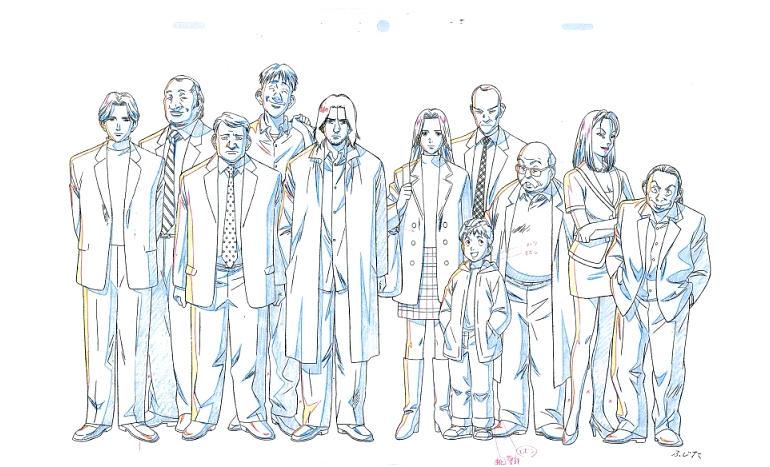
Character identities are handled with care where each of their philosophies, ideologies, and perspectives are all under the same subscription, resulting in equalized, balanced character writing, distinctive personality traits, and avoidance in overshadowing character archetypes over one another. That’s why characters like Wolfgang Grimmer and Inspector Lunge become much more appealing than a cast-away side character. Even Eva Heinemann becomes a candidate of redemption and development, despite how she’s written to be, that of her unlikability from her initial introduction.
While Monster is undoubtedly persistent in its constant display of reality-driven conceptualizations in humanity’s shortcomings similar to corruption and “evilness”, which may end in cheesy outcomes, the characters and groundwork easily add nuance and essence to these concepts, creating colorized opportunities for dramatization and effective psychological horror for the viewer to reflect upon. The experiments of 511 Kinderheim, the symbolic tale of a Nameless Monster, and the mysteries of the “Red Rose Mansion” are avant-garde in Monster’s success.
The sociological examinations connecting to human nature itself are thoroughly handled, not only that, but the in-depth psychological character study within Monster’s themes are both deceptively complexive and simplistic in telling a normal tale about society. The reason why Monster’s way of tackling human identity is brilliantly fascinating is mostly due to mixing in present-day society problems with historical events that have caused an unsolved dividend within humanity itself that still manages to stay popularized within politics and philosophy through the 21st century. Monster’s rational overarching narrative isn’t bound by two or more themes, rather a vast composition of motifs in the embodiment of character archetypes.
Johan represents nihilism. Tenma champions over morality. Eva takes the journey of redemption. Wolfgang Grimmer characterizes the human spirit. Lunge brings out the luminosity of curiosity, obsession, and genuine strength to unrealized standards. Nina embodies a struggle for acceptance with past dilemmas. In other words, Monster seems to be a complex research on human psychology, which is true, but if you manage to look under its compounded narrative, it’s a tale about humanizing. In general, the production isn’t overly ambitious in exploring a thematic view, but stays unwaveringly congruous all throughout.
I would be lying if I said Monster doesn’t suffer from pacing issues and minor confusions in context and logic as there are noticeable plot convenience as nanoscopic it may be, but if the viewer can appreciate and squeeze just a tad more dedication in Monster’s analytic scheming and stoical approach to mystery, then the outcomes will be colossally rewarding.
Production wise, it takes advantage of everything it’s privileged with. In the opening, the sequence follows a sinister key-signature that accompanies a mystifying opera, signaling the start of an ominous atmosphere before the episode begins. The in-tempo drums create a rhythmic, yet dramatic beat as a way of adding a catchy-feel to create intensity and engagement. The entire orchestration itself feels believably dramatic, yet poignantly melancholic, which is such an effective way of transitioning. Madhouse’s ghastly color palette with darkened shades, dull tinges, and boldless tones vastly contribute to the show’s menacing mood, but can quietly shift into warm, bright colors when the time is appropriate. Facial expressions are given immense priority. Quality detailing in presenting how characters react and respond is a subtle, yet another effective, indispensable weapon. The adaptation excels both cinematically and in overall directing.
Monster isn’t driven by pretentious drama nor is it influenced by over-the-top action scenarios. Instead, it patiently lays out a methodical puzzle for the viewer to participate in which by the end of its mind-bending analysis, where once every piece is attached, is when its symbolisms, characterizing, philosophies, and universal themes firmly cement their value. Ultimately, Monster depends on toning and atmosphere to keep things engaging. Sure, there aren't any signs of the requested “satisfying” closure many were hoping for, but was Monster’s humanized story meant to have one from the beginning? Personally, the final episode is evidence of a validated testimony staying truthfully consistent to its themes until the inevitable end, that of the grim, yet humanistic tale that Monster is.
Unsurprisingly, the elegant correspondence between Tenma and Johan is what makes Monster thrive in its narrative. A neurosurgeon continuously falls into unavoidable conflict, each segment vigorously testing the weight in his moralistic ideals prompted by an antagonist striving to make his chosen ideals evidently candid to humanity by demolishing another adversary. Each decision and action comes with a consequence. And with each newborn consequence, comes a change in self-identity. Physical appearances, names, social status, and many more become part of Monster’s themes as a way of conveying the nature of human identity. And because of this, society tends to discriminate and assort people by value and worth. Monster demonstrates the unfathomable importance of identity, because of society’s constant desire for gaining individuality and growth. But since most of society influences fair-minded impartiality and egalitarianism upon itself, things become hypocritical because of how identities are recognized as. And at this point, is when Johan becomes arguably the pinnacle of antagonistic writing through his philosophy, “the only thing humans are equal in is death.”
Discrimination is not only a sign of society’s shortcomings, but Monster proves a point that the concept itself is unfortunately fated to prevail, fundamentally an unfortunate, unpreventable destination. But since Naoki Urasawa’s acclaimed work isn’t entirely a tale with depressive, dark themes, the adaptation powerfully declares that humanity’s imperfections aren't made for the worse of life itself. Since Monster isn’t entirely about a psychological battle of philosophies between two distinct characters, the tale manages to tie up loose ends brilliantly, fully presenting the unexpected beauty of life through them, as affirmation of their value, both in independence and contribution to story direction. Monster implies that identities are simply fascinating. It manages to bring out the ‘Monster’ within, even among the brightest saints and glorified souls. It causes the unexpected to occur. It floods human life with diversity. It’s how we distinguish ourselves, both individually and collectively. It displays corruption and morality unlike any other. But altogether... it's a proclamation on how valuable life is.
162 out of 166 users liked this review
