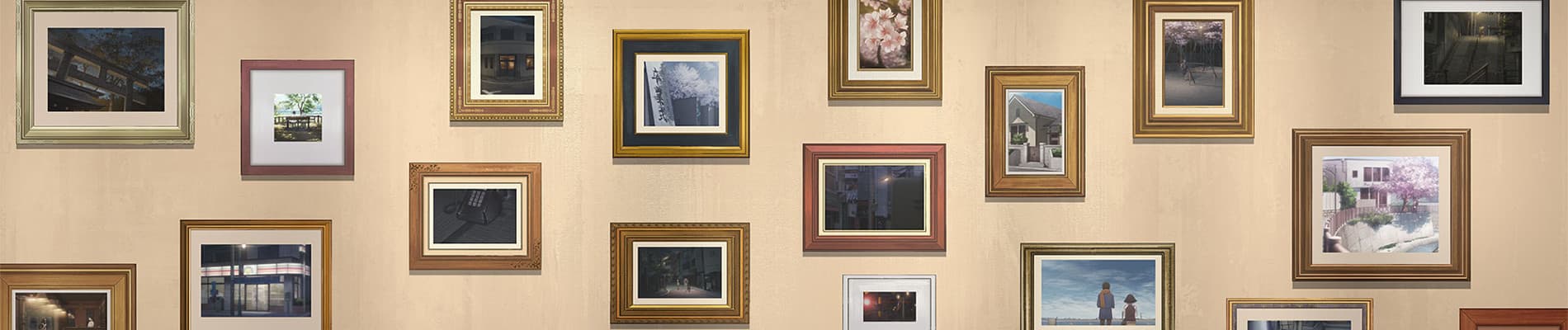
It has never happened to you to be ordering your things or cleaning your room and to find an old photo, perhaps a family photo or a special memory with your friends, and feel that nostalgia for having experienced something that seems that you’ve lived it yesterday and that you even remember the movements before the photograph was taken, but that brings an insufferable melancholy with it that reminds you that this photo, like others, can never be perfectly replicated?
That is the feeling that Yesterday wo Utatte gave me after having watched it (and read the manga) and reflected a little on it.
Having started publication in 1997, the manga underwent many cultural and temporal changes until its conclusion almost 18 years later in 2015. This doesn't mean much to me, but I can imagine the nostalgia that someone a little older than me must feel if they read this today, probably through their smartphone or their PC with their 32-inch monitor, when on the story that is presented to us the characters are trapped in a world in which cell phones were only a novelty. Or just imagine the people who started reading the manga from the beginning. Or even simpler, imagine those people who were following the manga with each publication, who reached 2020 and found an animated adaptation of it.
During the series, one of the topics on which the story focuses is loneliness.
It is something that many people try to avoid. But as ironic as it may sound, the more you try to avoid the more alone you feel. And it is no exception for the characters. Each and everyone shows their most honest side when they are alone, because they have time to organize their thoughts, they do not have to worry about the people around them and because loneliness always brings out the raw in oneself. But the question is not whether or not they feel lonely, the question is why.
To answer this we have to separate the four protagonists into two groups.
On one hand, Rou and Haru, two students (ex-student in Haru's case) who don't have a very close connection with their families and don't have friends either. Both are misunderstood by others. Or at least that's what they feel.
Haru and Rou feel lonely because they are dedicated to chasing the future. More precisely, they seek to ensure that the love they feel towards Rikuo and Shinako respectively is reciprocated. That actually, that's not the real motive, but it's the way they try. And the even bigger problem is the people they try to conquer.
Rikuo and Shinako, whose lives are not very happy to say the least, are victims of loneliness, and the main reason for this is because they are both chained to the past. Both seek refuge in the memories they store in their minds, mystifying them to the point of assuming that they will not get a better situation than the one they lived in those special moments.
The plot of Sing Yesterday For Me could be summed up as "the person I like doesn't like me back." The characters are on a constant push and pull of emotions between one another, directly or indirectly affecting others.
However, despite the above mentioned and the "war" that both female protagonists fought, the end of the story is considered by many (practically everyone) a disappointment. And they rightly think so; Even if you have been on the side of the winner of that "war", the ending was happy, but it didn’t feel truly satisfying or deserved.
This is mainly because the manga put more work into developing the relationships and the characters themselves. Just so you understand, the manga has about 112 chapters and some extras, in which the development of the characters is enormous. Despite this, the anime resolved to summarize those 112 chapters into 12 episodes. There were moments in the anime that you straight jumped from one scene to another, but you could tell that time passed between them. And with time passed I mean A LOT OF TIME passed. Some characters were left out of the story and as you can imagine, many, too many scenes were skipped, which may not be very impressive, but together they make up that characteristic feature that I praise, and that in the anime is not even remotely equal.
First of all, I want to say that neither the anime nor the manga it was based on are made for everyone.
The thing with Yesterday wo Utatte is that although I don’t identify with the characters, it managed to caught my attention, making me empathize with them so much, to the point of wanting to punch the wall out of frustration and anger generated by the actions of some characters (EHEM EHEM UOZUMI AND SHINAKO EHEM EHEM)
But everything has a reason, I think: From my point of view, Yesterday wo Utatte is not about characters that form a relationship and the progression they achieve throughout the series. It is about a struggle with oneself, how we are clinging to the past, to yesterday, and how we fight this battle in order to unleash what keeps us stuck in an infinite cycle. It's about how the characters come to understand themselves and what they really want.
This can be perfectly explained with the case of Rikuo; a boy who has just started adult life and is already completely resigned. He did absolutely nothing for his future, subsisting on a part-time job, putting aside his hobbies, unable to look forward. The way Rikuo is trapped in his day-to-day life is the same as how a bird is trapped inside a cage, suppressed and unmotivated. That is why he feels the need to feed the crows outside the store where he works. This is how he meets Haru, the "owner" of one of those crows. With her eccentricity, her pure and crude frankness, and her peculiar mysterious aura, she represents everything Rikuo fears: freedom, the future, and the unknown.
Haru is basically a reality check for Rikuo from living in the present. But of course, the way she presents herself to him causes Rikuo to remain defensive.
Soon after, his college crush, Shinako, appears in town again.
As 99% of the people who watched this anime or read the manga can tell, when this happened, what Rikuo had to do was leave the convenience store and run. Or more symbolically speaking, he had to leave behind what he felt for her, because clearly, Shinako appearing again was the representation of the past coming back to hunt him down. It's not that she’s just a reminder of his regrets, but that she herself is trapped in the past.
But more importantly, it's the difference between the two: While Rikuo is undecided which way to go from now on, Shinako doesn't even bother to walk. As much as she says that she wants to move forward, she remains still, because she really doesn’t want to. She prefers to play it safe, not changing anything and keeping the relationships she has as they are, not caring how others may feel about it. In this regard, we are shown even more differences between Shinako and Haru. While the first is reluctant to move forward, conforming to what she already knows without taking risks and keeping everything as she was and will be, the confidence and determination that Haru represents completely polarizes her. Haru follows the wind and is not limited in anything until she finds a reason or motive to stop her going.
We could say that she’s the most proactive character in the story, alongside Rou. However, both characters also differ a lot, because although both can be seen as teenagers who are in the typical rebellious phase and who are simply chasing their respective dream loves, when you see Rou you can’t do anything but feel pity . Since her brother died, he did nothing but seek to be the next for Shinako, which he has not achieved so far and that by watching the series you do not expect him to succeed.
On the other hand, Haru, a girl who dropped out of school and who works in a cafe / bar, her future doesn’t shine much, but for some reason, thanks to her confidence and charm we cannot help but think that everything will be fine, even when we see her being rejected on various occasions. It is as if she wants to make us see that she lives life without worry, and that nothing bad is going to happen.
And speaking of the latter, it is remarkable how the series shows the role that both women play in Rikuo's life, and the differences in his behavior when he is with one or the other. With Haru, his attitude is stubborn, not reserved, sarcastic and even a bit cruel, but he is closer to his true person: A kind and caring boy who is not good at expressing his feelings, but who doesn’t want to show it at all because he knows that if he came to a consensus or left room for Haru's explicit attempts to initiate something romantic or even get a compliment, it would progress their relationship very quickly, and that’s something he’s not sure he wants.This changes when Shinako is present, causing Rikuo to behave very cautiously and tense, overthinking his actions and gestures. Haru's assertiveness takes him out of his comfort zone and Shinako's kindness removes any concerns from his mind, leaving him content just to receive her attention. Rikuo and Shinako are more similar to each other than Rikuo and Haru, but Rikuo and Haru manage to connect better because they can both act openly and naturally with each other in any way they please regardless of the reaction that such actions generate.
Returning to Shinako and Rikuo, their relationship is a train that is heading in a straight line towards nowhere, it is more than clear that due to the actions of both and the events that affected the lives of one and the other it won’t work. She never did anything to make him consider it a good idea to start a relationship, she never expressed her thoughts to Rikuo and generally never got carried away by the depth of the situation. And even when she gets a little carried away, she immediately regrets it. For the purposes of the story, Shinako is the most passive character to the point that she herself tells Rikuo that she wishes to advance faster, and that she’s not sure what the situation between the two of them would be like if she would
It's like she does it on purpose. But even if I want to believe that, the reality is that she doesn’t.The love of her life died very young when she was too. This left her with a romantic preconception or standard impossible for anyone to emulate.
But this doesn’t mean that she doesn’t bear part of the blame: in reality, this love was nothing more than a crush. They weren't even dating and he didn't seem to love her in the same way. More specifically, it was as if she was completely devoted to him. Working for the family almost like a housewife, cooking every day, attending to the boy's needs and staying by her side as if she were her watchdog.
Basically, her life was focused on taking care of him, and I’m pretty sure that during all that time in which she took care of the boy, she didn’t confess how she truly felt for him. Feeling that I’m also sure were nothing more than admiration and respect for facing his illness without complaining, and not really love. This caused that the devotion she felt for him was so strong that she would most likely accept any request that he could made, despite how crazy or dangerous it was, and that she would forgive any action of him, no matter how mean or inhuman it could be
And not only that; As I said before, because that standard of love was based on admiration, it made a hypothetical relationship with Rikuo or Rou impossible, because although she cares for both, she does not admire them.
On top of all this, Shinako needs time to heal. She needs time to fill the void that her late lover left in her heart. The problem with this is that she doesn’t even bother to take it, because she doesn’t deal with her emotions. And the solution she finds to this problem is to use others’ emotions
Everything she does comes out of self-interest and she doesn’t really care about how these actions affect others, Whenever she has a problem, she recurs to Rikuo first, taking advantage of how nice he is. AND EVEN WORSE, the only reason she started a relationship with him was to escape from Rou’s feelings towards her.
Despite all this, Rikuo is by no means without guilt. He idolizes Shinako, he idolizes her for being all the things he is not. Smart, positive, beautiful. It’s like he has her on a pedestal. But he never really cared to find out how she really felt or simply to confess to her. All because of fear, fear of making a decision that will probably end in rejection.That’s why he’s satisfied with his job in the convenience store, why he doesn’t take time off to achieve his dream of working as a photographer and why he cannot advance in his relationship with Shinako. His life could be summed up as “waiting”, waiting for a person to turn his daily life around. And when that happens he decided to stay with the familiar (Shinako) instead of taking a step into the unknown (Haru)
That is why it was necessary for a relationship to emerge between the two. Not to make it work, but just the opposite. A life lesson, helping both of them discover what they really wanted. And actually, the result was so good that Rikuo was the one who started their breakup, exposing Shinako’s feelings in front of her. This translates into a decision made that favors his own person not only because it is the first act of respect that Rikuo has towards himself, but it helps him clarify his feelings: Being with Shinako meant being stagnant, without doing any kind of progress and with the potential even to go backwards instead of forwards. What Rikuo felt for Shinako wasn’t love, but admiration. Admiration for her kindness and gentle nature. Admiration that got Rikuo hooked on her, almost as if wanting those attributes to be transferred to him. As time passed and the only thing Rikuo felt was discomfort being next to her, he realized that this wasn’t for him.
At the same time, Shinako understood that she was simply using him as a distraction from her own problems, and how much she valued her relationship with Rou and his family, Thus, the dissolution of the couple opened the way for both.
What this series tried to show us, was that although there are people who can learn all these things without the need to have been in a relationship or without going around so much, other people are way too stubborn to learn unless it is the hard way. Yes, it’s true, the series finale feels pretty rushed and even a little weak, but I liked it. I liked it because it shows us how things don’t always go as planned. And while it was quite anticlimactic the way Rikuo went to chase Haru right after he broke up with Shinako, sometimes that’s how things work. And what really matters is if he did it for the right reason
Life doesn’t always have direct answers or instructions for dealing with such complicated emotions. Sometimes you have to resort to trial and error: At first you think you love someone but when you finally get to be with them it turns out that wasn’t what you really wanted. The point is knowing when to give up, and in the end, Rikuo manages to do it. He broke the chains that got him stuck with Shinako and finally moved forward, leaving his past behind, and chasing Haru to finally confess his feelings to her. (And if we take into account the manga version, in which right after confessing, it is he who kisses Haru and not the other way around as it happens in the anime.
As for Shinako, her ending in the anime differs from the manga. In the anime, we see her knocking on the door of Rou’s new house, who was having a little party with his friends for having gone to live alone, and is attended by one of his female friends. The final image the leave us with is a Shinako altered or surprised by this. It’s as if they wanted to tell us that everything that happened before, the break up with Rikuo and that entire scene basically were for nothing. As if Shinako instead of having managed to move forward, she took a few steps backwards. On the other hand, in the manga version, we see how she walks alone under the cherry trees, which we know she associates with the death of her lover. However, instead of shedding tears of sadness, she’s smiling, seeming to be at peace with herself
Analyzing all this, I can explain why I think Yesterday wo Utatte is a good (or great) anime/manga not because of the relationships between the characters but because of their personal growth
Sometimes we get too hooked on the past that we don’t realize that we’re living in the present, and the best way to free ourselves from that stigma is for someone, no matter who it is, to sing yesterday for us. It’s not like we want it, but that we need it to be able to see the world around us clearly, to discover our honest feelings and above all, to be able to sing tomorrow.
16.5 out of 19 users liked this review