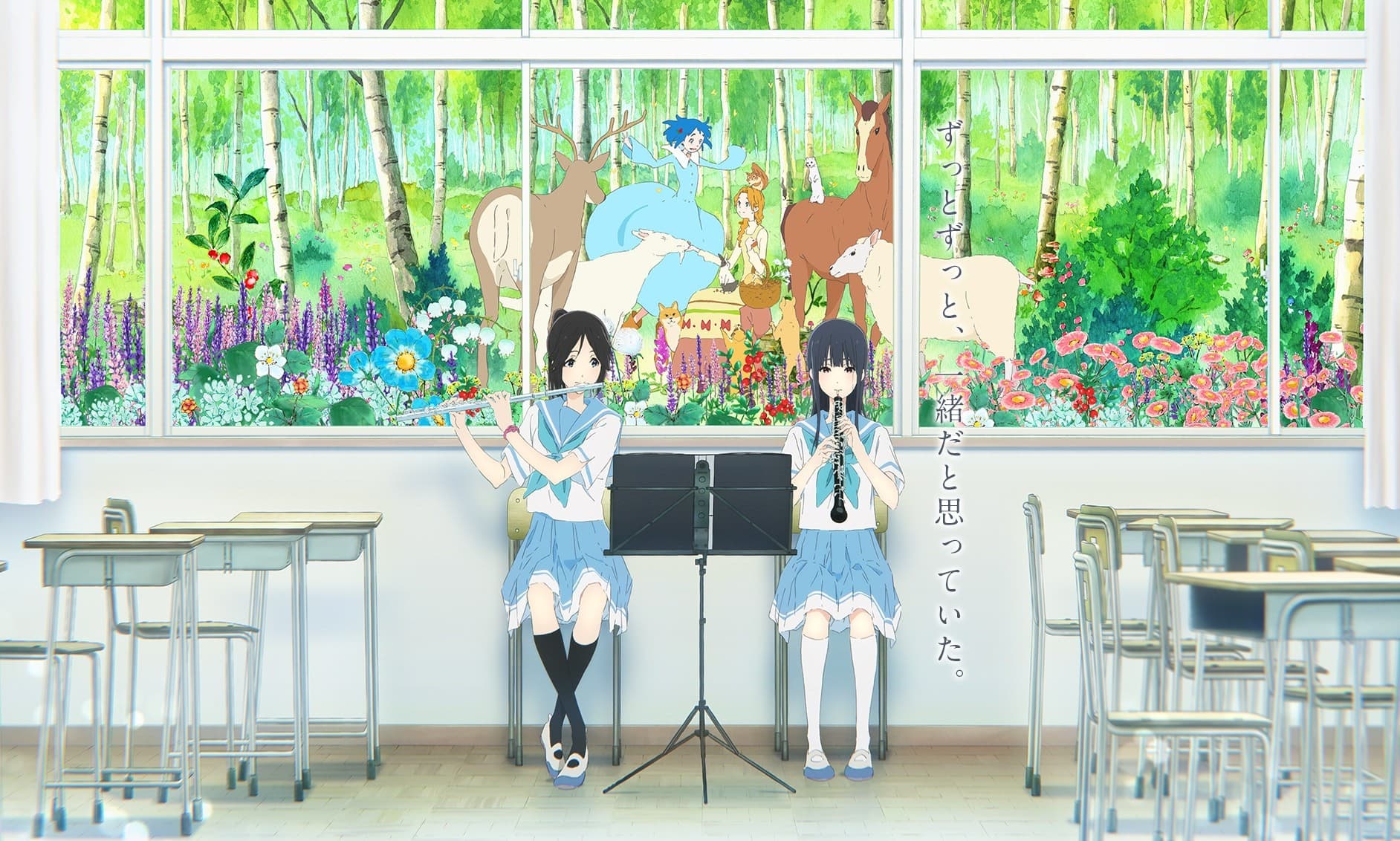
Liz and the Blue Bird, directed by Naoko Yamada, is the critically-acclaimed spinoff to Kyoto Animation's smash-hit, Hibike! Euphonium. It probably marks the most quiet juncture in Yamada's illustrious filmography, with its popularity dwarfed by the likes of its parent series, K-On! and Koe no Katachi(KNK). Yet, Liz also represents a complete culmination of Yamada's body of work thus far, opening new doors for the animation medium and industry. An emphatic display of technical mastery, a heart-wrenching message compounded with metaphor, and one of the greatest films I've seen to date. Liz may not be an international phenomenon, but its artistic and emotional contributions cannot go understated. In celebration of the movie's 4th anniversary, this review is dedicated to exploring the factors that make Liz so special. For those new to the Hibike! franchise, this article also looks to offer the context needed to fully enjoy this film as a standalone story.
Fresh off the universal acclaim garnered from Koe no Katachi, Yamada swiftly set her sights on yet another masterpiece. Sharing key staff members from KNK, Liz displays a comparable, if not superior, degree of emotional resonance and technical expertise. However, these two films could not be further apart. If KNK is likened to a charting modern pop ballad, with Yamada's talents utilized to effectively deliver hard-hitting hooks at breakneck speed; Liz then is a more intimate classical arrangement, with our conductor patiently entrancing us with measures of increasing intensity, all before crashing over us in a symphonic, cathartic crescendo.
The many cogs that make up Liz were turned by skilled collaborators running at top gear. Longtime Yamada colleague Reiko Yoshida's screenplay is equal parts simple and instrumental to conveying the foundation of the Liz experience. Naturalistic dialogue in day-to-day conversations makes way for poetic prose in earnest displays of emotion during pivotal moments. Through a lush soundscape, Liz's phenomenal score and sound design live up to the grand standards set by its parent franchise. Hibike! Euphonium's sound designer Youta Tsuruoka immerses in the closed-in campus of Kitauji HIgh with sonic nuances laid across the school. Kensuke Ushio builds upon the delicate piano score of KNK, by constructing his musical accompaniments around the realistic rhythms of footfalls and objects found in the real-life school Liz's setting is based on. A second composer, Akito Matsuda, offers the more classical arrangements associated with the world of Hibike. An orchestra from the Senzoku Gakuen College of Music performed Liz's titular piece for the film. Yet another essential element comes courtesy of the late character designer Futoshi Nishiya. His soft linework on the masculine Free! blends seamlessly with Yamada's mastery of the female perspective, leading to the accentuation of every tiny action. Each of these excellent aspects are more than mere displays of technical mastery; the facets of writing, sound and character visuals all embody grounded and symbolic attributes. The team's emphasis on detail-oriented storytelling perfectly complements that of Yamada's own skillset, which is made all the more impressive when one considers her method of helming series. Despite her specific objectives, Yamada is known to give room for her collaborators' individuality to shine. This balance between precise decisions and creative freedom allow for a versatile range of evocative elements that still feel unmistakably Yamada. Learning about these collaborators helps us to grasp the full breadth of Yamada's creative vision, and why her genius is so revered by industry animators.
Under Yamada, Liz's visual direction feels purposeful. Vibrant, colorful watercolors of certain dreamlike sequences are juxtaposed against the melancholic blue hues of the film's realistic school setting. The school is more than a mere backdrop, but almost a character unto itself. Save the aforementioned dream sequences and the final moments of the movie, Liz takes place entirely within the grounds of Kitauji High. What would have otherwise been a cumbersome limitation works to Yamada's creative strengths. Her use of space ensures that scenes are far less boring than one would expect. Standout shots provide an almost-claustrophobic feel for keen observers and are enhanced with thoughtful framing. The shot composition makes frequent use of lines in the background and lighting, and is key to keeping scenes feeling fresh. Her love for cinema shines through and works brilliantly within the animation space, thanks to the organic compositing of cinematic effects such as blurs and camera movements. Her timing of shots goes hand-in-hand with Ushio's score, imbuing the fitting tone for each sequence. Yamada is also keen on incorporating more unconventional artstyles in certain sequences, such as the use of decalcomania and abstract linework. Perhaps the most idiosyncratic attribute in this canvas of Yamada's is her unrivaled command over human expression in animation. Her work on Liz shows a perfected craft that goes far beyond her "trademark" leg shots. Closeups on our characters reveal their distinct mannerisms and unspoken emotions, creating the aura of relatability and a human touch synonymous with the KyoAni brand.
Even Liz's detractors would agree that the film is undoubtedly a technical marvel. However, one common complaint they'd raise is that the show did not deserve a movie-length theatrical release. While a select handful of scenes could have been cut, Liz stylistic choices are far more than set dressing. Rather, they make up the story itself, and leaving out such important moments would diminish this movie experience. In Liz, the medium and message are one and the same. We've covered a variety of techniques incorporated. But in order to fully appreciate all these sensory elements, we must first understand the metaphor so-tightly woven throughout each scene.
Liz is centered around two girls from the Hibike! universe, Mizore Yoroizuka and Nozomi Kasaki. While Liz mostly functions as a standalone film, some content may only makes sense or gets enhanced by having seen Hibike. Without spoiling the tv series, here's a brief summary of the two characters and their relationship.
Mizore is a soft-spoken, musically-talented prodigy. She and Nozomi belonged to the same middle school, where Nozomi invited her to join the wind ensemble. As the first person in Mizore's life to have reached out to her, Nozomi became a close friend and source of fixation for the shy girl. Mizore masters the oboe in large part due to her bond with Nozomi, who continued to play the instrument after Nozomi quit the club. Now, having found their friendship reignited in the Kitauji High orchestra, her co-dependency with Nozomi starts going to extreme lengths.
Nozomi is an easy-going individual with an aloof personality. She often finds herself surrounded by peers and keeps up a jovial demeanor. However, she lacks talent and admires Mizore's effortless skill from a distance. Her reasons for abandoning both the club and friendship are selfish in nature. In some respects, both characters are following in each other's footsteps. Mizore has made Nozomi her world, and Nozomi longs to excel in the way only Mizore can. This relationship, while intimate, is not one that can last. And it's this dynamic that is forever changed in Liz, as the girls meet at an emotional crossroads and come to a decision of the heart.
"Disjoint." This word is displayed following the opening scene of Liz, and both go on to define the rest of the film. Our girls are presented as close, yet out-of-sync. Their walk to the clubroom is accompanied by Ushio's "Wind, Glass, Girls", a track which is built around the footsteps of the brisk Nozomi and the measured Mizore (110 BPM and 60 BPM respectively) as they make their way to their club room. Yamada's direction shows Mizore imitating Nozomi's movements, but cuts away before she can ever complete those actions, signifying that Mizore is struggling to follow her friend's footsteps. The two cannot synchronise, and this theme pervades the rest of the Liz journey.
The second key device introduced is the nested story within Liz. The orchestral piece of the same name is an original piece composed exclusively for the film, and also exists as a fictitious companion storybook to the song. Both girls consulting the book is a recurring motif; as they try to understand the music piece, the tragic relationship the song is based off and, by extension, themselves. The tale is one of a village girl, Liz, who encounters an injured Blue Bird in the form of a human. Their story is one of farewells, as one remains fixated on taking to the skies once more, while the other beckons the bird to stay. A clear power dynamic is established, with the Bird being seen as "superior" and Liz as "inferior." This dichotomy carries forward to Nozomi and Mizore, as Yamada thematically frames Mizore as a figure who is needy for Nozomi.
Obstacles are introduced, hindering the pair from perfecting their song and driving a wedge between their shaky friendship. Motifs throughout the film escalate the tension; Liz often uses established Hibike! pairings to juxtapose their synchronisation with our main duo's lack thereof. The presence of other club members and cliques continually leave Mizore in isolation. The school campus gradually turns into a cage for the Blue Bird. Codependency in the height of your youth is being held back from your fullest potential, as if locked away in a cage. Our characters' gazes of longing outside of the campus windows denote their search for clarity, both within themselves and the world beyond the unescapable prison. The conflict lasts long after the final performance of the titular song, as Mizore and Nozomi lay their hearts out in a bittersweet confrontation.
This last stretch of the analysis will involve spoilers, so proceed with caution.
As they eventually leave the cage that bound them and step out of the school compound, the prefix in "Disjoint" is hastily scratched away. It's a powerful conclusion, one with a solemn undertones. But underneath the ballad lies an uplifting symphony, likened to the "happy ending" Nozomi cheekily foreshadows in Liz's opening. An experimental approach and expressive efficacy create a truly immersive experience. The heart of this film is deceptively simple, but allows a plethora of motifs to shine and break you apart piece-by-piece. Carried by masterful visual storytelling and detailed sound design, this heart-wrenching film represents Yamada's present magnum opus. Watch Liz and the Blue Bird. 10/10~
Special shoutout to @Lumpy for inspiring this review. I was toying around with the concept of a personal anecdote within a review, but initially conceived that plan for a different script. I only realised that approach would suit Liz when I read his now-privatised review on the show, so I'd like to thank him for the solid read.
I also want to thank each and everyone of you who read through the full review. It'll probably remain as one of the strangest things I'll ever post publicly, but this is the way I wanted to make my love for this show known.
If you happen to like my verbose rants, feel free to check out my other reviews for seasons past and present. I also frequently post writeups under my list updates, so definitely take a peek if you'd like to see me mald over anime as they hit the airwaves. Peace~
249.5 out of 256 users liked this review