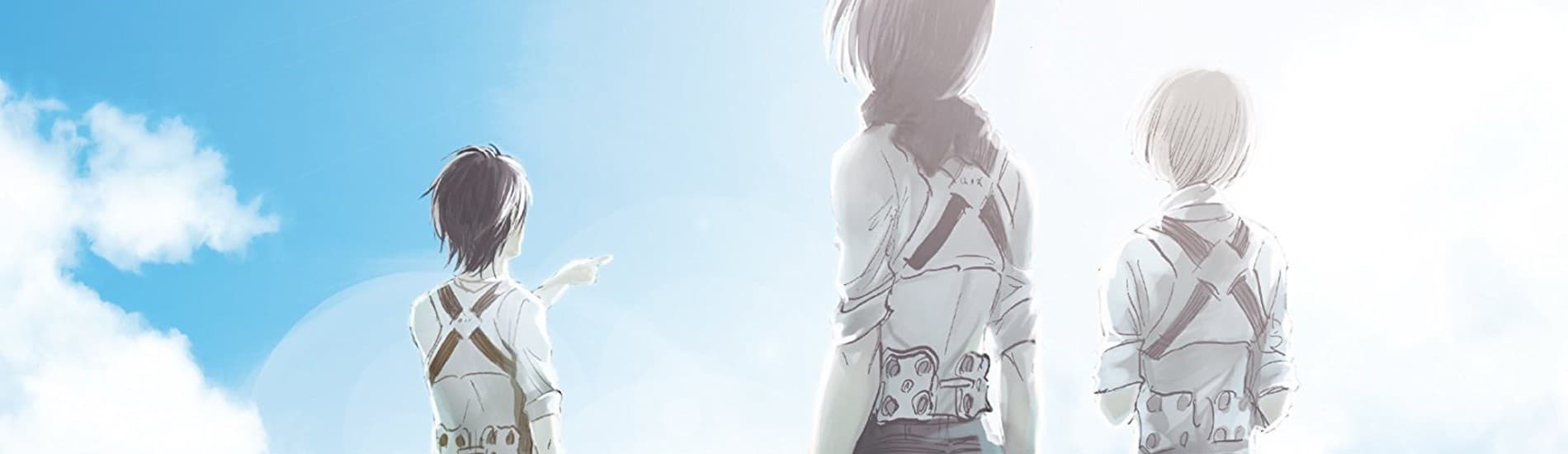
Attack on Titan
a review by 55BANK
a review by 55BANK
I will present the 3 main objections that ruin the manga.
1) The emancipation of Ymir
Isayama drew a parallel between Zeke and Fritz (royal blood, beard, desire to be obeyed) in which Fritz is perceived as an enemy to whom Eren opposes to free Ymir, all this to reveal us that Eren was never the one she was waiting for and who freed her during 2000 years? Logically, if she was in love with him, she should have obeyed his legitimate descendant who was authoritatively similar to him


Following 139's explanation that she obeyed him for two thousand years because she loved him, Ymir should never have disobeyed Sieg since he represents Karl Fritz's legacy. So if she does it, it is because she emancipates herself from him... So the power of the titans should have disappeared at this moment because she freed herself from the yoke of the king she loved by refusing to obey his descendant and by refusing to perpetuate his will that was the perpetuity of the titanic yoke, by obeying Eren who explicitly said he wanted to destroy the world of the titans
So if she refuses to be a slave and disobeys the heir of the royal family, it is because she was freed by Eren. Moreover, at the thematic and symbolic level there is no better character than Eren Yeager, who is the exact opposite of Fritz and Sieg: He doesn't demand anything from her but makes her understand that she is free, that she has the right to choose and wants to borrow her powers with her consent unlike Sieg and Fritz who only see her as a slave without any will of her own:


This can be briefly summarized in three points:
She was liberated because she possessed all the properties of freedom: The awareness that she is a person "You are just a human being" who can make a voluntary act "The decision is yours, make your choice" which she achieved by emancipating herself from that . Whether symbolically, mentally, physically or emotionally. She was emancipated.
We could object that Ymir disobeyed because Zeke's wish was opposed to Fritz's, but Eren also wanted to destroy the paths and Ymir should have triggered the Rumbling on her own initiative, when her people were divided and persecuted by humanity, because Fritz wanted to eternally tyrannize the world, but she did not do it because she obeyed the will of the king who took refuge on Paradise. She was a slave.
She followed his will by assuming her role as a slave for two thousand years, in order to perpetuate the titanic yoke - if unforeseen events occurred in the course of history and the Empire fell, it was because she obeyed mainly the heir of King Karl Fritz, she was the slave of the royal family to whom she disobeyed by refusing to carry out Sieg's orders ; which is impossible for a slave, so if she does it is because she is free.
Chapter 1: To You, 2000 Years Ago
Chapter 122: From You, 2000 Years Ago

Everything revolves around these two "moments", which are respectively the starting point and the climax of Ymir's story...and the events narrated in these chapters (if we stick to SNK's chronology, in relation to 2000 years) are enslavement and emancipation.
Even if Mikasa had contributed to Ymir's liberation, her contribution would be infinitely less than Eren's. So why credit Mikasa and portray her as the main reason for her liberation when it is obvious that Eren was the main cause of her liberation?
2) Eren's will, his goal and his dream
Isayama showed us Eren's deep intentions with metaphors, parallels with his childhood and his apology to Ramsi (chap 131). Talking about them, we can evoke that his thoughts imply that there is only one solution to solve the problem: The extermination of the whole humanity or the one of the Eldian people; and Eren chooses his own people to the detriment of the humanity :


Eren, wandering among the humans, deliberates inwardly on the outcome of the conflict, the resolution of which can only be brought about by the extermination of one people for the benefit of the survival of another; and he becomes indignant when he temporarily considers that the extermination of the eldians would be preferable, which implies that he was aware that the conflict could only be solved by the total extermination of one people.
If he had intimately wanted to spare 20% of humanity in order to restore the reputation of the Alliance, his questioning would not have been necessary and we cannot say that he would have lied because it is an internal, mental dialogue.
And we cannot say that Eren had not yet changed his plan, since Armin reveals us (in 139) that Eren was planning his turnaround since he had distanced himself from his friends, which started from the moment when the negotiations with humanity failed, and Eren opted for the Rumbling to save his people.

He reaffirms the threat he first made against the titans before using it again against the humans who have become the main threat to his people and their freedom.


Just after, he saves and kneels before Ramzi, to whom he reveals his ultimate goal which is not the survival of Eldia, nor to spare 20% of humanity but the fulfillment of his selfish desire and the pages that illustrate the events that were taking place at the moment accentuate this interpretation because we see Eren gloating as he flies over the clouds. At that moment, nothing mattered more to him than freedom. This was his ultimate goal which is accentuated by the parallelism of the flashback which is significant.
No mention of the 20%, of Mikasa, of the Alliance, and this only emphasizes the ultimate goal he had confessed to Ramzi. There was something more important than all that he outlined in chapter 139. Only Eren's deeply selfish desires :

But in any case, the placement of this flashback is not insignificant and is juxtaposed with the real-time events of chapter 131, in which Eren performs the Rumbling and satisfies his desire. This is consistent with the choice he made in reflection, and with the dream he confessed to Ramzi.
Accepting that Eren lied to Ramzi diminishes the emotional value of his heartfelt confessions. Imagine, Eren travels to the humans he plans to totally exterminate, saves a boy from being lynched knowing he will kill him, falls to his knees and confesses all that is in his heart, apologizing for what he is about to do and revealing his ultimate goal which is deeply selfish.
How do you reread this chapter without being embarrassed knowing that the moment he was supposed to be most vulnerable was yet another manipulative attempt on his part to a boy who doesn't know the ins and outs? It doesn't have the same impact anymore.
How are these sentences relevant knowing that he intended to lose and let live 20% of humanity? Why does he make us believe that total extermination is the only solution? Why does he make us believe that his ultimate goal is the truth and his own freedom when the last chapter reveals that it was to play the villain so that men would ally themselves? We cannot say he lied to others because it is an internal dialogue. All the incoherences caused will be refuted by telling us that Eren was lying, he lied all his life, to everybody and even to himself, for his character, his life and his dreams because it is absolutely impossible to reconcile his old words with this chapter.
I will add this excellent compilation of Eren Yeager's words, during almost the whole manga, which were in adequacy with his objectives until chapter 139 comes to ruin his whole character : https://www.reddit.com/r/titanfolk/comments/mnlxk5/every_line_of_eren_in_139_and_how_on_average_each/
Many will say that freedom is what characterizes him, but it would be better to say that it the lie.
Let's anticipate the Pavlovian assertions about Eren "You're frustrated because he's not the chad you thought he was." The unanimous acclaim of the masterfully executed chapter 131, which narrates Eren's excursion and his psychological breakdown before collapsing in tears in front of Ramzi, refutes this pitiful accusation. It is not the emotions exposed that debase him, but the psychological destruction of his character.
3) Mikasa memory
The peculiarity of the Ackermans was that they could not be affected by the power of the King who has a memorial hold on the eldians, as proven by cass 1) Frieda who erased Historia's memory after every moment spent with her 2) The policy of the last real King Fritz who took refuge on the island and erased the memory of the people - Zeke says "What a pity that the King erased their memories" during the first battle of Shinganshina " 3) By Kenny's grandfather, in chapter 65 who reveals to us that the King persecuted the Ackermans because their memory could not be manipulated


In the last chapter, we have theses lines: 

Which means that she also underwent this treatment when she got her memories back.
Somebody objected to me that Eren could have altered his memories in the paths. There is no mention of such an ability, otherwise the descendants of the royal family could have used this method to manipulate the ackermans after they fled to the island, even with the full power of the Original, for Livai, in chapter 138, says that the ackermans cannot be affected by the abilities of the Original - apart from transportation in the paths - which implies that their peculiarities were still in effect.
At this point, a short time had passed between Eren's death and coming to Armin, the only person Mikasa saw was Armin, and if she refers to the return of her memories, it is because she experienced this and not because someone else told her about it.
Conclusion :
It is impossible to dissociate a manga from its ending which is the whole concretization of the work that will determine its absolute quality, especially since Isayama insisted on the temporal parallels, the new levels of reading and paradigms that give a whole new meaning to the current events. So the ending severely taints the manga.
The worst thing is that it taints any retrospective reading, not only because the ending is disappointing but because it discredits the whole manga and those trying to save the furniture indulge in unprecedented mental gymnastics.
It is as if the cornerstone of a meticulous and sublime edifice was destroyed, causing its collapse and the impossibility to contemplate it. People will reassure themselves by saying that it was possible to admire it when it was standing, except that it is no longer possible now, just as I can no longer appreciate SNK even though 124 (the two that are added to the 122 are chapters 130 and 131) masterpieces have been made.
People who have a minimum of critical thinking and who do not have eyes only for the survival of their favorite characters, like teenagers, and who focus on the main and underlying themes of the story, as well as the psychology of the characters, can only be disappointed by this disastrous ending.
71.5 out of 105 users liked this review
