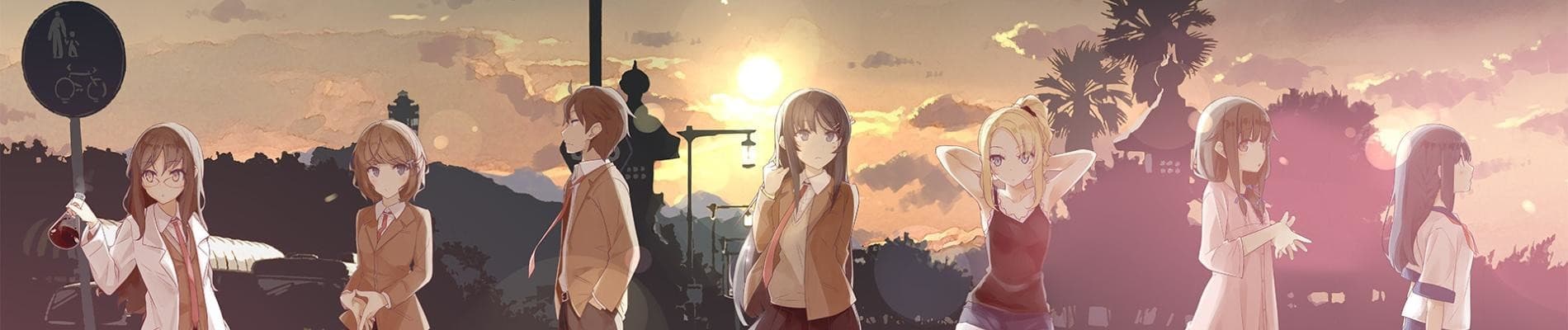
TL;DR - Despite its long, deceptively ecchi title, supernatural elements, and presence of 6 main girls ("harem!?") in the story, Bunny Girl Senpai is at its very core a simple story of how high schoolers deal with societal, parental, and whatever pressures and status quos that distressingly permeate in their context that thus affect them in more ways than one.
You may think of the likes of TWGOK in the ‘guy helps many girls in a supernatural setting’ angle, but I’d like to think it’s also the simple, deadpan humor; lack of exaggerated scenarios (e.g. girl throws guy into the sky for accidentally groping her); and overall sweet storylines of how these girls bring themselves to overcome their problem or insecurities (with some push by the main character) that may make or break the anime.
When you read up the synopsis of Bunny Girl Senpai, you might just ask, “what.” Don’t let that deceive you, though. This anime is very simple: when someone experiences some emotional distress and instability, the rumored ‘Adolescence Syndrome’ occurs wherein abnormal things happen to the person that has it or to the environment in which the person is inhabiting. Thus, the main character named Sakuta Azusagawa finds himself helping girls who’ve contracted this syndrome by essentially figuring out what it is that’s causing the distress and doing what he can so these girls could get through their predicaments.
Is it a harem? Surprisingly, no, even though a few episodes are allotted for a certain girl. If you’ve watched/read TWGOK, they’re similar in the premise of a character arc per certain episodes (for the most part of TWGOK), but Bunny Girl Senpai has continuity: the girl characters don’t get discarded or aren’t forgotten, and they appear somehow and somewhere after their respective arcs. The outcomes don’t necessarily conclude to romance either.
Personally, I think the continuity is a plus. I like seeing the main character be friends (or be better friends) with the girls he’s helped, without them forgetting or being awkward for having caught feelings for the guy.
How about the characters themselves? They’re actually pretty great and well-designed. As far as I can tell, most don’t fall under overused character tropes. Their problems range from not wanting to disrupt the status quo (or as aptly used in the anime, ‘atmosphere’), insecurities, and whatnot. They may seem simple, sure, but I personally liked how each of them get dealt with and concluded given the supernatural aspects of the show.
How about humor and tone? Well, this may or may not be a dealbreaker for you. Bunny Girl Senpai is known for the humor being either deadpan with the sprinkle of not-really-serious lewdness or just plain old snark. The characters and their actions aren’t as ‘loud’ as like in shows with comedic elements, so you’d have to find entertainment in their choice of humor. But still, don’t go to Bunny Girl Senpai expecting to laugh.
Even then, each character has their own defining, unique traits that would make you love them for sure, and it is their interactions with Sakuta (clashes, retorts, and all) that make it fun to watch through.
Also, as far as I can remember anyway, the animation is good and fairly consistent, but not so much that you’d be able to avoid awkward CG background characters. Unfortunately, my ears aren’t trained enough to pick up on whether or not the music direction is any good.
But hey, the OP and ED are very great. “Kimi no Sei” by the peggies is absolutely catchy especially when listened to with the actual animation, and “Fukashigi no Karte” is quite soothing. I love how the latter changes per character arc, as it depicts the person(s) central to their arc. (Also, my favorite out of the bunch is Futaba’s.)
A main con I can think of, though, is its being an adaptation consisting of 13 episodes, which usually and inevitably have loose ends. The existence of and background behind the Adolescence Syndrome were never dealt with. Even if the sequel movie deals with it, I don’t personally find the end of the anime itself as satisfying as the entire rollercoaster-like ride the other episodes have given me, souring the overall experience ever so slightly.
Nevertheless, I can recommend Bunny Girl Senpai with a certain degree of confidence if you’re into girls (seriously speaking) being cute and dealing with realistic problems and if you don’t mind the humor and tone—most especially from Sakuta—being relatively simple, not-so-serious, and deadpan, albeit with the sprinkle of lewdness and/or snark.
45.5 out of 52 users liked this review
