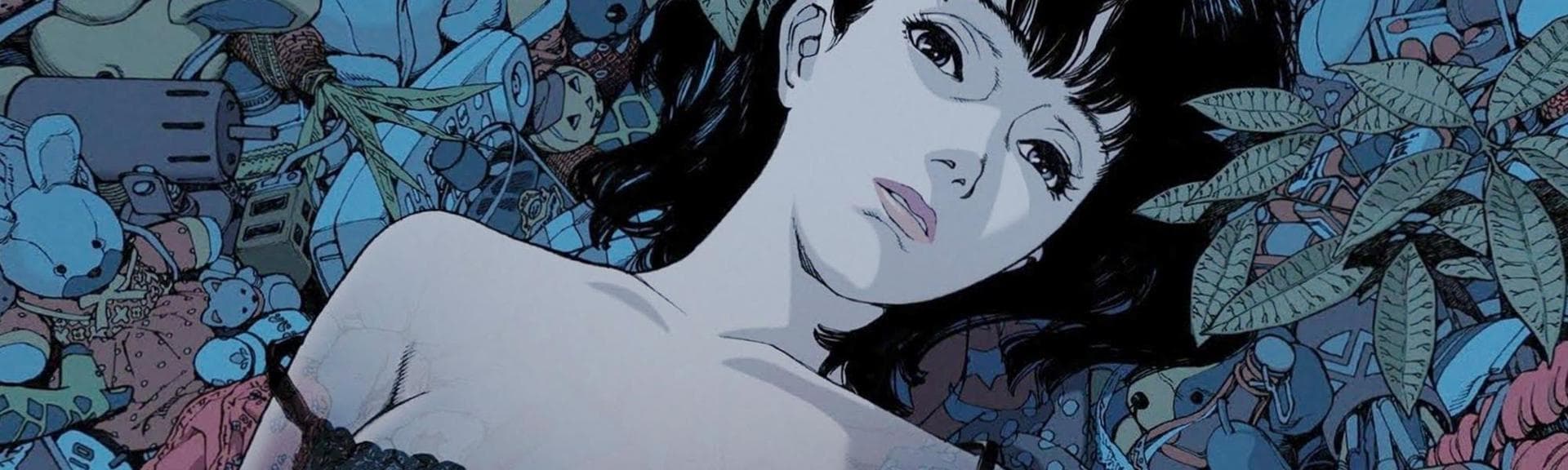
Perfect Blue
a review by ZNote
a review by ZNote
As Mima finally starts getting accustomed to how to use a computer, she stumbles across a website called “Mima’s Room” that seems to go into painstaking detail about her personal life. Nearly everything, from her steps off the train to the kinds of goods she buys at the supermarket, are broadcast as diary entries for the internet to see. One particular line disturbs her, and she clicks the accompanying sound file numerous times. She hears her own voice, taken from when she was on set and reciting her single line in the scene:
“Who are you?”
“Who are you?”
“Who are you?”
It may be life’s greatest existential mystery, and one that often has individuals running for the door instead of confronting it head-on. It is within the realm of personal identities that Perfect Blue resides. Mima herself undergoes what we all have had to do at some point: a reinvention of ourselves into something new. We see Mima as three different people: the pop idol, the aspiring film actress, and the woman who gradually feels her grip on reality slipping away.
No matter which Mima we see at any given moment, she is a part of the same visual, sexualized game; the only differences lie in the details. As a pop idol, Mima was eye-candy because of her sugar-sweet music, outfits, and incomparable ability to force a smile on her face. As an actress, she strips for a photographer and engages in a rape scene for her role. As a woman, she has been subjected to a violation of her privacy, a violation that “performs” the role of Mima the pop idol for its online visitors. The audience become a quasi-participant in Perfect Blue’s physical and psychological voyeurism, but the way the world views Mima churns the stomach rather than titillates. No matter how much sexualization takes place in the moment, there is nothing erotic in this film. The feeling is a cold, uncomfortable dread.
That discomfort comes from the realization that what we see on-screen is all-too-familiar. Creating identities that play to fantasies or jobs required of us is no longer a foreign concept for the present generations. Social media’s rise and being able to craft precisely how you wish to present yourself to the world is no longer a fantasy; rather, it is the way of being on the internet. After taking our naïve steps into such a universe, we expose ourselves to the dark implications surrounding identity creation, theft, and destruction. Throw into the mix the idea of an identity of you that’s beyond your control, and the possibilities are numerous and gross. In this matter, Perfect Blue has aged terrifyingly well.
Mima, in essence, is one such outsider taking her own naïve steps into a new world. Those steps are accompanied by a problem that is, likewise, easily-recognizable: was venturing into new territory the best decision, or did you leave the best behind? It appears that CHAM!, the group she used to belong to, is actually doing better without her there. She mentally breaks down on her bed at home after filming her rape scene, saying she swallowed her pride in order to film it. On some level, she is disgusted with herself. The “innocent and virginal” mask that served her public image so well has been ripped off. Her years of experience and wearing it are betraying her convictions in the here-and-now.
But the mask was never-fully secured to her face to begin with. Even back in the days of CHAM!, one could only assume her depths of dissatisfaction with performing in this way. Her final performance early in the film was a microcosm of what she experienced: lunatic fans and doing the same song-and-dance routines over and over again. Even as she begins tearing the mask off for real, the website that tracks her every move haunts her mind. Against the advice of her agent, she continues to visit it with increasing regularity. She has become a self-voyeur, but for a version of herself that she’s trying to separate from. Combining the regret of leaving CHAM! with the uncertainty she now feels, Mima begins to question where or who the “real Mima” is. She is caught in the middle of a world that wants to use her two different identities for their own ends. The only way to reclaim her agency, ironically, is to hold fast to her original conviction and continue her acting work.
As so often happens, work does not provide the refuge she needs. The more Mima dives into acting, the deeper the mental labyrinth runs. Some of her old fans simply cannot reconcile the new Mima with the version they’ve constructed for themselves over the years and subsequently consumed. To them, she exists only to satisfy their own desires about what they want her to be. The film already has shown one violent action as a result of this with the Mima’s Room website, but it manifests in other ways. There’s a certain man who seems to constantly appear in her presence, but the way her mind is seeing things, or not seeing, calls his appearances into question. The barrier between fantasy and reality muddles, leaving Mima disoriented. Even some of the character designs are disorienting, with the feeling that something is off about how they look, no matter how ordinary they appear to be. Is this even how they “look” in actuality?
Perfect Blue is as much a celebration of cultivating one’s own identity as it is a warning of identity’s power, both over us and over other people. It penetrates deep into the heart of who we are as living bodies while being the ever-unstable lens that gives us meaning. Weaving in and out of itself in a binding, thick web, the film strings its heroine and all who know her, “know her,” and “are her” along for a dizzying ride of terror.
“Be yourself” has rarely been such a frightful thought.
60 out of 62 users liked this review
