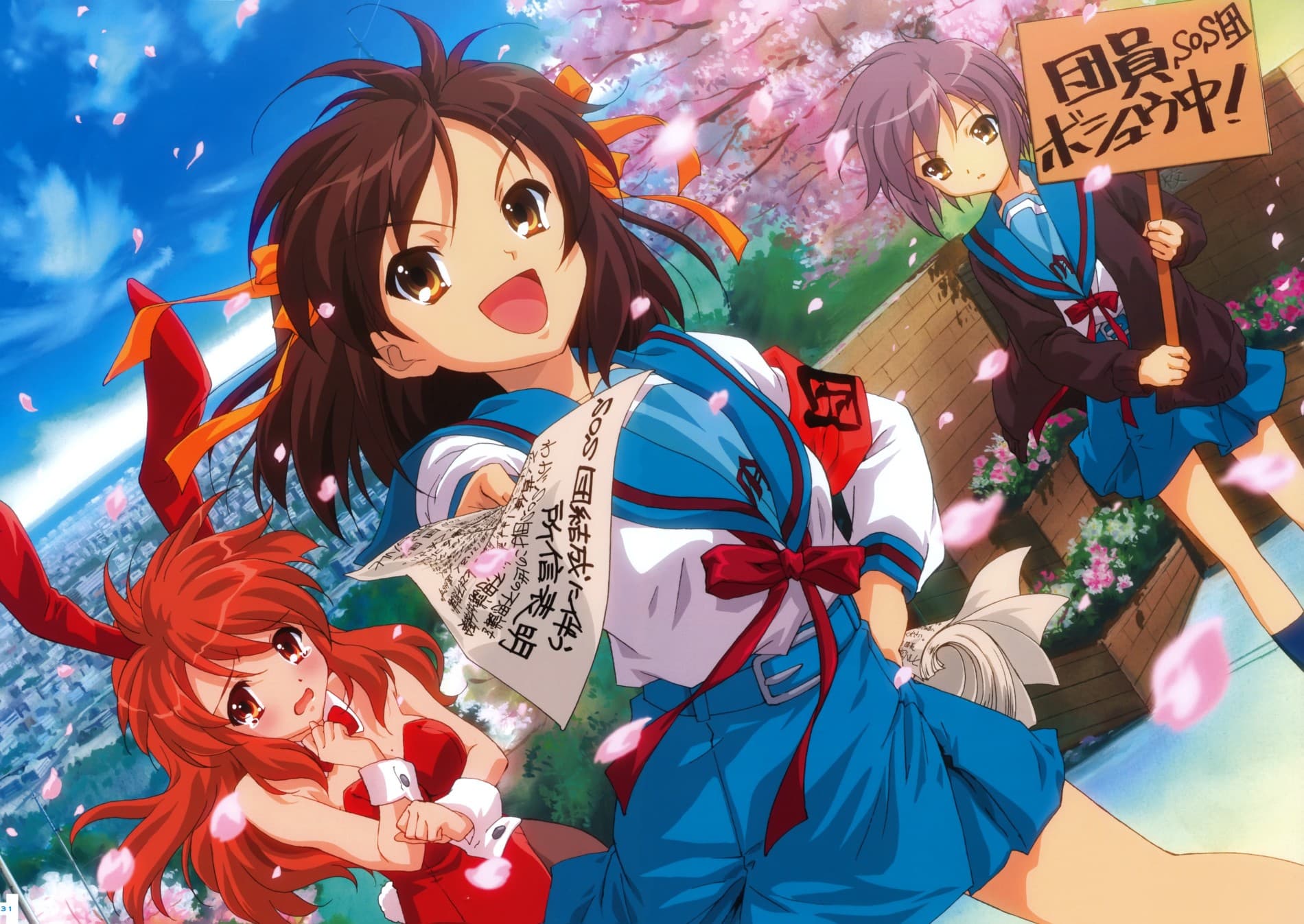

The state of the online world isn't something I'm terribly fond of nowadays, but a little over a decade ago, the Internet was a captivating wonderland. A large part of my juvenile personality is owed to numbing my developing brain on Ray William Johnson's =3 series, Salad Fingers, asdf movies, YouTube Poop, NicoNico Douga MADs, Newgrounds videos, Chris Chan's descent to insanity, etc. So, perhaps a Pandora's Box is a better fitting term. Whatever the case, I was simply one of millions of other kids discovering the magical explicitness and eccentricity of the Internet.
And chances are, if you had the slightest familiarity with anime and the Internet ten, fifteen years ago, this video left an eternal impression on you. And if you were like me, greater chances are that you didn't even know what this or anime really were, but Cupid's Arrow had struck and you fell inside the rabbit hole.
Barely ripe in my 20s, I find it somewhat awkward to be nostalgic over things that seem so recent and I've always hated when people uttered the classic colloquialism "Only 90s kids will remember". These days, I find myself unfortunately more and more disconnected from this medium for several reasons too trivial to discuss in this already boring enough prologue. However, rewatching or simply musing over Haruhi Suzumiya and some of my first anime sparks a little more reason and motivation for my connection with this medium to stay alive.
The "Seinfeld is Unfunny" Effect
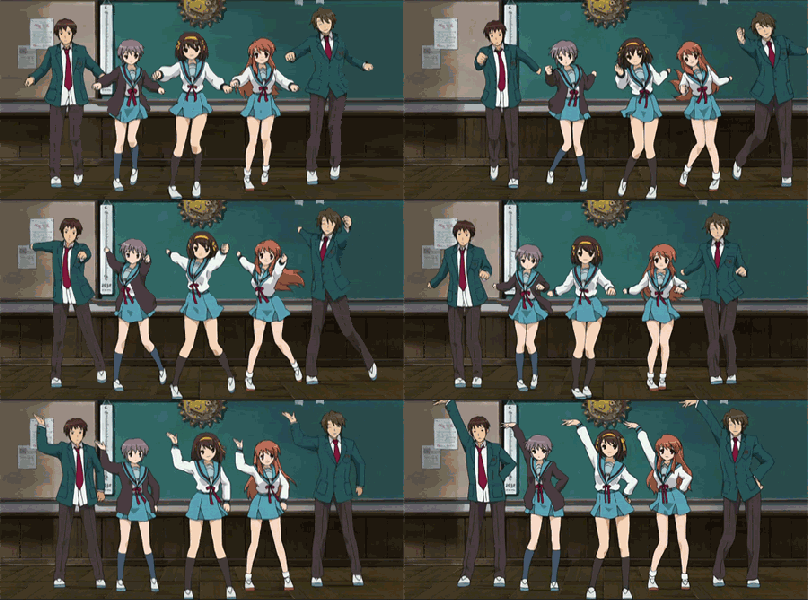
In retrospect, Haruhi Suzumiya isn't extraordinary in the school slice-of-life genre. At least, under the scope of today's standards. I find that the series suffers from the "Seinfeld Is Unfunny" Effect. That is, Haruhi Suzumiya was an unforgettable experience during its conception in 2006 but fell from its livelihood as more similarly-premised shows came out. Perhaps this sounds little more than baseless, poor defense, but I truly do find this as the case. The otaku meta-humor, the strange out-of-order airing release, one of the first (if not the first) pioneers of light-novel adapted anime, the eccentric twist on a usually mundane school story, and, of course, the smash-hit choreographed dance ED. All of this may certainly sound ordinary by today's standards, but for me, the memory of its freshness remains ripe in my mind. Thus, I believe that coming into Haruhi Suzumiya with this generational/standard gap in mind is imperative. Hopefully this all doesn't come off as condescending or criticism of newer fans. I suffer from this effect for multiple older shows that I never watched during its conception, thus I look at these otherwise pioneering, genre-changing series as simply too mundane from being desensitized by their imitators. Simply put, I wanted to emphasize the matter of right place, right time in regards to common questioning of Haruhi Suzumiya's popularity and cult status in the community.
Now, onto the actual meat of the tale of an eccentric school club.
Aliens, Time Travelers and Espers
Though I've established some context behind Haruhi Suzumiya's popularity somewhat prim and proper, I won't be able to dissect the pure eccentricity of this show so orderly and neatly.
One reason behind its infectious popularity that I left out, was its eccentric genre amalgam. Labelling Haruhi Suzumiya as a school show isn't technically wrong, but diving into the show, you'll find splashes of detective murder mystery and downright bizarre supernatural battles accompanying school festivals and baseball games. Add in the unchronological airing order, and you have a dysfunctional story of the most unexpected and out-of-place events taking place inside the mundane premise of an afterschool club. This may be befuddling and outlandish to unsuspecting viewers, but that's the real charm of this show. Certainly, some aspects have definitely not aged well, such as Haruhi frequently subjecting Mikuru to sexual harassment, but this weird, bizarre mishmash that doesn't care about concrete story lines is practically screaming at you "Have fun!". Even now, some of the episodes don't get any less strange, but it simultaneously warps me into their world, sharing the SOS Brigade's fun, weird and abnormal adventures.
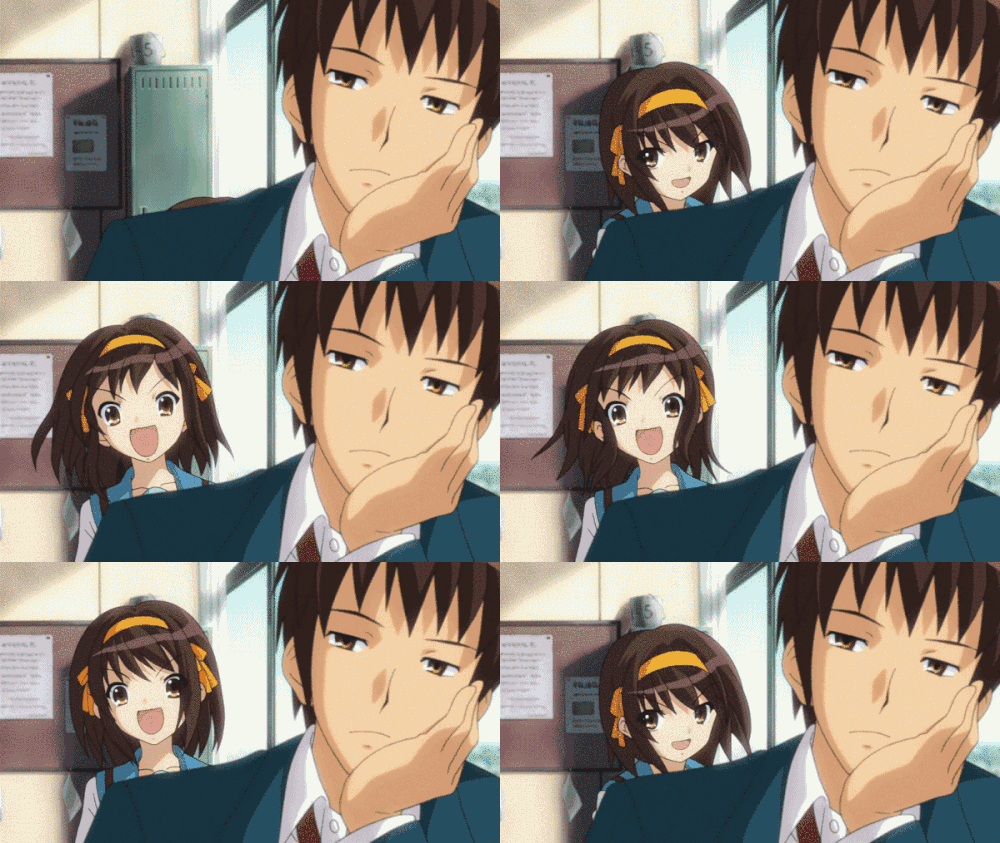
Haruhi Suzumiya, the infamous sociopathic SOS Brigade leader, is a character you love to hate and hate to love. It may be a bit laughable to analyze such a seemingly one-dimensional and insane character, but Haruhi is quite literally the epicenter of the story. Delving into a dissection of Haruhi is meaningless without the mention of Kyon, though. Kyon, the miserable narrator forcibly drawn into Haruhi's eccentric activities, is one of the more quaint beloved aspects of the show. His cutting, cynical remarks and passive personality resonated with and amused many fans, with his character acting as dry humor clashing against Haruhi's courses of eccentricity. Note the "clashing", because Haruhi is just that. Where as Kyon is the laidback guy sitting at the back of the room and staring off out the window with his head cupped by his up straight arm, Haruhi is his anti-thesis. Obnoxious, egotistical, arrogant, stubborn, short-tempered, Haruhi is just about anything but the ideal moe girl archetype that flourished and idealized at the time. But that everything makes Haruhi, Haruhi, and one of the most hatefully beloved characters in anime. Her vehement orders, superbly supplemented by Aya Hirano's phenomenally strong and charismatic voice acting, and stone-set personality breathe life into every episode. After all, if Haruhi didn't want to find aliens, time travelers, espers or anything just as nutty, what would this show even exist for?

Broadcast or Chronological?
Admittedly, though, episode quality isn't exactly consistent. Some episodes are moderately more enjoyable than others, which leads to a brief discussion about the age-old question: Broadcast or chronological order? Simply put, it's up to you. Ignoring the technical context of the original Japanese airing release, here's a handy-dandy chart regarding which order to pick. In my own experience, I initially watched the show's broadcast order then rewatched in chronological. Both have their strengths. As the chart I provided mentions, broadcast order maximizes the Haruhi experience, with the messy narrative structure perfectly complementing the mystery nature of the series. Starting off with the infamous The Adventures of Mikuru Asahina Episode 00, first time viewers will certainly be somewhat flabbergasted as to what exactly they're diving into. However, I think it perfectly shows what Haruhi Suzumiya is. A love letter to otaku culture via the amateurish film-making and mahou shoujo cosplay, the unexpected course of events in the story and just a strange experience. Conversely, the chronological order serves the story on a platter, easy-to-digest. However, I found that the story weakened after a while in this order. Though, one saving grace is that my favorite episode in the franchise, Live Alive, is towards the end and makes for an extremely delectable cherry-on-top. That all said, don't stress too heavily on which order to roll with, as each order makes for differently enjoyable experiences.
 ___
___Join the SOS Brigade today!
Owing the show's charm to solely Haruhi would be unjust to the other members of the SOS Brigade. Though, not all of them have the same amount of charm. Take Mikuru, for instance. In obvious essence, Mikuru is no more than the moe mascot. She has my upmost sympathies, but her subjection to sexual harassment is easily the worst aspect of the show. Other than supporting a confused Kyon on scarce occasions, Mikuru has a bare-boned character, that I certainly don't hate but can't feel anything but bored of. Then again, she's sometimes credited for the boom of moe so there's that, I suppose. Moving onto Koizumi, I can't help but think of him as a homeostasis of the club. Kyon's usual levelheadedness dissipates into irritation when confronted with Haruhi's unreasonable demands, Mikuru whimpers in submission, Nagato quietly turns pages in the corner of the room and Haruhi is Haruhi. Similarly to Kyon's cynical and dry remarks, I adore Koizumi's playful, all-knowingly winking conversations with an often irritated Kyon. Judgmental and calm, Koizumi acts as the Brigade's mediator and the club would certainly fall into chaos had his presence not been there.
The character that surprised me the most, however, was Nagato. Her kuudere archetype doesn't contribute to the show's unique nature at the time, but her character contributed massively to its enjoyment. Deadpan and unfathomable, Nagato is often an unintentional rebuttal to the club's eccentricity, her passive reading depicting her presence in the clubroom like an unnatural homestay. However, her own quirks pop up time to time, simultaneously painting her more than an apathetic, precision machine and adding another flavor to the comedy, already rich in meta-humor. Her supernatural identity is the most fleshed out out of the Brigade members, often bringing in dense fantasy exposition that breathe the supernatural aspect of the show. Unfortunately, I can't delve into the Endless 8 arc from the 2009 sequel or The Disappearance of Haruhi Suzumiya (which continues to be my favorite anime movie of all time), which the former sets up Nagato's character in a very unbearably-meta manner and the latter superbly fleshing out that set-up. To get the most out of both the Haruhi anime franchise and Nagato, it's imperative to watch all 3!
If Mikuru is Haruhi's outlet toy for her sadism, if Koizumi is Haruhi's reliable yes-man and if Nagato is....just there, then what is Kyon to Haruhi? Cat and dog, oil and water, black and white? Their clash of personalities and bickering overshadows their relationship, but there's a beautiful subtlety underneath. Ironically, what Haruhi seeks out in Kyon, is not an alien, time traveler or esper, but a human confidant. Haruhi's monologue about her insecurity of not being special, being part of the crowd in the baseball stadium as a child, paints a richer shade in the context of their relationship. Just why does Haruhi forcibly pull Kyon the hardest into her shenanigans and voyages for the supernatural? Perhaps, Kyon acts to remind Haruhi of her humanity and mundanity that she shuns. Kyon's rationality, biting criticisms and being the only person who has the balls and gall to stop her in her unstoppable stride, is just what Haruhi needed after all. And for Kyon, as much as he sighs, rolls his eyes, grumbles and monologues about Haruhi's irrationality, he himself slowly realizes that this irrationality paints a vivid color in the mundane life he oh-so wishes to return back to. And as the story progresses, the consequences of their relationship become apparent. Haruhi surprisingly heeds Kyon's words at times, her irritation at Kyon fawning over Mikuru disguised jealousy and, of course, the Live Alive concert scene.

God Knows I fucking love this show
Perhaps dedicating a section to a single episode sequence of a school festival concert is a bit too grand, but I'm here to gush about my adoration for this show. And at the root of my adoration, is the God Knows sequence. Filling in for an injured band member, Haruhi takes the Light Music Club's request to play for their cultural festival concert, for no real concrete reason. After Kyon visits the various cultural festival attractions and booths, he settles down in the school gymnasium, only to see Haruhi up on stage, tuning her guitar and setting up her music sheet stand in an expectedly outrageous bunny girl outfit, once again nodding to the meta-humor. My reaction to what preceded and succeeded from over a decade ago is still so, so fresh. Expecting another outlandish shenanigan from Haruhi, I couldn't help but half-grin as to how bewildering Haruhi would perform, And I was both right and wrong. Haruhi performed outrageously, as KyoAni outrageously animated a stupidly gorgeous action sequence that legitimately sent me into stunned silence for its entirety.
Kicking off with a vibrant hi-hat, the band explodes into Nagato's rad guitar solo, briefly panning to the agape-mouthed audience just as the real viewer audience was, before segmenting to Aya Hirano's vibrant singing. As she rings out line after line with strong soul, the audience's cheering and uniform clapping become louder as Kyon continues to watch silenced and mouth agape. This all, however, is just a dessert for the finale of the sequence. The bass break is accompanied by Haruhi's calm-before-the-storm voice and unified clapping, before the peak of the song reaches. Panning closely to Haruhi's face, KyoAni went hell on animating Haruhi's scrunched-up face, shifting mouth (supposedly KyoAni filmed Aya Hirano and her bandmates performing the song prior and rotoscoped their movements). Ringing out a powerful "KIZUATOOOO NAZARUUUU", the camera pans out for a breather before quickly focusing back on to Haruhi's sweating, determined face as she exclaims a "Watashi" and proceeding to the final section of the song, the audience's clapping stronger than ever. As the song ends with Nagato's rad riffing once again appearing, Haruhi glistens with a smile devoid of smugness, arrogance, pride and sincerely thanks the audience.
I can't do this sequence nearly enough justice by writing this. It was random. Out of nowhere. Nonsensical. I mean, who would go so far to so superbly animate such a mundane thing like a school festival concert? Then again, this show is all about the unexpected. But, this random sequence was the show's icing-on-the-cake. Haruhi's development shines, as she willingly helps someone out for no self-serving reason and the school recognizes her as not the cultist weird girl, and even Haruhi herself was shocked by this. This sequence, in hindsight though, was just bizarre in the end. It didn't add to the story or have any other concrete reason to have happened, but that's the beauty of it.
Many fans praise this sequence for its timeless animation by KyoAni and the cinematography, which I certainly agree with to an extent (there's obvious reused character animation riddled here), but the real charm of the God Knows sequence lies in its soul. The soul of KyoAni's painstaking work on this, the soul of Aya Hirano's singing, the soul of Haruhi's determined spirit. I'm by no means an anime connoisseur but my opinion is set-in-stone. That, this action sequence will always be the greatest anime sequence I've bore witness to. It was this sequence, that my vague preconception of anime born only from Dragon Ball Z, Naruto and One Piece at that point was torn down, in that anime was something special. My rewatch count of this sequence easily ranks in the hundreds and God Knows how many times I listen to the song every week.

Conclusion
A first experience is an unforgettable experience. Haruhi Suzumiya is a personal testament to that statement. Though suffering from the "Seinfeld is Unfunny" Effect, the misadventures of the SOS Brigade remain gold in many hearts over a decade later. Though, the show certainly suffers from flaws, such as uncomfortable sexual harassment. Haruhi's character, is a bit difficult to stuff inside that box. You love to hate her and hate to love her. Owed to Aya Hirano's rich voice acting, Haruhi flourishes with irritating charisma that'll forcibly drag you into the SOS Brigade's dysfunctionality.
The story is a charmingly shaky mess. Whether you watch in broadcast or chronological order, you'll be boggled by the variety of situations the episodes revolve around. Often, they also playfully jab at otaku culture and long-staying tropes, such as the island murder mystery, supernatural battles, grandiose space battles, amateur film-making, cosplaying and more.
The characters also suffer from similar shaky charm. Though a few characters don't crack out of their monotone shells, others more than make up for their peers. Nagato plays off the classic kuudere archetype, while possessing her own charming quirks and mannerisms. Koizumi is the mediator, with a vague backstory of nothing more than a secret organization, and often treats the audience with his playful conversations with an unwilling and irritated Kyon. Kyon and Haruhi's relationship is one not explicitly fleshed out, relying on subtlety, but by the end, I'd be doubtful if you hadn't stepped upon the HaruKyon ship.
Well, after gushing all of this out, can I truly recommend this dear-to-my-heart, flawed show to an unsuspecting anime fan who wasn't caught in the late Y2K Hare Hare Yukai dance epidemic? In short, it depends on how you come into this show. Chances are, you'd have watched quite a few shows with similar premises, meta-humor or tropes and Haruhi Suzumiya wouldn't offer much, besides its banger OST, sparse moments of great animation and great voice acting. However, if you're coming in curious what this 2006 anime had to offer at a time when obnoxious Blingee sparkle edits dominated, the Hellish Age of Torrents prospered, Linkin Park AMVs thrived and the Caramelldansen plagued, perhaps you'll find just as much as enjoyment as I did. To maximize your enjoyment, I highly recommend pushing through all the anime installments in the Haruhi Suzumiya franchise, with The Dissapearance of Haruhi Suzumiya being serious catharsis, not to mention a beautiful Christmas movie.
To close this off, I offer you an introduction to this cult classic show:
I'm Haruhi Suzumiya, from East Junior High. First off, I'm not interested in ordinary people. But, if any of you are aliens, time-travelers, or espers, please come see me. That is all!