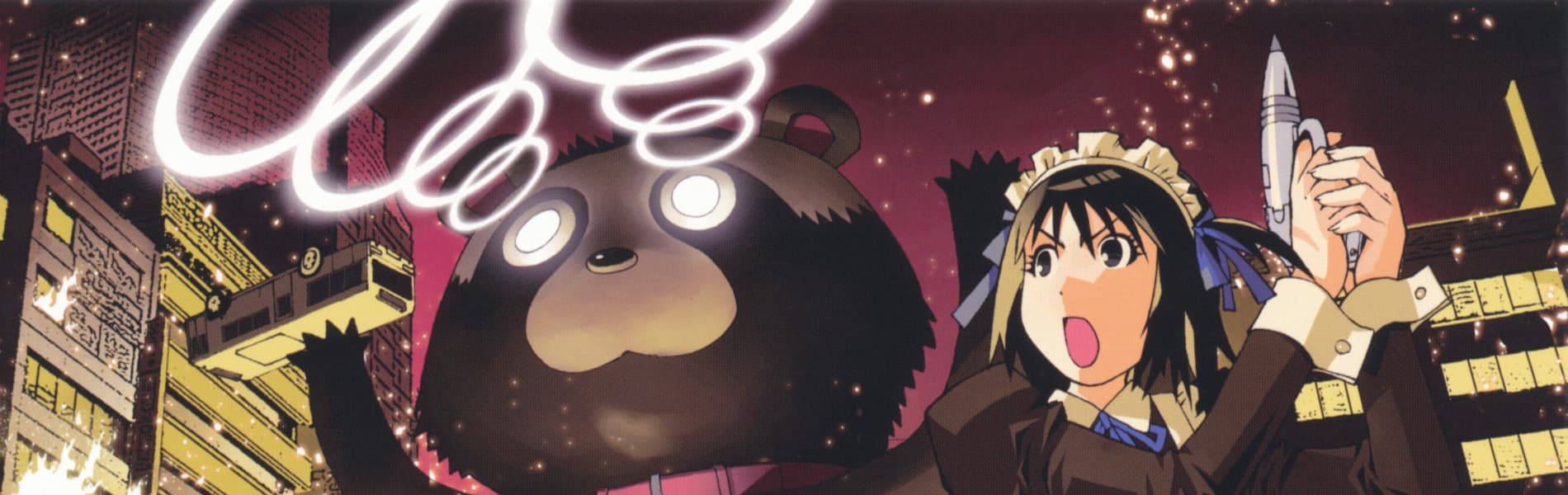

At this point in time, Studio SHAFT has well cemented itself in the hearts of many anime fans with its peculiarity. That is, with their anatomy-defying head tilts, love of symmetry and vectors, avant-garde artistic direction, and the list goes on. Recently, I wondered, does my perception of SHAFT's reputation hinge on simple novelty or genuine quality? Is the so-called Shinbou style a dull one-trick pony or remarkable ingenuity?
Well, I concluded that, does it actually matter? Regardless if there's dissonance between originality and experimental, I've come to love the idiosyncratic nature of SHAFT. The departure of some of their talents in the last few years has left me uncertain of their future, but the groundwork they've laid in the past couple decades is entrenched with numerous classics certain to keep their soul fresh for years to come.
One of which, is a lesser-known and quaint slice-of-life of which you're presently reading a review on.
Spoilers ahead. Skip to the end for a short, spoiler-free review

The Detective of the Century
Along with the Monogatari and Sayonara Zetsubou Sensei series, Soredemo Machi was another source material that perfectly synchronized with SHAFT's eccentricity. Typically, slice-of-life doesn't scream eccentric, chaotic or disheveled. And yet, ~~the town moves~~ Soredemo Machi is just that. With "mystery in mundanity" at its core, the mystery, supernatural and slice-of-life coagulation was a match made in heaven with Shinbou's insatiate peculiarity, still running high from overseeing Bakemonogatari the previous year.
Speaking of Monogatari, perhaps fans will find these two series swimmingly striking from the very get-go. That is, that Tomoyuki Itamura was the episode director of the pilot so it'd make sense to see some resemblance between his work on Monogatari and the very first episode. But enough with finding excuses to go off on a Monogatari-esque tangent about Monogatari, I still haven't delved into the actual story of Soredemo Machi, haven't I?
Rather than exposing the overarching plot, it's more meaningful to first introduce the peculiar high-school detective, idiot savant maid named Hotori Arashiyama. Less of a character, more of a condensed personification of a natural disaster; Hotori drives the episodes wild with her cluttering antics and dopey personality. The poor souls that encounter her for even a brief moment are in for hell. Policemen's testicles be damned and math teachers' sanity forsaken, this maid detective whirlwind ensures any situation to be blown out of proportion for the sake of the viewer's entertainment. Then there's also Chiaki Omigawa, who sold 80% of her character for me, with her childishly whiny voice bringing Hotori's dumb nut self to life. Central to the entire series, you'll be hard-pressed to enjoy Soredemo Machi if you don't find Chiaki's lovably annoying voice appealing.
It's a bit as if Hotori herself invaded Shinbou's and the individual episode directors' minds during the creative process of the show, whispering childishly sweet nothings into their ears as they excellently breathed exaggeration and dumbfounded peculiarities in the direction. Dramatic close-ups, overemphasized motions, weird in-between breaks of Hotori's pet racoon Josephine spouting random nothings and much more. Well, these all just sound like typical SHAFT, though. Nevertheless, these all largely contribute to constructing the narrative of mundanity coexisting in absurdity, and vice-versa.

The Appeal of the Mundane
What is this coexistence of mundanity and absurdity, you may ask? Well, just look around you. The Soredemo Machi manga was in anachronistic order, which the anime went further and selected episodic plots in no particular order. The irony of this chaotic order, is that it best resembles our mundane daily lives. That is, there's no particular structural order to the events and situations we find ourselves in. Shit happens, maybe for a reason or maybe not. There's no resemblance of a solidified plot line in Soredemo Machi, it's simply a barrage of antics on antics. Though, the wackiness does simmer down at times to alternatively offer the mundanity with a comforting sense of tranquility. There's Hotori and Sanada skipping school for a "date", Hotori and her younger brother sneaking out for a midnight stroll and Hotori's little brother and his classmate's secret "date". These occasional switches in tone serve to remind the variety in Soredemo Machi.
While variety is of the topic at hand, the supporting cast does its best to carry the show, and succeeded well. Hotori's main clique, comprised of the tsukkomi Toshiko, heart-stealing Kon and comparatively-scarce-yet-entertaining Haribara, are logical rebuttals against her often irrational remarks and actions. There's also the ever-entertaining head maid Uki, often the trump card when Hotori's friends fail to keep her in check. And if I may add, their voice actors were just as remarkable as Chiaki's. Kon and Uki's, especially stood out to me. There are several others who make their imprint on the show, as it generously allocated the spotlight in some episodes to them, rather than Hotori. For instance, Uki's late husband wanders around town as a ghost in a fit of melancholy, though ending on a lighthearted and humorous note at the end. Though that episode was overwhelmingly supernatural, it and other episodes shining the spotlight on the supporting cast upheave the presence of the town, of community and of life. After all, isn't life about being surrounded by people?

The Appeal of the Absurd
As mentioned before, there's a supernatural aspect imbued in Soredemo Machi. The aforementioned episode of Uki's late husband's ghost is one such example, but there's also the time-traveler candy episode and dimension-warping aliens episode, as well. Certainly, I won't attempt to cram these into a box arguing that these happen in real life, as well. They're stemmed from fiction, rather than mundanity.
For the absurdity stemmed from mundanity, it's present in almost every waking moment in the show. Otherwise normal conversations turn into hysterics and drama. Moriaki's lecture to Hotori turns into a psychological mind game of choosing the correct chair that wouldn't be out of place in a Kaiji episode. A simple ping-pong game turns into Shinbou's brief rendition of Ping-Pong: The Animation. Rather than rattling of every instance of normal situations turned strange, it's shorter to say that when Hotori's in the room, you're guaranteed to see the barriers of normalcy shattered. Perhaps it's here that you'll find the most striking resemblance to the Monogatari series, with their listless conversations somehow turned extravagantly peculiar and dragged out (Alright, Monogatari tangents are banned from hereon out).

Home, Sweet Home
The last episode in particular hit me with how great the chapter selection choice was for this adaptation. Featuring the least antics and comedy typical to the show, a much more subdued tone of melancholy is presented when the plot centers around Hotori being fucking dead.
Detached from the mundane, Hotori travels to heaven and slowly realizes that she's dead after being hit by a truck. The highlight of the episode, possibly the entire show, is her silent witnessing to her family and friends' reactions to her comatose state. Her friends in denial of her death, the pop-shop owners in anger at the truck driver, her father bargaining to the gods with shrine offerings to return her back and the general depressive air hanging around the town; everyone encompasses different stages of grief upon the news. The spectacular voice-acting from the supporting cast has the perfect chance to outshine here, and successfully does so. And Hotori's usual cheery tone is gone, her still squeaky voice now penetrated by the verge of tears and overwhelming sadness. The soundtrack accompanying everyone's lines is just as fantastic, supporting the already melancholic tone to its full extent.
But Soredemo Machi is simply not the same without the enigmatic maid detective, so Hotori is unsurprisingly revived due to God's mishap. Brought back to life, life is well and the show gracefully ends on yet another comedic antic.
This particular episode might be seen as completely out of left field, even considering how quirky the show already is, and too jarring of a tone switch. However, I loved every moment of it. I think it encapsulated the final, overarching theme of Soredemo Machi. That is, the town keeps moving. Life keeps moving. Regardless if you, the main protagonist in your own life, were to disappear and regardless of how impactful your presence was, life doesn't bat an eye and keeps moving forward. It isn't as simple and straightforward as a linear path, life adapts to whatever change happens and branches off in innumerable branches. Perhaps it's too bitter of a thought to entertain, but it's an unforgiving truth. Though the resolution here was much more forgiving and favorable, life is too busy of an entity to stop its track for one person.
Regardless of what occurs in your life, life all over the world will keep moving. The world itself could end, and yet, the town keeps moving.

Conclusion
Life is an unpredictable whirlwind and not even God himself could permanently stop it in its tracks. Soredemo Machi condenses this idea and dips it in sauce flavored with absurdity and mundanity. Maid detective Arashiyama Hotori faces the world headstrong, with nothing able to halt her as she manages to force normalcy into peculiarity everywhere she goes.
Shinbou's creativity litters the entire show. Offbeat cinematography, lively character animation and uncanny monologues/offsides point to a single thought, "Ah, that's definitely SHAFT". Soredemo Machi was a perfect chance for Shinbou to shine the spotlight on his ingenuity. 2009 was Bakemonogatari, 2011 was Madoka Magica and 2010 was Soredemo Machi.
Featuring a cast with strong and rich voice acting, the characters are sure to hook you in with their just as strong distinctive personalities and chemistry with one another. Though, this chemistry is mostly everyone acting as the tsukkomi to Hotori's boke. Mundane situations are turned absurd and supernatural situations are turned even more absurd.
Though, at their cores, these episodes are mundane and that's what makes Soredemo Machi appealing. Despite its surface-level absurd antics, there lies a surprising genuineness to the show. Surely enough, it's all spelled out in the title, too. Whether we change or not, whether we disappear or not, whether anything happens or not; the town keeps moving.
If you decide to watch and finish, please also check out the original source manga, too! I've written a review for that, as well.