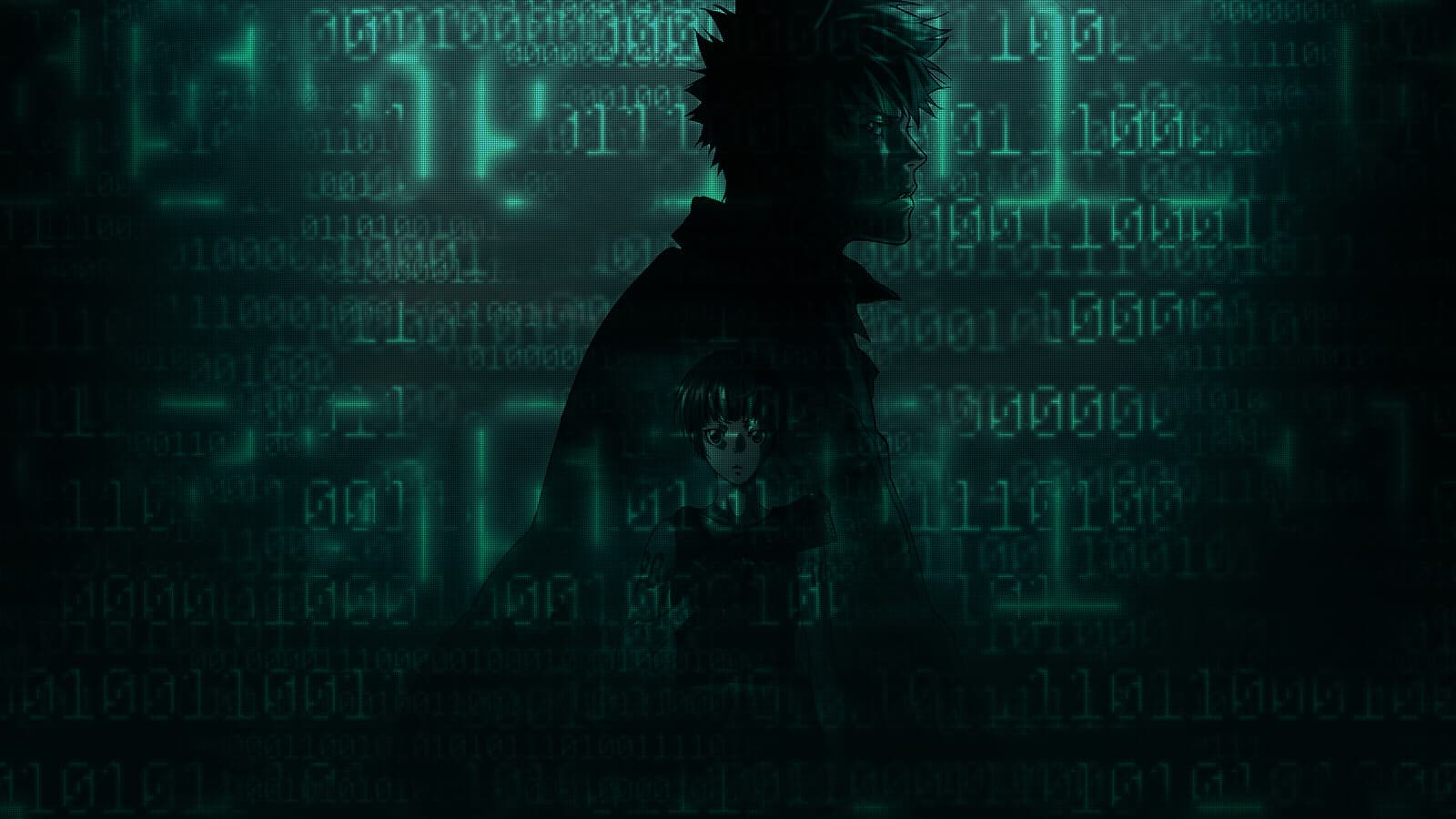
PSYCHO-PASS
a review by APortInAnyStorm
a review by APortInAnyStorm
PSYCHO-PASS will not be the first story to discuss the ubiquitous philosophical issues of free will, value judgments, and the eternal debate between security and liberty - and neither will it be the last. In a world where many people like to think that they know enough about politics and history to write entire treatises on why their favorite ideologies should prevail, without realizing that the more they think they know, the less they really know, it is fitting that here we have an anime that tries to cram as many heavy topics into 22 episodes as possible without delving too deeply into any of them.
The result is an extravagantly-prepared meal comprising a little bit of everything that never gives you enough time to chew over one item before shuttling you on to the next. Yet ultimately, it is such an entertaining anime that even the harshest skeptic would find much to enjoy, even if many uneasy afterthoughts inevitably linger long after each episode is done.
Premise (4/5): Not many anime have the cojones to dive headfirst into a meticulously-constructed setting and immediately set about deconstructing it from the get-go. Dystopian near-future sci-fi anime are not at all uncommon, and the dilapidated slums and disgruntled citizens are taken straight from the playbook, but the sort of authority questioning and willingness to plunge into the abyss of controversy that happen in PSYCHO-PASS are typically only seen in Western movies. This alone already makes PSYCHO-PASS a more original anime than most, though that does not mean the premise itself is unfamiliar.
In a world where the city's best and brightest brains quite literally run the show, removing all pretense of privacy and policing the unstable thoughts of the residents via scanners and cameras placed in every street corner, it is those who dare to toe the line that seem to suffer the most. It is so far unclear what sort of catastrophe has led to such a drastic curtailing of fundamental freedoms - hints are provided here and there, but nothing concrete about the history of the PSYCHO-PASS universe is really given in season 1, which makes the setting feel just that little bit artificial. However, the frequent insights into daily life (the costume changer, VR headsets etc.) do add a lot of color to the otherwise drab reality of PSYCHO-PASS, which helps keep viewers interested.

Characters (3/5): A diverse cast of personalities make up Division 1 of the Public Safety Bureau, whose interactions and conflicts are sometimes straightforward, sometimes completely unexpected. Perhaps the most startling was the revealing of the familial relationship between Ginoza and Masaoka, which was casually introduced during an argument between the two without any prior notice or hinting as to the truth. An entire episode of the anime was dedicated to recounting Kunizuka's life story, which felt jarring seeing as Kagari was decommissioned before his own backstory could ever be so much as glimpsed.
The characters are likeable and easy to sympathize with, since they are victims of the system that incarcerates them for crimes they have never committed, but the way in which their stories are developed probably requires more elaboration than is given. Main protagonist Tsunemori Akane develops unbelievably well as an Inspector, turning into a cold, hardened detective molded on the persona of her favorite Enforcer, and straight-arrow Ginoza eventually does loosen up and give in to the inevitable, but the rest of the cast remain relatively static and monochromatic.
As for the antagonist mastermind Makishima and the criminals that he aids, though his motivations are interesting once revealed, they take quite a long time to uncover, leaving him as an enigma for most of the series. Which, to PSYCHO-PASS's credit, works fairly well, though it is occasionally difficult to decipher every element of his complex deliberations, considering how murky the dialogue can be. In fact, the dialogue might be considered one of the show's weaker aspects, as too much is often left unsaid, leaving chances to expand on the characters' thought processes going begging.
Perhaps the greatest criticism that can be made regarding the characters is the way in which their supposed intellect is expressed. Never in an anime have I ever seen this many random quotes from historical figures being thrown around in conversation. From Descartes to Pascal to Plato, an entire glossary of platitudes and aphorisms is hurled at the viewer at breakneck speed, which is especially a pain if you watch the series with subtitles, as you may have to pause the video and connect the dots for a few seconds in order to find out what the relevance of the quoted phrase is. Knowledge does not necessarily make one intelligent, and arbitrarily quoting philosophers and writers ad nauseam is a horrible way to go about proving one's sagacity.

Audiovisuals (5/5): The incredible quality of the audiovisuals in PSYCHO-PASS just about forgives any other trespasses. The direction of the action scenes is dynamic and vivid; the background art is detailed and expressive; the character and CGI animation is well-designed, fluid, and blends well into the surroundings. There is some gore and a few other uncomfortable moments of ultra-violence, but those only really add to the experience. I usually skip OPs and EDs, but the creativity of those sequences and the excellent music used in them meant that I never once felt tempted to do so. (The first ED has become a personal favorite of mine, both in audial and visual terms.) The soundtrack, a fitting, thumping repertoire of electronic and orchestral music, is always appropriately inserted, never too obvious, never too inconspicuous. In this respect, it is a spectacle for the senses that is little short of perfect.
The cinematography in particular deserves some special plaudits - it is some of the most extensive, flexible, and effective camerawork that I have seen in any anime. Perhaps this malleability benefits from a large animation budget, but the series is definitely made all the better for it. Ultimately, it is an action anime, and if the action is no good, why bother?

Execution (3/5): It would be harsh to say that PSYCHO-PASS makes many mistakes in its execution - after all, such facets are a matter of personal preference more than anything. Even so, much like the characters in the anime, PSYCHO-PASS often feels like it tries to be too clever for its own good. Obscure references line the list of episode names, and confusion can reign if a flashback has "3 months ago" preceding it, but no such timestamp is used on a later flashback. Narrative devices such as the cutting of the screen into three pieces to show each present character's reaction may be used once throughout the 22 episodes and never seen again. There is a relative lack of consistency in the overall approach of the storytelling, simply because PSYCHO-PASS tries to use too many ideas at the same time, without realizing that less is often more. These sound like minor nitpicks, and they probably likely are, but they held my mind back whilst I was trying to enjoy the many things that the show did get right.
Nevertheless, the myriad idiosyncrasies of this anime are charming in their own way, probably because so many of PSYCHO-PASS's themes and characteristics harken back to some of my favorite movies: Minority Report, for its pre-emptive imprisoning of criminals before they can even lift a finger in anger; Blade Runner, for its near-future metropolitan atmosphere and enigmatic upper echelons of society; Equilibrium, for its suppression of emotion and free will, and the underground resistance's desire to break free and find their own purposes in life - just to name a few. I am also reminded of Dimension W, an anime with a very similar and exciting premise that also ends up being hampered by its execution. PSYCHO-PASS dares do all that it can in its quest to become a unique show, which is always appreciated, but sometimes "who dares do more is none".
This show teeters on the edge of greatness, so I give it a tentative 4 out of 5 for now, and I definitely look forward to watching the other seasons. But, bite off more than you can chew, and the ache in your jaws might just outweigh the satiation of your hunger.

37.5 out of 41 users liked this review
