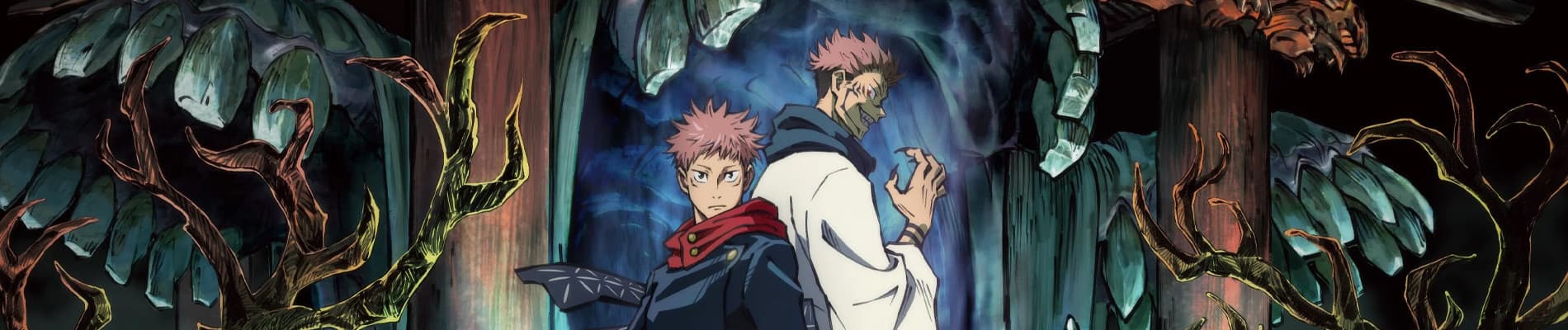
JUJUTSU KAISEN
a review by chezaye
a review by chezaye
Spoilers ahead!
I was eager to watch this anime: who wouldn't? Top-tier animation, attractive characters’ design, occult arts, wonderful openings. I actually had some problems digesting some things at first, and I dropped it. However, a friend told me to give it a second chance, because the overall plot was deserving of my time. I still didn't like the fast-paced introduction of our hero but, eventually, I felt trapped in the vivid fighting scenes and the engaging plot. I’ll thus focus on the main points I didn’t like and, lastly, on things that made me appreciate this show.
Things JJK got wrong, or reasons that made me drop the show at first:
• First of all, I hated the fact that almost everything relevant about the main character happens in the first episode: an overpowered human being perfectly knows how to fight a gigantic demon/curse? No context at all? I felt annoyed by the sheer straightforwardness of this show. Why is Yuuji so strong, how can he fight monsters even if he doesn’t regularly fight or simply practice karate, boxing, or taekwondo? How could he possibly CONTROL a millennial demon with no efforts? I got that it will be revealed later in the show since we couldn’t hear it from his grandfather. Still, it felt wrong and too rushed;
• Even if the protagonist had been introduced without formality, we still don’t know anything about Geto. This adds suspense and certainly keeps the audience waiting for the second season, or encourages them to read the manga. Hanami is an interesting character, its actions are underpinned by strong reasons. However, Mahito had plenty of screen time and I still feel like he’s flavorless. I think that his character design lacks depth. I still can't decide if it's deliberate or a writing flaw;
• With a bunch of strong, interesting, and non-conventional female characters… WHY THE HELL WOULD YOU DRAMATICALLY REDUCE THEIR SCREENTIME TO THE BARE MINIMUM? Give! Us! More!
Things JJK got right, let alone the wonderful animation and the characters' design:
• Even if Yuuji, Nobara, and Megumi’s personalities resemble the brightness of Naruto, Sakura’s temper, and the mysterious aura revolving around Sasuke, there is no ambiguous hint at a romantic relationship/triangle between the main trio: they are simply friends. Yuuji brings in the necessary and healthy amount of idealism and kindness, he's funny and we still have a lot to learn about his past. Megumi portrays a calm and rational facade, anguished with a turbulent past that is for us to discover. Nobara is strong and selfish when necessary, but altruistic in demanding circumstances. The overall chemistry between the three of them is significant;
• I’ll now move on from Nobara’s isolated example to the whole spectrum of female characters in JJK. They are STRONG, they have REAL PERSONALITIES, not stereotyped ones, with REAL STRUGGLES TO LIVE WITH, REAL AMBITIONS driven by motivated reasons. It sounds so silly to say, given that we are so used to appreciating these features in male characters. The amount of fanservice is pretty inexistent, as well;
• Supporting characters are so relevant that I rarely found people dramatically in love with the main trio: it’s easy to be charmed by Nanami, Gojo, Junpei (poor him), Mai, or Maki. It means that well-written characters are an advantage to capture the viewers and that they have a strong potential to evolve in the future;
• There are no excruciatingly prolonged or boring fillers/subplots: except for the sports tournament between the two schools, which somehow urged the author to introduce some other students, I felt like the anime was fast-paced in the progression of relevant events, which can be really rare in the shonen market. The comedy and funny scenes also alternate the perfect pinch of horror to well-deserved lightness;
• I’m absolutely obsessed with the openings and the endings. They contribute greatly to the auditory and visual experience, definitely a great choice to attract viewers and keep fans engaged.
128 out of 157 users liked this review
