Cat Soup
a review by saulgoodman
a review by saulgoodman
Without sounding like a beret-donning art snob, Arthouse films, and the avant-garde in general, possess a charm usually lacking in more mainstream entertainment media. Though often at the cost of elucidated stories, story development, themes, etc, I find a mesmerizing subtlety stashed away in the works of Satoshi Kon, Studio 4C, and Masaaki Yuasa. The latter who's of the essence in this review.
In a roundtable discussion of the best anime directors, titans like Hayao Miyazaki, Isao Takahata, Mamoru Hosoda, Makoto Shinkai, Satoshi Kon and Kunihiko Ikuhara will undoubtedly be thoroughly analyzed. I'd throw in Masaaki Yuasa without a moment of hesitation. Unconventional, would be somewhat of a dry description regarding Yuasa. There's a drunken flamboyancy to Yuasa's style, with exaggerated, fluid character animation and abnormal character designs that make moe-exclusive anime fans shudder. He has somewhat of an eclectic side, as well. The Tatami Galaxy, Lu Over the Wall and Ping Pong: The Animation possess a rehabilitative, bright optimism defined by quirky humor. Then there's his other works grounded in existentialism and dark themes, such as Kaiba and Devilman Crybaby. Now, where does a particularly infamous, 30-minute OVA lie in all of this?
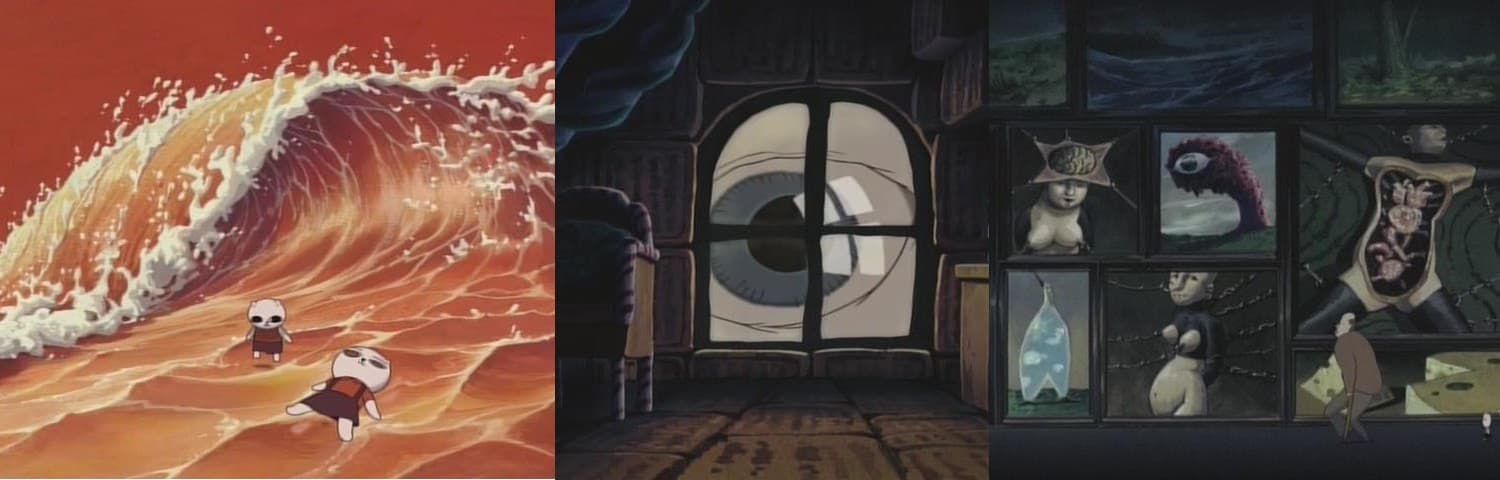
Summers are the best of times. Chirping cicadas, gentle summer breezes, soft bell chimes and otherworldly adventures.
Finding her older sister Nyatta whisked away by a strange blue deity, Nyako proceeds to chase them down the streets. Well, after, popping a neighborhood house wife's air seal, resulting in her deflation, all while the other house wives continue to gossip. Finally caught up to them, Nyatto pulls her sister's arm in a amusing tug-of-war fashion with the deity and eventually winning her sister's deflated body, signaling the start of a trippy series of events.
Earnest to retrieve Nyatta's lost soul, Nyako embarks on an otherworldly journey too incomprehensive to all spell out and interpret. A circus show where a women gets comically dismembered as an act, giant animals born out of clouds, a giant, sadistic human man showing hospitality to the exhausted sisters who he attempts to cook, God turning back the gears of Time. By summarizing these supernatural events, closer to reveries than events, in a meager, single sentence, I hope to convey the lesser importance of analyzing and interpreting these events, the greater importance of Cat Soup's whimsical immersion and experience.
Certainly, there's a blotting sense of existentialism omnipresent in Cat Soup, but I believe its presence isn't intended for thematic representation and interpretation, but for the sake of simple self-representation. Cat Soup doesn't seek to pose thought-provocation, it wants the audience to take part in its silently chaotic world through the eyes of Nyako. Or rather, their own eyes. Of course, there's the Hindu deity guiding Nyatta at the start and a blatant God for religious symbolism, and other subtilties beneath all the gore, maim and odd-ball events. I'm not going to vehemently reject the idea of people interpreting the course of events, because analyzation is part of any media's experience. However, Cat Soup is as silent as its protagonists, it won't confirm or reject anyone's interpretations. It's more keen on flashing its humorously dark world in of itself, spared from consuming overarching themes. So, I suppose Cat Soup has a twisted sense of purity. A purity defined by a greater desire to represent itself, rather than themes.

Silence is a virtue, and Cat Soup embraces it.
Cat Soup has no oral dialogue, occasionally broken by grunts and mumbles. While it does rely on verbal dialogue at times, via speech bubbles, there's a strong case of "show, don't tell", executed in a plethora of ways.
Ironically, the lack of dialogue immensely elevates the auditory experience. In the scenes devoid of obscure and explicit chaos, there's a relaxing quaintness to it owed to the sound production. Take Nyako and Nyatto's home at the start. The summer bell chiming, cicadas blaring, cluttering of dishes being washed and Nyako's soft pattering on the wooden floor exude such a mundane, homey atmosphere, unaware of the looming otherworldly adventure. Besides elevating the world-building and ghastly atmosphere, the sound production is phenomenal in just of itself. The scene of Nyatto's detached arm being sewn back is my favorite instance of the great auditory orgy, with the sharp, clear sound of the needle pricking Nyako's arm.
Background sound design aside, Yutoro Teshikai did an equally memorable job with Cat Soup's OST. Also devoid of words, the instrumental songs have a delicate beauty to them, though a bit too creepy to be inserted into a Ghibli film. The last sequence of Nyako and Nyatta crossing the Styx River showcases the height of the euphoric OST, somehow simultaneously relaxing and unnerving.
Perhaps the strongest visual appeal of Cat Soup is in its story/image-boarding, done by none other than Yuasa himself. The very opening sequence of Nyako playing with her toys in the bathtub from a low-angle shot, proceeding to jarringly and elaborately snake the camera's way throughout the house, to a close-up of a cicada corpse, a trail of ants then a bed-ridden Nyatta flamboyantly shows off the great story-boarding and cinematography, showcasing the talents of Yuasa and the animators.

Nekojiru, the original creator of Cat Soup, had a laudable, timeless style defined by contradiction. That is, her alarmingly adorable anthropomorphic chibi characters living in a world so ripe with death and maim, to the point of comical tone. Rather than what the laughably violent, explicit situations represent on a thematic level, I believe the late mangaka wished to represent her jarring worlds in of themselves and their all-encompassing explicitness. Though director Tatsuo Satou and Masaaki Yuasa considerably differed from the source material in this short film, the value remains.
Despite being credited for scripting and story-boarding, Yuasa's DNA is omnipresent throughout Cat Soup as if he was directing this himself. The cinematography and story-boarding are eccentric and fascinating, elevating the otherworldly nature of Cat Soup. And of course, what's a Yuasa work without funky imagery? One of the final sequences flashily and erratically vomit Yuasa, with a barrage and montage of short, colorful, vivid, imaginative and bizarre scenes.
Perhaps one may believe that arthouse films and experimental works possess themes and messages too snobbish or pseudo-intellectual to reveal themselves to laymen. Or perhaps they're just devoid of themes for the sake of being distinct. Cat Soup borders somewhere between these two thoughts just as much as it borders reality and dream in its story. While interpretation is part of an experience, immersion is the focal point of the Cat Soup experience. It feels like its existentialism and other dark themes exist to guide you through the swirling world and the choice of silent and deadpan protagonists wish for one to experience this world not through their eyes, but one's own.
Come in blind, come out even blinder.
71 out of 74 users liked this review
