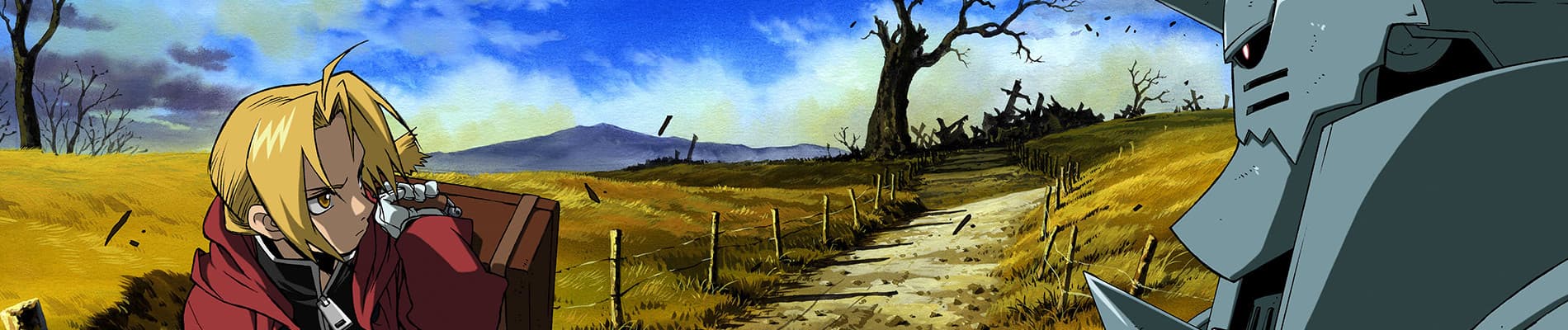

I make it no secret that I am very much a fan of Fullmetal Alchemist.
I am one of the few owners of the rare Blu-Ray set, so nice I bought it twice, not just any release of it, but the special edition release that comes with a postcard collection (not quite insane enough to get the big boy ultimate edition though), I have a nearly complete collection of the DVD volumes purely for their cover art, I have stomached remarkably poor licensed games simply because they were tied to this series. To top it all off, during my last rewatch I annoyingly spammed everything I bothered to take a screencap of (and I took over 1000 by the end).
Needless to say, anything I write will be immensely biased. Bias for this original work will seep out of every pore of this review, let this be a warning, if you have not seen this series, don't read the review. I'll probably spoil things for starters, and you generally won't get a feel for the series. If you want a proper review, there's tons more to look at. My short answer on whether not the series should be watched for anyone asking that is HELL YES. Go watch it right now, the only bad episodes are 4 and 10, everything else is a great ride. Now then, on with the review.
Typically, these things would go over the series history, but I'm above that. Mainly because, again, tons of reviews already do that for this series. Rather, I'd like to clear the air on one topic, that being when 2003 became a different series from the manga, and it's honestly pretty obvious. A lot of people say it changed gears at the Greed arc, others say they simply rushed out an ending when they ran out of time, and obviously these people haven't seen the series, as there are very deliberate changes right from the start. Namely, the choice to change the series timeline and furthering the idea of religion as a con in the Liore episodes.
For the former idea, the changes to the series timeline are rather obvious. Tucker's content is moved to before Ed is a state alchemist, Barry the Chopper is introduced first as a human long before he originally appears, the conflict on the train is inserted to be Ed's first meeting with Roy, and so on. It's these changes, ones that most people will shrug off, that add and up add to 2003's core ideas. Tucker and Nina's tragedy being so early on, in addition to what comes after that conflict, shapes Ed's views of Amestris and the military government, and it pushes him further in to his idea of alchemy as a religion of sorts. It's his escape from Nina's tragedy, when he finds her splattered against the wall, all he can do is keep performing that prayer motion, and slamming his hands against the wall, even though nothing is happening. A tinge of irony is present to this whole affair, present in the manga as well, but the change to Ed's reaction is what gives these things different meanings. Nina's whole tragedy was because of the alchemy Ed revolves his whole life around.

Now, I said a lot there, but it's pretty easy to turn your nose up and go "How does that tie into where the series went later on?", and believe me, it's a bit of a jump to go from small changes completely reshaping how you view the context of a scene, to dimension hopping and World War I. But these are seeds planted to set up the different direction the story goes, as Ed's character itself goes in a completely different direction. Throughout 2003, Ed is consistently brought down, emasculated, and generally thrown a dozen curve balls every new plot revelation. He's used by some members of the cast, lied to for his mental wellbeing by others, and the few remaining ones assist in systematically destroying his worldviews. To go back to the idea I mentioned earlier, the Liore episodes focus more heavily on the con-religion, that being the church worshipping the Sun God Leto. While in the manga, this is a nice start to the series, 2003 makes this the inciting incident for Ed's character deconstruction and reconstruction. It is here where we see him mentally beatdown on Rose, making her life infinitely more difficult, having to live with her sadness instead of blindly following a religion that promised her impossible things, and while Ed says the same lines here, this section, where Ed talks to Rose, is taken by the writers and they run with it.

As 2003 goes on, you see that Rose and Ed were suffering the same way and were dealing with it the same way. Ed couldn't live with the death of his mother, in fact, the first thing he says after his mother's funeral is that he's going to use alchemy to bring her back. He couldn't handle the tragedy he was forced to witness, and fell into a religion of his own, alchemy, and another drastic change 2003 makes is present here. How Ed perceives and uses alchemy compared to the rest of the cast. Him strictly following the laws of alchemy, going on about equivalent exchange, is something unique to him and not shared even in how other characters use their abilities. Scar's deconstruction can loosely be explained as equivalent exchange, but how do explain other stuff he uses it for? When he finds a pile of documents, he uses his ability to deconstruct the words and use it as a glorified "ctrl+f" command, I doubt that's very in line with Ed's rock solid ideals about alchemy, and Scar himself doesn't care for the rules of alchemy. He just knows his arm takes anything it touches, and uses it expressly for that purpose. Ed even laments in a 2003 original episode about how despite all of his suffering, him and Al have gained nothing in return.

All of this buildup around Ed's view of alchemy and equivalent exchange is continually highlighted across the series in small ways, though what should really clue people in is the Wrath arc. Wrath shows up, having Ed's missing arm and leg. There was no equivalent exchange, Wrath didn't do anything to gain them, Ed lost them because of his own stupidity and selfishness. Wrath even outright states this idea, saying Ed just left his arm and leg "at the door", and states he'll take Ed's whole body next, while mocking the self-imposed rule of equivalent exchange.

This, along with countless other smaller scenes, leads into the point where many people agree 2003 jumped the shark (and obviously I disagree), in a rather famous scene. Episode 49 is mostly a long and drawn out conversation Edward has with the series antagonist, Dante, about the nature of alchemy, the humans who use it, and of course, equivalent exchange. Here is where Ed's character is completely broken down by Dante, she confronts him with the fact that when applied to real life equivalent exchange is hardly true, that even if everyone puts in the same amount of effort, they inevitably won't have the same gain. She calls equivalent exchange what it is- a theory, not a hard rule. This exchange is then followed by Ed literally being taken out of his world and put into a new one, and not just his world, he's even taken out of his own body. His whole worldview is recontextualized and he's given a moment to have a real conversation with his father, now that he's been put on the road to understanding, both understanding his father's actions and his mother's death. This whole scene in another world ends with Ed getting crushed by a crashing zeppelin, and Ed is brought back into his own world, with new understanding.
When Ed experiences his second death, he is accepting. He waits by the door of truth, not getting enraged at Envy like he typically would have done before, even accepting Hohenheim as his father in these moments. His slow change is truly shown when Al brings him back to life, where he immediately performs alchemy on himself to bring Al back, knowing very well that the exchange might not be equivalent, and despite knowing this, he goes through with it. Despite knowing this, he hold faith that Alphonse was returned when he arrives back in London, and he has faith that they will one day meet again. He's no longer using alchemy as a religion, a coping mechanism, but as a way to hope for the future. Him holding onto his ideals like this, even in a world without alchemy is a good thing. It's far healthier than applying theories to everything, creating arbitrary rules to live by because of your own misfortune.

All in all, that was my manifesto on Edward Elric's character in Fullmetal Alchemist 2003, and the vast majority of my review. I could've chosen many different topics to talk about, as I believe this series does have a lot of depth to it, but I'll leave that to others. There's Lust's tragedy, Tucker's open-ended ending, Wrath's breakdown over his ideal of what a mother is supposed to be, Roy defying authority and sticking to his mature ideals even if it means he'll never succeed again, etc., there is so much within this quaint series to discuss, and it get continually overlooked because people are told not to watch it. There is actually a misconception that Arakawa wasn't involved at all with this series, when in fact she has done 4komas about its production (one will be shown below), drawn art for it (mainly in her chibified style), and in general has always expressed excitement about it, and she respects the series director Seiji Mizushima a good deal. In the comic example I'll be posting, she even highlights the fact that 2003 would coincidentally have the same idea as her, and she'd rewrite her own story because she wanted both the anime and the manga to be unique experiences.

So, in general, I think to put down this series in favour of the manga is a mistake. In addition to all that I've said, it has amazing direction on its side, an immensely intriguing and unique storyline, amazing characters, and it was beloved at the time for a reason. Good anime didn't start existing in 2009, the original anime had to compete with Hunter x Hunter, Naruto, and Bleach. I'm not saying you should put down the manga either though, in fact, what I am saying is consume both. They're both great, it's not a competition, the creators intended for both to be unique takes on the same original idea.
So, that is why I love Fullmetal Alchemist. Love it enough to put it in my 4x4. One day, maybe I'll talk about the movie and why it gets a deserved amount of hatred, and is also underappreciated in how it depicts Germany at that time. But, that's not happening now.
Until the day we meet again.
