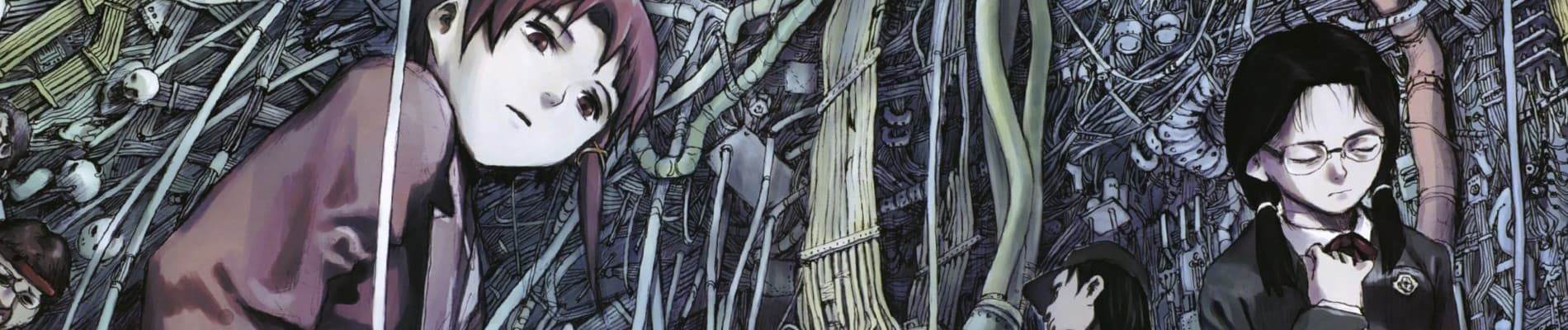
If you’ve been following the news lately, you may have heard of Chisa Yomoda, a middle school student who committed suicide by throwing herself off the roof of a tall building in a seedy downtown area of suburban Japan. If you’re like Lain, a quiet, introverted girl who rarely has a word to say to anyone, you may not have heard about what happened until a week later, when her classmates began to receive mysterious emails from the deceased student. Checking her email on her seldom used Navi, Lain discovers that not only has she received an email as well, but it openly references the rumors that have spread since the other emails went out, implying this is more than just a one off prank.
Intrigued, Lain convinces her IT savvy father to upgrade her out of date Navi, and she begins to explore the Wired, a world-wide communication tool that Chisa’s email claimed she’d abandoned the living world to ascend to, almost like it was another plane of existence rather than a bunch of ones and zeroes being transmitted between satellites. As Lain delves further and further into the technological rabbit hole, the lines between reality and the wired continue to blur, and the bodies keep piling up in it’s wake. Will Lain be able to discover the truth behind this strange alternate reality? And if she does, will it be the reality she wants to find, or will the revelations regarding her own life become too devastating to bear?
Serial experiments Lain was produced by Triangle staff, and if you haven’t heard of them, well, I honestly can’t blame you. They’ve released a few titles I’ve heard of, like Magic Users Club and Macross Plus, but Lain is by far the most famous work that they produced before they folded in 2002. The most recognizable thing about their history is actually the fact that they splintered off from Madhouse, and that does kind of fit in with Lain’s visual style, but they split off way back in 1987, so any actual stylistic connection between the two feels incidental at best.
What’s more understandable about Lain in particular is that it’s director was the late Ryutaro Nakamura, and more importantly, it was written by Chiaki Konaka, who worked with Nakamura on Ghost Hound and has a noteworthy taste for dark and psychological subject matter, as his contributions to the Digimon and Cthulhu universes should prove. Much like in Ghost Hound, Nakamura’s visual style and direction is the perfect match for Konaka’s writing, at least on paper. They were, at the very least, on the same page creatively. However, like in Ghost Hound, there’s a noticeable disparity in the animation and art quality. Since Ghost hound came out nearly a decade later and had a much better studio behind it, the divide between normal human animation and the trippy surreal animation was distinct, but both still looked good.
In Lain however, this is far from the case. The surreal animation is outstanding, truly ground breaking stuff. It plays primarily with static, focus and matrix-like 3D elements, and the ways it uses color turns just about every shadow into a portal to some outerspace pocket dimension dripping with blood-red plasma. The more normal, every day animation just looks bad. Characters are constantly off model, they barely move or even blink when they’re not the ones talking in frame, and frankly, I’ve seen better drawn faces in hentai doujin. It’s pretty obvious that one had to be sacrificed to protect the budget of the other, and it says a lot about the priorities of the series, but more on that in a minute.
For the most part, the music ties in directly to the visuals, more to enhance their surreal nature than to stand out on their own, so they’re pretty easy to forget. The exception to this is when composer Reichi Nakado, a professional musician in his own right, was able to shine through with his own rock and roll roots, including one really lengthy sequence that’s basically just an extended guitar solo. It’s a strong, but mostly forgettable soundtrack. The opening, however, is my favorite part of the series. The soulful song Duvet was performed by british indie rock group Boa, and while the lyrics seem largely inconsequential to the series, the song fits well with the visual of Lain wandering aimlessly through an empty town as she peeks in at people through their TVs. As for the ending, well, it’s basically just an extended shot of 14-year-old Lain naked on the floor next to some wires. I get the symbolism behind this... You generally show a character in such a position when referencing either birth or rebirth, so the idea of Lain being reborn through technology is there, but lingering on that one shot for over a minute and a half is kind of creepy and uncomfortable, honestly.
The english is dub kind of similar to the soundtrack, as it’s definitely strong and substantial, but it’s mostly forgettable as everyone fits into their roles and does their job to tell the story. Kirk Thornton has a pretty difficult job playing Masami Eiri, someone who’s more of a babbling mouthpiece than an actual character, and he does his best to make his edgelord monologues palatable. Actors like Jamieson Price, Patricia Ja Lee, Lia Sargent and Brianne Siddall perform their roles to perfection, but they’re really only there to act as hypemen for the real star of the show, Bridget Hoffman, who had to play multiple different sides of the main character while still sounding like the same girl, and she absolutely slayed it. It’s a strong dub all around, but it is absolutely HER vehicle.
Now, anime is no stranger to surrealism. Honestly, it’s probably the best medium FOR that genre. Don’t get me wrong, people like Darren Aronofsky and David Lynch can do amazing things with live action movies, but no other medium is more perfectly geared towards it than anime. Animation is already rife with possibilities, and there are western cartoons that have experimented with obscure styles and dense visual metaphors, but the western world also sees animation as mostly a tool for either children’s entertainment or crass, immature adult entertainment. Japan, on the other hand, uses animation to reach a variety of different demographics, so there are far less restrictions in place to limit the imaginations of it’s creative minds.
There’s also several ways that surrealism in anime can be used. The first name that should come to you when the subject is brought up will naturally be Satoshi Kon, and good. It absolutely should. He had a tendency to use surrealist visuals and concepts to explore the themes of his work, normally after establishing the world, characters and internal logic before gleefully breaking all three of them. The second should be Kunihiko Ikuhara, and again, good. Ikuhara had a lot to say about maturity, gender roles and sexuality, and his work has always been extremely dense with symbolism and avant-garde ideas to the point that understanding what he’s saying drastically alters your viewing experience, but as more of a lateral move than an actual improvement. And then you have works that just plunge you into a strange, surreal world and expect you to still be breathing on the other side.
Two of my favorite surrealist anime are Revolutionary Girl Utena and Cat Soup, both of which I’ve reviewed in the past, and while I didn’t go into any heavy spoilers, I do believe I did a pretty good job explaining some element of what they were trying to say. I also enjoy quite a few Satoshi Kon works, but aside from Tokyo Godfathers, whose narrative I felt was a bit weak before I started piecing things together, I haven’t even bothered trying to work out all of the intricacies, because their narratives are usually perfectly concise and coherent regardless of how weird they get. So, because I have some passing familiarity with anime surrealism, and I have at least a rudimentary ability to analyze them, I should be able to come to a decisive opinion regarding Serial Experiments Lain, right? Well, let’s dive in and see where this show lands on the surrealist spectrum.
To start, one of the stranger things about Lain is that it’s already using trippy visuals right at the beginning of the story. In most cases, an anime would save it’s surrealist visuals for a little later on, letting you get used to its version of the normal world before things started to get weird, so the difference in setting can feel more striking. When we’re introduced to Lain, after a gaudy sequence leading up to Chisa’s suicide, she’s already walking past shadows and power lines that look like they had more artistic effort put into them than she did. She’s already having trouble focusing on the board in class, causing letters her teacher is writing to go in and out of focus before Chisa’s death, which by the way happened a week prior, was even brought up to her. This could have worked, if what they were going for was some late game twist that Lain was dealing with a mental illness from the start and most of the events of the story were only happening in her delusional mind, but I don’t think they were.
To figure out what they were going for, we’ll need to figure out what the plot is, but I don’t think the inciting incident is ever made clear. You could say it’s a mystery surrounding Chisa Yomoda’s suicide, but that whole sub plot feels like more of a McGuffin to get Lain interested in the Wired than anything else. To try and decipher this, I’m going to have to set all the trippy imagery aside and instead look at a literal interpretation of the events of the first few episodes. A girl kills herself, and apparently starts sending out emails to her classmates. A week later, Lain discovers this, checks her email, and somehow develops an interest in computers. She immediately starts hearing about some doppleganger doing things she doesn’t remember doing, and the classmates who told her about the emails invite her out to a night club, where... As soon as she gets there... Some boy who previously ingested some kind of microchip drug starts shooting people, and kills himself right in front of her. Lain is sent one of those drug chips soon afterwards, and tries to figure out what it is.
Okay, great, is that the inciting incident? The mystery regarding the microchip? No, because we already know what it is and what it does. Before the shooting, we were told... Yes, I mean that literally, the story stopped dead in it’s tracks to tell the viewer... What it was, and what it did. But the chip is barely brought up after this. It gives the men in black a reason to spy on her, and it gives her a reason to interrogate someone for answers later on, but it’s otherwise unimportant, and you know what? That’s how a lot of things work in this show. Just about every potentially interesting element that gets introduced is just meant to advance the story to it’s next potentially important element. This happens with Chisa’s suicide, with her emails, with the chip, with the Knights, hell, even a ghostly image of Lain in the clouds doesn’t leave a lasting impact on the story. I guess you could just call this a slow burn of a mystery, but what’s at stake? What’s so important about solving that mystery?
Well, there’s Lain’s doppleganger, who threatens to ruin her reputation and tear her new friends away from her, but that feels more like a ‘stop looking into this’ kind of threat. The only thing that really remains important throughout the story is the Wired, but what exactly IS the Wired? Conventional wisdom would be to say that it’s basically the internet, but it doesn’t work the same way the internet works. Sure, it sends and receives email, but actual depictions of what it is and how it’s used are pretty scarce. From what little I remember seeing, it’s some kind of social area where people can connect to communicate, which is represented visually through people embodying avatars in some strange pocket dimension. This could just be an artistic interpretation of what’s actually happening, but we don’t see people huddled over computers while using it. We see people walking around in virtual reality headsets, or staring at a screen in a trance while talking disconnectedly to some invisible companion.
I don’t think there’s any direct analogue for this in our world, but I guess the best comparison I can make would be to say that it’s like an SAO full-dive version of VR chat, but instead of Ugandan Knuckles, you have the knights using disembodied lips to tell you that Lain is da queen, and you do not know de way. We learn way more about how the Wired came to be and what it’s doing to Lain than we ever do about what the Wired is. There’s an entire episode where they stop the story dead in it’s tracks five entire times to give you an American history lesson, drawing a decades long through-line between Roswell, Area 51, MJ12 and the Schumann resonance... Some of which is factual, some of which is based on old conspiracy theories... Until it eventually diverges into a fictitious Japanese guy using the Wired to try and start the Human Instrumentality Project. Keep in mind, this same episode featured a little grey alien in a Freddy Krueger shirt peeking in on people, which Lain is later accused of doing(she is literally accused of discovering Arisu’s deepest secret and spreading it, but I’m pretty sure HOW she allegedly did any of this is never explained, at least not in a way that Arisu or anybody else could believably buy into) and this is all happens after a previous episode where Lain interrogates an old German man who ran psychic experiments on children.
Okay, so the plot is hard to follow, that’s nothing new, but what is the series trying to say? I actually think I have this one in the bag. Throughout the story, people get sucked into the Wired, and the lines between that reality and their original one become so blurred that they kill themselves to jump into it, because they don’t need their fleshy bodies holding them back anymore. It also creates alternate versions of Lain that get her into trouble and threaten her personal life and attachments. This is clearly intended to be a cautionary tale about a technology that was still brand new in the Pre-Y2K time period that she show was made. It’s warning that the internet could become a tempting market substitute for reality, and could even lead to people developing split personalities and suicidal tendencies as a result.
There are two problems with this. First of all, that didn’t happen. Sure, there have probably been a few outlying cases involving people already dealing with mental illness issues in the first place, but the idea that people could abandon the real world for a virtual one to the degree this anime claims has become such a tired and cliched joke by the year 2020 that it almost looks adorable in retrospect. Don’t get me wrong, the internet has claimed a huge place in the modern world, to the point that social media has largely replaced in-person socializing, but mankind has mostly adapted to it’s presence and compartmentalized it to a mostly harmless place where the only thing about it that can really cause suicide on a noteworthy level is cyber-bullying. Also, the idea that you’re a different person from the version of you that exists on the internet just sounds like a lazy excuse for shitty behavior.
The other problem is that almost everything else that happens in the story... Aliens, government agents, microchip drugs, conspiracies, the works... Almost feels like window dressing that Chiaki Konaka used to make his message sound more profound and deep than it actually was, because instead of him just telling you what his paranoid, delusional fears for the future of mankind were, he buried it in edgy surreal nonsense, almost like he wrote an essay and then cut it up into a jigsaw puzzle. Don’t get me wrong, I’m sure there’s some solid backstory to everything going on in the series. There has to be some intricate way everything’s connected, and I’m willing to bet Konaka spent hours obsessively slaving over it to make it as airtight as possible, because Lain reeks of genuine effort like the passion project that it obviously was. If you’ve pieced it all together, or if someone else has, I’d love to hear about it, but I’m never going to figure it out for myself, and the reason for that is that I don’t care.
I love analyzing surrealist anime. I enjoy coming back to them and discovering some new element every time I do, which is why I hold shows like Utena and Madoka Magika in such high regard, and why Cat Soup is one of my favorite movies of all time. The reason those shows keep pulling me back in but Lain doesn’t is pretty simple: Lain gives me nothing to care about. There’s no plot, there’s no stakes, but most importantly of all, there’s almost no characters. The only people I give a crap about are Lain’s sister, who was the only character in the show who had realistic or relatable reactions to all the weird shit going on around her up until she went comatose halfway through the story, and Arisu(I am NOT going to call her Alice), who was the only character who seemed to genuinely care about Lain as a person.
And then there’s Lain herself, who is little more than a vehicle for the writer to explore his concepts through. She has no personality. Everything about her that should make a main character compelling, from her wants and needs to her arc and development, is designed specifically to revolve around the Wired, so Konaka can use it as a metaphor for the early internet. I have no idea why she pursued the Wired as fervently as she did, and I’m pretty sure in order to figure it out, I’d have to piece the show’s lore together to discover that she was some kind of psychic homunculous created by the German scientist to find that one Japanese guy who’s posing as God in the Wired and ascend to kill and replace him. The only thing I can really grasp about her as a person that’s at least kind of compelling is that she’s depressed about her neglectful family, and that does extend a bit farther into why she’d form such a strong attachment to Arisu, and that’s all great, but it’s still pretty bare bones when we’re talking about the development of a main character.
I’m totally fine with anime having deep, complex meaning and conveying some political or social message, but there has to be something else there that’s worth getting invested in. I don’t analyze Utena because I want to know what Ikuhara’s saying, I do it because I care about Utena, Anthy and all of their amazingly written costars. I don’t binge Cat Soup over and over again because it explores the conflict between family and religious values, I do it because of the little boy cat trying to save his big sister cat. All of the depth these pieces of media have is just icing on the cake, with the cake being stories and characters I love and identify with. Depth is great, but unless you’re given a reason to care, it can never become poignant. I didn’t mention it before, but there’s another way surrealism can be used in a narrative. You can use it as a distraction from content that’s not strong enough to stand on it’s own. There’s a LOT of anime that do this, from Haruhi Suzumiya using it to keep viewers from falling asleep during it’s endless philosophical monologues to... Well, pretty much anything directed by Akiyuki Shinbou, for better or worse.
This can be done well, but most of the time, it’s done to make material come off as smarter, deeper and more complex than it actually is. It’s hard to call a popular anime pretentious without getting called out for ‘just not understanding it,’ but when Lain starts devolving into edgelord monologues claiming there’s no God outside of the internet and using condescending words like “Merely,” it’s hard to take anything it’s saying seriously, and that’s before it decides to go the route of a heavily cliched style of ending... We’ll call it a Jesus ending, as that’s the least spoiler-y thing I can call it... Which is something that I will freely admit I’m personally biased against. I don’t even like it when it’s done well. Madoka Magika had an ending that was kind of similar, and even though it works perfectly in context, it’s still my least favorite part of the series. At least I cared about Madoka.
All of this leaves Serial Experiments Lain as an anime that’s more style than substance, more tell than show, more convoluted than complex, and more falsely prophetic than emotionally resonant. The only genuine emotion it manages to convey is the occasional fear of a character in danger, and the constant confusion of the viewer. I can marathon six episodes in a row, then turn on a random youtube video and forget almost everything I just saw. As I said before, it does seem like the people making it genuinely cared about it, and it doesn’t seem the least bit lazy or half assed. On the contrary, they truly believed they had something to say, and they poured their hearts and souls into saying it, but by focusing more on making the show look deep than on giving it any actual depth, they missed the mark pretty hard. I respect it for it’s creativity and ambition, but unless you’re looking for something trippy to watch while stoned, I can’t recommend it.
I give Serial Experiments Lain a 4/10
129.5 out of 196 users liked this review