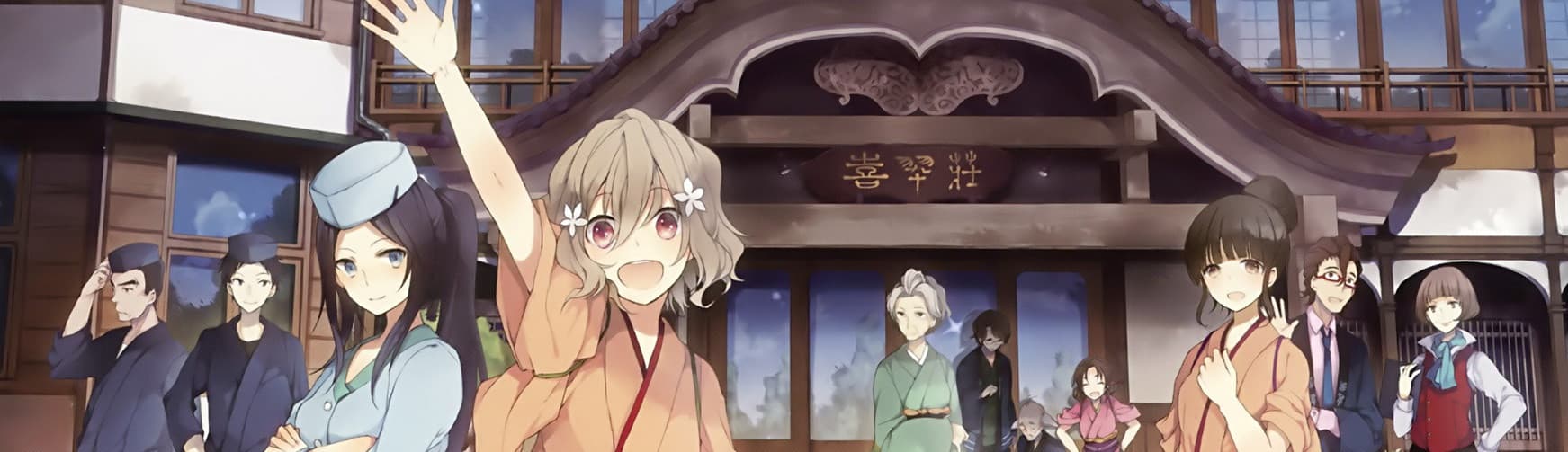
Introduction
Airing in April of 2011, Hanasaku Iroha is a show by PA works that serves as their magnum opus.This review will be a deeper dive into the themes this show explores as well as what I think of the anime that changed the way I have and will ever look at anime.
1
The Background/Staff
If anyone asked me why I think Hanasaku Iroha is one of the best in the business, a decent chunk of the credit lies in this part. Despite being released in 2011, it is still one of, if not, the best anime in the pure SoL genre.
- With Majority of the script written by a name known to many, Mari Okada, the story of Hanasaku Iroha is the first show that truly showcased the full extent of her talent - from the tight main plot filled riddled with strong introspective moments to having some of the best characters and coming-of-age.
These points are now all part of Mari’s writing, having presence in other shows that she wrote following Hanasaku Iroha, such as Anohana, O Maidens and Sakurasou.
Next up on the list we have Jin Aketagawa and Shiro Hamaguchi, each responsible for sound and music respectively.
- The former needs little introduction to the quality of the work he does as he is one of the biggest names in the industry, having worked on Kaguya Sama, Rezero and Yorimoi amongst countless other big shows. The lesser known latter, who has spent a large part of his career on One Piece is not to be slept on as well. Both do a wonderful job at bringing the whole concept of a ryokan, the inevitable advancement of the traditional town of Yunosagi and a boringly bustling Tokyo to life through OSTs and atmosphere.
Rounding up the main staff is director Masahiro Andou (Wolf's Rain, FMA). As is with his team, he plays a huge part in making sure Hanasaku Iroha succeeds. Andou’s style teeters on subtlety mixed with clarity.
- An example of this would be in episode 1▶ Video
where Jiromaru was cleanly set-up for his arc while the current one was running.
Aside from that, his use of symbolism and general story structure - especially during multi-episode and character focused arcs are executed with finesse. Thanks to these amazing backstage talents, Hanasaku Iroha was able to shine even brighter.
2
Characters
Following the technical aspect of the show is the practical side. Starting off with characters; Main as well as the important sides.
2.1) Ohana
- A phenomenal MC that is one of the key pieces of character in the show. As the epitome of a Coming-Of-Age character - she goes through a ton of changes. From an optimistically forward-looking yet aimless MC to an adjusted, determined waitress to finally discovering her own meaning of life and how to make the most out of it. All of this while never faltering in her own values, a trait all characters of this show share and one of its strongest points.
2.2) Sui
- The other piece of the puzzle, Sui is tradition personified. Because she is written so damn well, she is the core of most of the good drama in this show.
- She is confident and unwavering in her beliefs, values and absolute rules, always on the edge of right and wrong, something like following your heart vs doing the right thing, making her the perfect anti-hero/pseudo-villain as viewers are more often than not likely to find themselves agreeing with her views on certain events. Together with Ohana, these 2 are undoubtedly the core of Hanasaku Iroha.
2.3) Enishi and Takako
- The parallel of Sui, representing an evolving future generation. The two play the part of the fools - a young, inexperienced but hard working couple, serving as the shepherd of a new age where times change and adaptability is key.
- Throughout the show, Enishi is presented to us as a faithful son of Sui, always trying his best to learn and improve himself and the inn as the heir. Takako is introduced as his partner in crime, a manager he acquainted with during his college days.
- Together, they constantly look for new, innovative ways away from the norm to try to better the Kissuiso, much to Sui’s dismay. As a result of their clash in views, the 2 parties frequently have run-ins, leading to good, tantalizing drama, as both sides never truly have the upper hand since no one is right or wrong. I will go into further detail about some of their conflicts in a later segment.
2.4) Nako, Minko, Tomoe
- We complete the list of “essential” characters with this trio. Even though Ohana, Nako and Minko are listed as the main circle of friends, I decided to relegate the latter 2 down to the level of Tomoe; that of a smaller side character. Make no mistake, I am by no means calling the 2 of them weaker characters but rather felt that they fulfill the same purpose.
- All 3 of them fall under the umbrella of “Plot Material” for me - the in-betweens/content of most major arcs are filled up by them and their personal issues. As such, each of them fill a more generic character archetype i.e dere types and whatnot.
- However, these 3 individuals outmatch their competitors of a similar character type as they display the potential to easily develop into wonderful characters with the help of great drama, should the need arise.
3
Themes
Moving on the last segment of content, Themes.3.1) Growth + Tradition
- A topic I’m still not fully confident in discussing as I don’t feel that I have the skill to explain, originally thought to have separated the two, are growth and tradition. Going hand in hand, these 2 themes make up 90% of Hanasaku Iroha, always appearing in one form or the other around every corner.
- Briefly touched on during Ohana’s character segment is growth, the ever prevalent. Present in all of the characters and in our own IRL, growth is beautifully showcased in Hanasaku Iroha. Every character maintains their personalities and qualities while unknowingly becoming the best versions of themselves. A surreal mix. Even as a standalone, this aspect of the show is easily one of the best in the game. But when coupled with the next big theme, tradition, perfection is somehow lifted even higher.
- Tradition is no doubt the most unique thing of the show. It is presented in a way that I have only seen one other time outside of this show - Sakura Quest that comes out 7 years after that is nowhere close to this series. Tradition is constantly challenged in this show, through Sui, Kissuiso or the whole damn town of Yunosagi. Change is inevitable, we all know that. But when brought up in the face of tradition this brazenly, a miracle happens. We spend a decent chunk of runtime exploring the minds of the traditional, as they struggle to adapt to the ever-growing and advancing world around them, relentlessly finding ways to keep their treasured way of life alive.
- The centerpiece, or rather, embodiment of this is Sui. As is the way of a marvelous character, Sui displays both sides of the conflict towards the end of the show, showing her adept adaptability, being able to stick to her tradition while also breaking the rules to allow what is needed when the time comes, exemplifying growth and tradition together as one.
Enishi and Takako also fall in the same vein, except their part is of the new generation as mentioned in their own character study. Easily able to abandon tradition, they show growth by having the adaptability and innovation that the new generation leans towards.
- As for the other characters (Ohana, Minko, Nako and Tomoe), they play their part in a slightly different way - all of them go through the same type of growth while sticking to their own unique beliefs, as a result of their drastically different backgrounds.
- With such a vibrant cast going through the same process yet bursting with their own individuality, Hanasaku Iroha is the Coming-Of-Age anime that fans of the genre need to see.
3.2) Kissuiso
- Finally, the elephant that is surely tired of being in the room for 1400 words is addressed. The last major theme is the Inn itself.
- The silent deuteragonist of the show. Serving not only as a beautifully crafted backdrop inspired after the real life Inn in Kanazawa, the Yuwaku Onsen but also the source and heart of the story. In a sense, the story revolves around Kissuiso. It is the catalyst for the growth of all characters, the reason for tradition and the one thing that connects every single plotline. The importance of the Kissuiso cannot go unstated and credit really has to be given for this absolute marvel of a location.
- Coupled with the other major theme above, a bustling-ly quiet story about one’s meaning of life is perfected.
Conclusion
- This is technically my 3rd review of Hanasaku Iroha(2nd if you’re counting anilist only) done after my 2nd rewatch and I was hoping that I have 1up’ed myself from my previous attempts. I tried my best to incorporate and detail as much about the drawing points of the story as possible without spoiling.
- In my first 2 reviews, I state that Hanasaku Iroha is one of the best anime of all time and was my then-favorite anime. I have since found more shows that I personally enjoy more than it but what Hanasaku Iroha taught me will stick with me for a lifetime.
- #Aside from my personal stuff, I wholeheartedly believe that anybody, no matter your taste, will be able to at least appreciate this anime for what it’s accomplished.
Previous edition
vSpoiler, click to viewclick to hide
From the studio that brought you Classics like Angel Beats (2010) and True Tears (2008), comes a SoL never before seen. Hanasaku Iroha, 2011, is without a shred of doubt my absolute favorite anime of all time.Hansaku Iroha has everything - Visuals that far exceed its time, a Story that is unprecedented till this day, Characters that are intriguing and behave as realistically as actual humans, a Sub-Plot so good it could actually be a story of its own and last but not least, all of these achieved in 2011! (A lot of the objective criticism will trace back to this)
Brief rundown (my own rephrasing?)
The story follows a 16 year old Matsumae Ohana, forced to move from the bustling city of Tokyo to a Rural Town of Yunosagi, (based on the real life location of the Nishigishi Station in the city of Nanao) after her mother, Matsumae Satsuki, decides to elope with a man she recently met WITHOUT taking Ohana. In Yunosagi lies an Inn called the Kissuiso, run by Satsuki's mother or Ohana's grandmother. Sent there by her mother, Ohana must find a way to cope with her new life at the Kissuiso, following in her mother's footsteps of "Rely only on yourself".
In depth explanations (I suck at these bear with me, in fact I've never even tried it)
Visuals
Not much to say about this other than the fact that it's absolutely beautiful. For a 26 episode TV series anime it has some of the best animation. This was in 2011! See it and you'll believe it.
Story
This is the only part where I tend to have a hard time convincing people on how good it is. Without a doubt, this is the 1/2 of the anime's best features. As an Asian, this anime and everything about its' story hits too close to home. The drama is seldom overexaggerated and even when it is, it's usually for the purpose of comedy and not because of a mistake. It has a great flow of story for a SoL, nicely paced with equal parts funny, touching and downright depressing moments. While often bright and loud, it's during the sombre, quiet scenes backed by the beautifully animated background that truly shine the brightest.
Characters
The other half of what makes this show truly a masterpiece. As it should be with original stories where characters are tailor-made for its progression, no character felt out of place in any way, shape or form. Each character has their own unique set of priorities, personalities and the most important point - values. The show relies HEAVILY on the values of its characters. Every decision made by a character is shaped by their values, and this is the main reason of why I think this anime has the best characters. One more important point i forgot to mention is that the character dialogue and overall realism to real life is uncanny. I wouldn't, for even a second, doubt that any show can come close to what this anime has achieved in its time. If anyone were to disagree with me, let me preface it - any dialogue that is not made with the purpose of fulfilling comedy is ultra realistic. And once again, this was written in 2011!
Music
Someone fill me in on this I don't really pay attention to music in anime except for openings and endings. I simply don't think music is too big of an influence on a show.
Sub-Plot
I won't say too much about this because spoilers, but the back and forth of this shows' sub-plot is superb. There was only one small part which I didn't get, otherwise, MINT.
All in all, i rate this anime 10/10 personally. It is, like i said, without a doubt my absolute favorite anime of all time. If i had to rate this objectively, would ya guess it, it's still a 10/10. I firmly and absolutely believe that whether you come out liking or disliking this, you will not be able to deny this show of it's achievements.
So, if you've read this all the way, thank you and please check this anime out. This is my Anilist so you guys can come at me and tell me how shit my taste is and how I haven't watched the popular shows hence my hastiness on giving this 10.