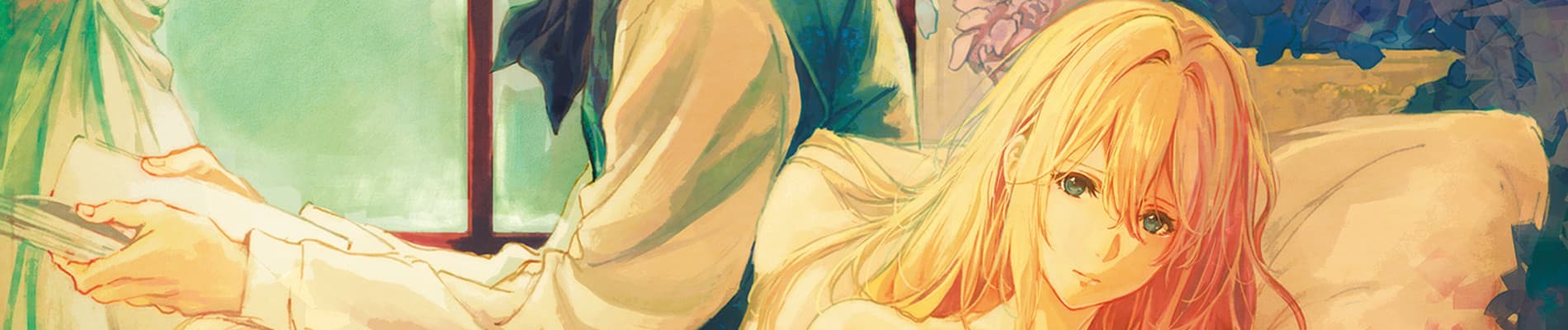
Our titular protagonist starts off as a machine-like soldier, a weapon of war. When the war ends, she's hired to serve as a Doll - exemplary servants charged with crafting tailor-made letters for their clients. Violet's profession leads her to encounter people from various walks of life. She acts as a first-hand witness to her clients' humanity, watching as their desires and feelings gradually emerge. Violet's letters conveyed emotions to others, and those emotions reached her in turn. Her empathy blossoms, transforming the stoic Doll into a caring, resilient individual. Now that she's grown, VE: The Movie gives Violet the opportunity to write a letter of her own.
This piece contains a spoiler, which will be tagged. Skip ahead to my spoiler-free Tl;Dr if you'd like to go in blind.
This new Leiden is explored in greater detail with Violet Evergarden Gaiden: Eien to Jidou Shuki Ningyou, which may be worth your time if you're in need of more VE. The key takeaway of this story choice is that of changing times. Leiden is far from a fragile post-war state; a symbolic radio tower erected in the city center embodies the progress of the nation. Technology has advanced, and innovations such as the telegraph and telephone are relegating the Dolls to a bygone relic of history. Times are a' changing, but some are struggling to flow with the tide.
We all knew that the show would have to come back to The Major eventually. Teased at the end of the TV series, speculation surrounding his fate has circled the community. These questions have also lingered long in Violet's mind, and the lack of closure has kept her from moving on in life. Just as her writing ability has grown, so have the feelings welling up inside her. Violet's clients have earnestly demonstrated the meaning behind the Major's last words. But now that ignorance is long gone. All she has are letters unsent and feelings unrequited. In its first act, VE takes ample time to explore the concepts of survivor's guilt and loss. The TV series still threw our protagonist into combat skirmishes and was thus unable to explore this territory. Now that we're well into peacetime, I found these threads to be rather compelling. VE reflects on the ramifications and toll taken on survivors such as Violet, the Major's brother Dietfried, and...
Spoilers aside, VE includes memorable callbacks to past adventures, highlighting a handful of important moments that impacted Violet's life. Coupled with this arc is one more Doll job Violet picks up on the side. We'll leave the finer details out of the picture for now, but let's just say this arc took several cues from the infamous Episode 10^^.
Is it right to swallow our regrets and carry on? How VE articulates its response is a powerful, resonant highlight within the movie. While the film gives a clear answer to these questions, it doesn't antagonise the idea of staying silent. At various points in the story, our central characters arrive at a common conclusion. They each decide it's best to bottle up their emotions and leave their past behind. Doing so isn't always cowardice, sometimes keeping quiet is the right course of action. Things will sting momentarily, but people are conditioned to get by without a Happily Ever After. It's a storytelling approach that caught me off guard, and more so coming from KyoAni.
I didn't want to be reminded of the arson incident that devastated Kyoto Animation. And yet, that was all that was on my mind as I headed into VE's final stretch. It dawned on me that this movie didn't need to get made. Just like countless anime IPs before, we might never have seen a conclusive ending to this story on our screens. And in this instance, no one would blame the creators; KyoAni suffered an unspeakable tragedy. In their shoes it would be understandable to throw in the towel and leave this tale unfinished. For all the fond memories and heartwarming stories this studio brought into the world, I was willing to accept that their time had come to an end. Surely, what we've already been given was enough.
Letting out the inner desires of our hearts is liberating, and seeking closure brings catharsis. Such is the message of VE, delivered uncompromisingly by KyoAni. Under trying circumstances, I anticipated some form of trade-off from the illustrious studio's gold standard. However, the film's visuals are as stunning as ever; I couldn't find a single frame where the art dropped below the quality that we've grown to know and love. Backgrounds and facial expressions alike look gorgeous on the big screen. A swooning soundtrack accentuates the highs and lows of an emotionally-charged script - one that demonstrates the value behind the feelings we share and the words we write. VE's lesson is about the importance of conveying messages of your heart while you have the chance. KyoAni certainly seized the opportunity to do so with this finale, and for that I'm grateful.
Violet Evergarden: The Movie brings definitive closure to this beloved series. Filled with memorable highlights from the TV season, VE still has a few more new stories to tell. The moving narrative, enhanced with the ever-sensational visuals and soundtrack, showcases the beauty in acknowledging the past that has shaped our present selves. VE also urges us to say what we need to say, while we still can. VE is a triumphant return for a hard-hit studio, a love letter from KyoAni to you. 7/10~
From the bottom of my heart, I thank you for making it this far! Feels great to finally enjoy the Blu-rays, I've been looking forward to revisiting the film ever since I stepped out of the theatre.
If you happen to like my verbose rants, feel free to check out my other reviews for seasons past and present. I also frequently post writeups under my list updates, so definitely take a peek if you'd like to see me mald over anime as they hit the airwaves. Peace~
First published at MyAnimeList on December 15, 2020. Edited for AniList.
49.5 out of 63 users liked this review