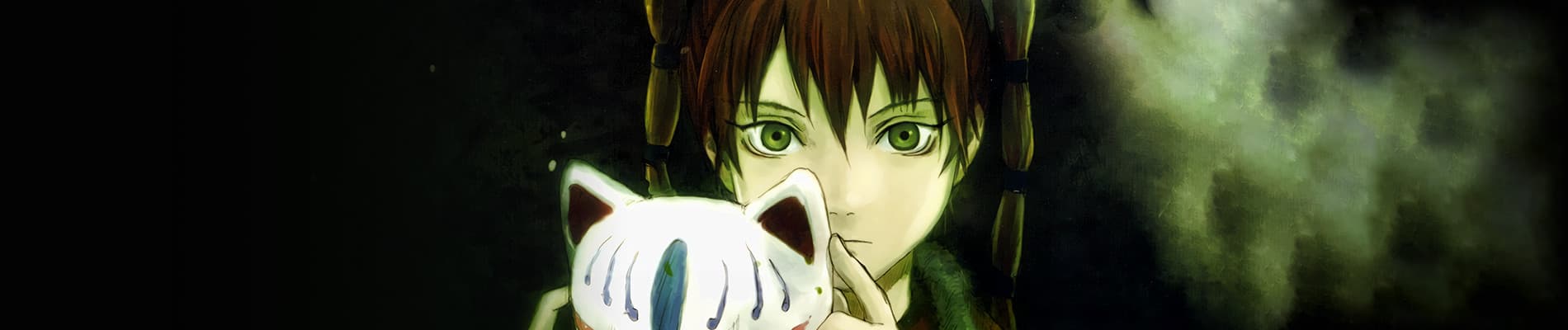
Texhnolyze
a review by corgetov
a review by corgetov
In my opinion, Texhnolyze is beautiful. It is a story of millions of words, told through so little dialogue. My appreciation for Texhnolyze lies in its execution, in its concepts, and in its intentions. However, Texhnolyze is not for everyone. The animation is off at times, the mood is overwhelmingly dark, and the pacing is profoundly slow. I personally was fond of these aspects of the anime, but I’m certain others will not be. It is intentionally obtuse, so it is perfectly reasonable to come away from it with a sour taste. Despite all this, I still encourage you to watch it, and to form your own opinion on it.
Additionally, this review does not come close to covering all of the intricacies involved in Texhnolyze, it simply aims to discuss what I perceive to be the central tension and message of the show. There is so much more to this anime that is covered better in other reviews, and I see no point in rehashing that.
The rest of this review assumes that you have already watched Texhnolyze in its entirety. Spoilers ahead. (There are also spoilers for the 2016 film Mother!, which I recommend if you enjoyed Texhnolyze)
We should begin at the heart of the show. Texhnolyze is about humanity. It attempts to present ideas and opinions on mankind’s journey through time using the medium of animation, in a style I find very reminiscent of the film Mother!. Like mother, Texhnolyze follows the life, and more prominently the death, of humanity through heavy usage of metaphor and symbolism. Every character, every setting, and every motif represents some aspect of humanity. The precise meanings behind each and every character and concept within the series is beyond the scope of this review, and also already covered by other reviews. Rather, I intend to focus in on the broader message of Texhnolyze. It puts forth that, at its purest, humanity is unadulterated, unreasonable rage. Rage against one’s enemy, rage against cosmic injustice, rage against nothing at all except the unrelenting entropy of the universe. Thus enters the human: Ichise.
Ichise is rage. He is hate, he is violence, he is stubbornness and perseverance. His entire life is defined by oppression and exploitation. Nothing is fair for him. He literally fights for his life each day, earning his living as an underground boxer, as shown to the audience through a brief montage at the beginning of episode 1. But he never gives up. The show claims that, like mankind, Ichise will fight on to survive, even if he has nothing to live for. Within the first few seconds of the show, Ichise's character is immediately established. His modus operandi (the manner in which he interacts with the world) is violence. He is entirely unaware of how to function in society through any method other than violence. His inciting incident occurs when his boss, who is tied to the mafia-esque Organo, rapes him. He initially submits, but as he grows fed up with the situation, sees no out except violence. So he hits her, hard enough to knock her across the room. In return, he receives violence, as the Organo arrives later that night to literally take an arm and a leg.
We are soon introduced to our second vessel of humanity, the head of the Organo, Onishi. Onishi is entirely the opposite of Ichise. He represents security, the desire to maintain order and structure in society. Compounding this, despite clearly being very capable of it, he abhors violence. He rarely draws his blade, often citing that “the city does not wish for a spectacle.” This subservience to an abstract, as yet unobserved entity, combined with his penchant for hierarchy and clear planning, immediately portray his place in the narrative. He is an alternative, functional state of being for humanity. He is much more relevant and relatable to our current day humanity, as our world is one of order.
Order, and its counterpart: chaos, are important concepts in this show. They represent the central tension of Texhnolyze. A society of order is one where people follow laws, even if nobody is watching. A society of chaos is not necessarily a land with no laws, but rather one where the laws are not absolute. Chaotic beings do not follow laws, simply for the sake of following them. As such, in a chaotic society, the strong hold power. They can be strong mentally, physically, or in any other manner. The important thing to understand is that without order, the strong are able to enforce their will upon those who are weaker, because chaotic society doesn’t respect the procedures of rulership simply for the sake of it. Lukuss, the central locale of Texhnolyze, begins in a state of moderate order, somewhat comparable to our real world. As Onishi says, “the city does not wish for a spectacle.” The city could be considered to be in a state of homeostasis. It’s needs are being met, without needing to unnecessarily excite itself. People follow rules, both cultural and legal.
Enter Yoshii. Chaos. Yoshii is almost like a force of nature. He arrives in Lukuss, causing havoc seemingly only for the sake of it. Because he wants to see humans “truly free” and “truly living”, as he puts it. To understand why Yoshii acts the way he does, we need to understand where he is coming from: the surface. The surface represents a perfectly ordered society. It is so well oiled and regulated that it is simply decaying into nothingness. The society is so choked and restrained that the people are too apathetic to even notice their slow, degeneration into “ghosts.” At one point later in the show, Sakimura brings up his murder of Yoshii to a co-worker, who literally cannot comprehend the sentence. He simply stares at Sakimura, before walking off. This is a hyperbolic representation of a society so strangled by politeness, that the very concept of senseless violence is literally incomprehensible. And they die with just as much politeness, only passively acknowledging that “their time is up.” Many of the people on the surface have adapted to this society. But some do not fit in, namely Yoshii. Driven mad by their monotonous, mundane march into non-existence, Yoshii attempts to rekindle what he sees to be as the fire in humanity: Chaos. He moves to Lukuss in the hopes of beginning a new society, as diametrically opposed to his homeland as possible. It is an act of escapism for him.
Now let us return to Ichise. We now have better terms to define him as a character. He is not just violence, but he is chaos. He is strong, and this strength allows him to enforce his will upon others. He is the true manifestation of chaos, and his arc throughout the story is meant to parallel (the show’s perception of) the real life progression of humanity. He, much like our ancestors, begins in a state of chaos. The world around him may be ordered, but his ecosystem depends on violence and strength. Eventually, violence cannot carry him any further, however, as his leg and arm are taken from him by the Organo. He rages against the injustice, attempting to maintain his chaotic ways, but is halted at every turn. So, realizing violence can take him no further, he attempts to integrate into what little order exists in Lukuss. He joins the Organo, run by the literal manifestation of Order, Onishi, and so begins an era of stability for him. The characters reference this progression in their nicknames for him. Initially he is a stray dog, as without his limbs, he cannot use violence, leaving him purposeless: a stray. Then he joins the Organo, and a co-worker warns that he will now be collared. Throughout this period, we occasionally see flashes of Ichise’s true self. When he is put to the limit, he resorts to profound and extreme violence. This comments on similar perceived qualities in greater human society. The show puts forth the claim that humans may act in niceties towards one another, maintaining a polite global order, but deep down we are still the same animals we once were. One could point to the atrocities of war or genocide as indicators of our deep-seated desire for violent, carnal chaos. Whether or not this is an accurate depiction of humanity is largely irrelevant however, as I am purely interested in how the show conveys its ideas, not the validity of said ideas. This state of order comes to an end when Kano comes down from the hill.
Kano is the next evolution of Yoshii. He too has seen the horror of the surface world, and seeks to create a society that escapes its fate. However, Kano chooses a different method to reach this shared goal. Yoshii represented chaos, and as such died because another (Ichise) was stronger than him. With his death, order begins to return to Lukuss, slowly but surely, represented by Onishi making his way back to the top of the Organo. Kano takes the opposite route of Yoshii. He enforces even greater order upon Lukuss by forcing its people to both conform, both physically and mentally, to his own whims. He turns people into “shapes,” a name specifically chosen to dehumanize them. Unknowingly, he creates a climate almost identical to the ghostly realm of the overworld. He would claim that his “shapes” can live forever, while the people above are simply waiting to die, but ultimately their existences are the same. Instead of persisting as ageless ghosts, Kano’s shapes will exist silently forever as little more than conscious trees. Both of these societies represent ultimate order, a state that essentially marks the end of humanity as we understand it. So far, Texhnolyze’s timeline for humanity is as follows: We begin in a state of pure chaos. Eventually, chaos can’t take us any further, so we form society, creating some low form of order. Order persists for a long time, with only the occasional reminders of mankind’s rabid nature. This state may be disrupted by occasional chaotic forces (e.g. world wars), but ultimately recovers. Texhnolyze then predicts that our ordered state reinforces itself until we are so far removed from our original, primal selves, that we no longer bear any semblance of what it is to be human. Some specific point will mark our “evolution” from humanity, or in other words, the death of humanity as we know it, as a result of forming a society of ultimate order.
Kano fully realizes his ambitions while Ichise is above ground. Eventually, like Yoshii, horrified by the surface world, Ichise returns to Lukuss to rekindle the spark of humanity. But he is too late. Everyone has either gone mad, or turned to shapes. So, cornered, Ichise returns to his natural state: violence. He kills his way through an entire crowd of people before eventually finding Kano. Kano attempts to explain the superiority of his design and his solipsist ideology, imparting a line that truly encapsulates the show’s message: “To kill me, who is saner than anyone is to acknowledge your own insanity and embrace it until you die.” Ichise does exactly that, and is finally allowed to die at peace. Peace afforded to him because he has finally acknowledged his true self. He no longer hides, nor resents, his chaotic nature. Instead, he has embraced it in this one act of murder. In other words, Texhnolyze claims that humanity can only find peace when it has, like Ichise, embraced its chaotic nature rather than removed itself from it. At the end of the day, it is a precautionary tale. It warns that man’s desire for progress and stability will lead it astray, and ultimately to its own demise.
In humanity’s death, we see the final parallel between mother and Texhnolyze: the cycle. It is hinted at throughout the entire show that the events we see have happened before. That there is always an Ichise, an Onishi, a Yoshii, and a Kano. We finally see visual proof of previous iterations of this cycle in the film presented to Ichise and Doc on the surface. It depicts war (chaos), followed by bureaucrats much like the Organo creating order, which they only obtain by forcing the people of Lukuss underground. The people of Lukuss are explained to have harbored monsters within them, which we as the audience can recognize as referring to their chaotic nature. This is the very chaotic nature that Texhnolyze puts forward as being true humanity. After the events depicted in the film, we know that the surface enters an era of absolute order, and begins to die. They have purged their land of true human nature, and this is what causes their decay. This mirrors Kano forcing out the humanity in Lukuss, by turning the people into shapes, only to achieve his society of perfect order. Kano even suggests that there will be a new age following the end of the series, claiming he need only endure the passage of time until some untold salvation arrives. The visions of the seer may not even be of the future, but rather simply echoes of previous loops. She even states herself that “nothing changes”. This phrase is another motif of the show, also spoken by Ichise with regards to his violent nature. It falls perfectly in line with the concept of repetition. The seer is forced to watch as humanity is born, lives, and dies, falling to the same mistakes over and over again while she can do nothing to help. This is the true story of Texhnolyze. A story of humanity being goaded into forsaking its true self, and embracing death in the process. It is these mistakes that Texhnolyze seeks to warn the audience of.
TLDR: Texhnolyze presents a proposed cycle of humanity’s existence, depicting its birth, life, and death, as well as exploring how we structure our society. This is just my interpretation though. Don’t take my word for it, if you haven’t seen the show, go watch it. There is so much more to it than what I have written about here, and I think more people need beautiful art in their lives.
(also the soundtrack slaps)
38 out of 39 users liked this review
