Kakushigoto
a review by JULESWK
a review by JULESWK
"Today I turned 18 dad ..." This is what Hime says at the end of one of the episodes of the series. It is also possibly one of the most feared phrases for a parent to hear, as it represents the greatest of their fears: Your little girl has grown up. This, the idea of accepting the growth of children is the main axis on which Kakushigoto moves , a series about a single father and the immense love he feels for his little daughter ...

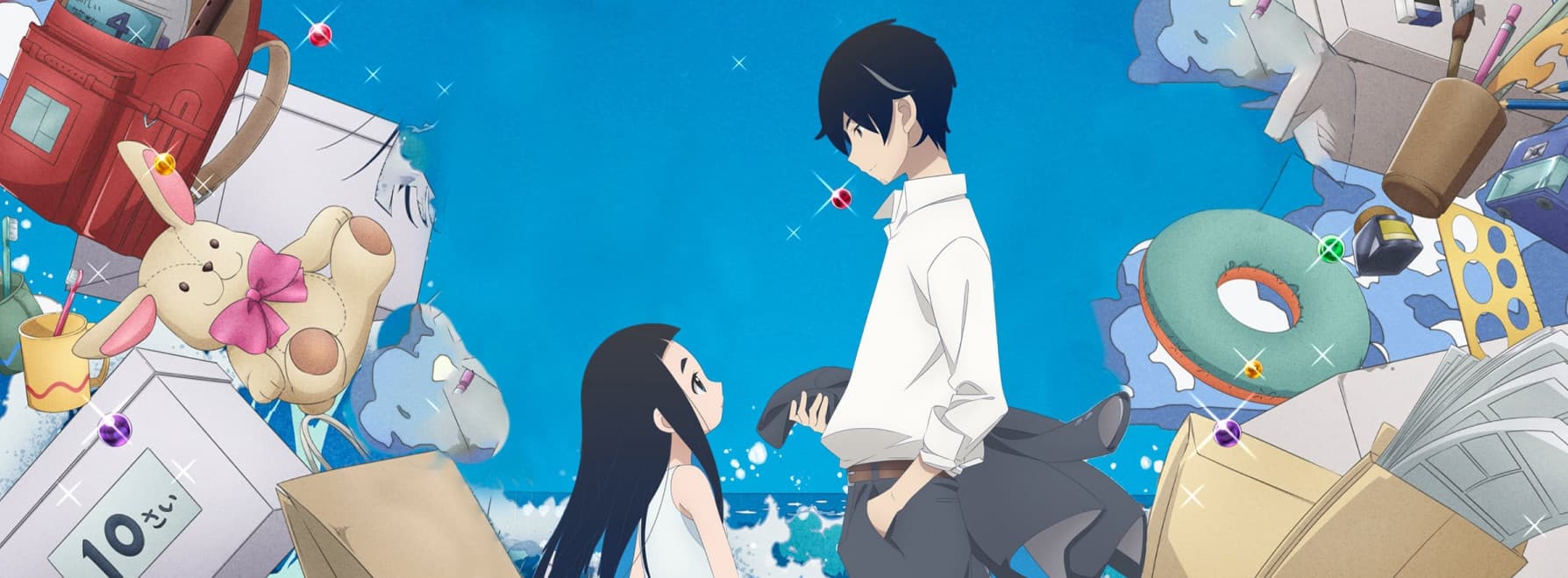
Kakushigoto introduces us to the character of the same name and his little daughter: Hime Goto. They are the only members of their little family because it is not known what happened or where the little girl's mother is; This causes that as any father would do, Kakushi lives permanently worried that his little girl is happy, that she has great experiences and that she knows that everything can be told between them, that there are no secrets. This, however, can be a bit of a problem if we take into account that Kakushi has a secret: he works as a mangaka and "worse yet" as a mangaka from a dirty joke manga.
This will cause him to do everything possible to protect Hime from knowing the truth, as he considers that this would make her hate him and reject him as a father. And this desire for protection is the one that takes us by the hand through an endless number of funny situations that Kakushi and Hime have in their daily lives: from the way Kakushi pretends to be an Office-worker by dressing as such (although then run to get comfortable for creativity to flow) and always complaining about it; or the way he makes his assistants help him look after (coff, coff, spy ...) on Hime when he's busy. We even have moments where Kakushi totally innocently and unintentionally plays Romeo.and to fall in love with every lady in his life (florist, cooking teacher, even his little girl's sensei) and consequently, keep them aware of what will happen with him and Hime; sadly for the aforementioned, there is no one else in Kakushi's eyes than his daughter.
And it is that ultimately this is the critical point of the work, the devotion that Kakushi shows to Hime is a hook to the heart because it is simply natural, it is not forced and above all, it is a reflection of what happens in daily life (just ask your father dear readers). For him, Hime is the most important thing in the world and as such, any sacrifice he has to make is well justified if it makes her happy, even if he has to abandon certain things as seen as the episodes progress ... as simple as this.
Another of the points in favor is the narrative of the work, which is what makes this idea never look simple despite the fact that it is, in this sense, the format of each episode constituted in turn by "mini-episodes" helps because we feel that we are moving smoothly, the jokes that are presented are never loaded (although they may not be of the generic type of humor) and this makes this slice of life does not tend to drama unnecessarily.

However, not everything is rosy and as in reality, things change, people grow ... This is where the phrase stated at the beginning of this article comes in: "Today I turned 18 dad ..." and also where the other half of the work is presented to us, one where there is a time jump; Hime is now 18 years old and is in a house suspiciously similar to the one she lived in with her father as a child. However, she is alone, with a lost look and a face that reflects decision but also a certain disappointment? Now the immediate question is where is Kakushi? Why isn't he with Hime?and this is a mystery that is directly related to the mother of the little girl and that will remain undisclosed until the last moment. This other part is the one that shows us the fragility of the characters through one thing: the growth of Hime, going from the small and innocent girl to the confident young woman who is shown to us in these future moments. This only fuels the intrigue of the viewer and keeps us waiting to find out how and why it is that Hime will discover her father's secret.
Regarding the design, both of characters and settings, we can say that Ajia-Do has done a good job adapting the original style of the manga, enhancing the spirit of the work with a palette of vivid colors and an aesthetic similar to the SHAFT studio. , specifically to his work Sayonara Zetsubō Sensei. Likewise, each character displays unique characteristics that help define their personality. Separate mention deserve the seyuu of the series, standing out among all of them (of course) Hiroshi Kamiya, my favorite seyuu with forgiveness of you.
All of the above accompanied by an OST that although it does not have so many songs that attract attention, it does have one of the best composed Opening of the season: "Chiisana Hibi (ち い さ な 日 々)" interpreted by flumpool which from the first second you gives a feeling of nostalgia and joy; on the other hand, the Ending is "Kimi wa Tenneniro (君 は 天然 色)" by Eiichi Ootaki which, although not as good as the first one, does maintain the theme of the series.
Kakushigoto is one of the best series of the season (and perhaps of the year) with a simple but powerful message that does not take itself very seriously (which makes its comedy effective) also, as I said, its approach to reality gives it that necessary touch of naturalness that captivates us and makes us believe and wait for the end. At the end of the day the series leaves a smile on his face and the feeling that, despite his madness, Kakushi is right: his daughter's happiness is worth everything ...
24 out of 25 users liked this review
