This review may contain SPOILERS for the entirety of the Monster manga series. Proceed with caution.
My expectations were very high when I decided to read Monster. To be honest, Naoki Urasawa as an author has always interested me, given the notoriously big praise that his works usually receive. I begin this review, however, stating that I'm rather disappointed by the end result, which I'll elaborate further below.
Monster is a manga series written and illustrated by Naoki Urasawa from 1994 to 2001 in Shogakukan's Big Comic Original magazine.
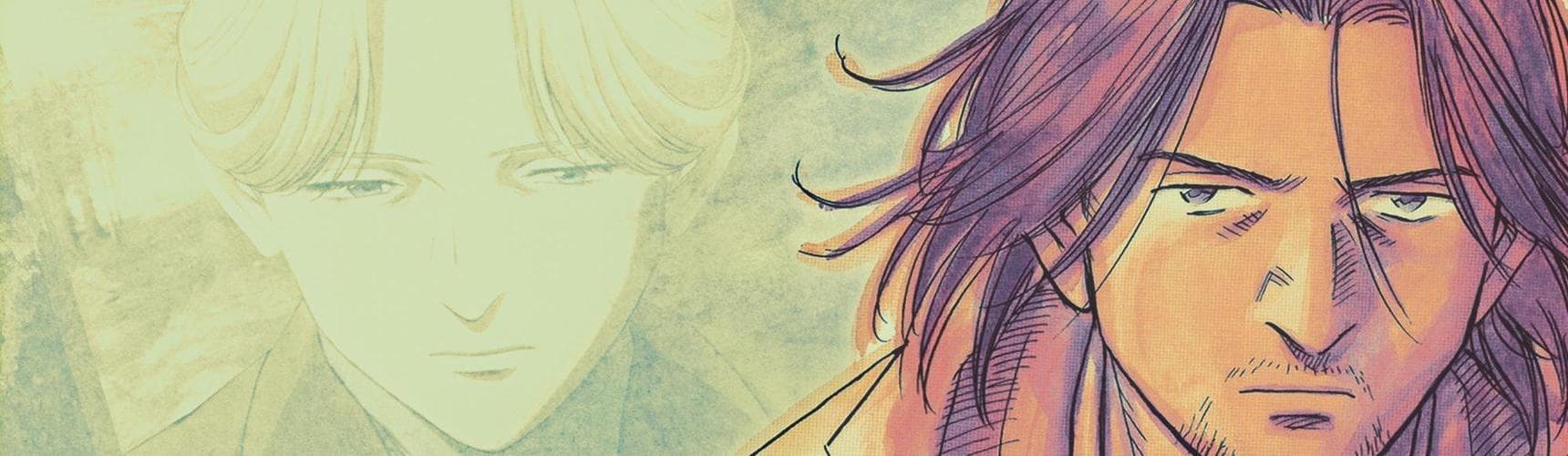
Our protagonist, Kenzo Tenma, is a japanese doctor that works in a hospital in Germany, and is considered to be a genius neurosurgeon. Dr. Tenma is an idealistic doctor with a strong sense of duty with regards to his profession, focusing primarily on his own personal morality of the equivalence of any human life. Quite a good match for a character who is a doctor, is it not? Throughout the story we see Tenma constantly having to put this moral system of his to test, whether it be by disobeying his superiors at Eisler Memorial Hospital and operating on a boy rather than the Mayor, by giving medical assistance to criminals, by hesitating to kill people, and many other situations.
Urasawa creates a great variety of scenarios for these moments to happen, which is greatly appreciated. There are also situations where Tenma's otherwise solid values do falter, like when he tries to shoot someone who is threatening someone else's life. I was afraid of Tenma turning into an unrealistic character because of that, something of an unfaltering vector of morality and duty, which would really negatively affect the story, given the realistic approach the author strives for. Therefore, it is interesting to see how Urasawa makes Tenma question his beliefs frequently while also failing to stand by them occasionally, which humanizes the character as a whole.
The main "issue" (to call it just an issue would be an understatement, to be honest) that Tenma struggles with, however, is what constantly tests the strength of his values. The boy that he decided to operate on, Johan, grew up to be a sociopath, directly and indirectly responsible for many murders. So Tenma, almost in a paradoxical way, decides to kill Johan as a way of taking responsibility for saving a sociopath, which inevitably leads to a direct confrontation of his morality.
After I finished reading Monster, I was pretty unsure of what I really thought about Johan's character. The words and thoughts that kept coming to my mind were "hollow", "lost", and other adjectives that circled around his indifferent, refractory attitude. This apathetic behavior is common in sociopaths and psychopaths, however. Where Johan's character really shines is that it brings that whole archetype into another level: he is a ghost (or a Monster, as the manga calls him). An empty shell. Nothing seems to affect him, but his actions affect many people throughout the story, as if he is "possessing" them in some way. He is hollow, almost in a machine-like way, a spiritually and mentally dead individual, that acts with no more reasoning than an automaton.
What really adds to Johan’s character and to the narrative as a whole is this folkloric and fabulous undertone that the whole backstory of Johan has. Much of the aspects of the main antagonist’s actions are parallel to a certain children’s storybook present in the series, called “The Nameless Monster”. Slowly comparing the events of the book to Johan’s actions is a really delightful process, which gives a sort of ominous, otherworldly foundation to an otherwise apparently indifferent character. These ominous undertones occasionally fall off short, however. As an example, I couldn’t help but feel some degree of pretentiousness in the manga with the quote that opens the story, directly from Revelation 13 in the Bible, but I digress.
This is one of the most critical dichotomies and contrasts of Monster, on one side we have the overly idealistic and ethical Kenzo Tenma, while we have Johan, an apathetic, unscrupulous shell of an existence, not guided by any moral or value systems.
One of the things that surprised me during my reading of Monster, is the enormous amount of characters that Urasawa put into the story. It even struck me as an episodic manga in the beginning, like when Tenma was travelling in the countryside helping people here and there. These short arcs are of varying quality, but the sheer amount of them is honestly something that Monster would be better without.
As an example, Grimmer, shifting from an "automaton" state to a more humanized being, acknowledging his feelings and emotions. Eva, suffering because of lack of maturity and excessive materialism which obsessively fuels her narcissistic self. Lunge, who is obsessed with his own concept of truth and justice, which blurs his vision to equally important things in his life. Bonaparta, who attempts redemption because of a deep stain of his past, caused by excessive idealism and a blurred perspective about human life. They are characters that have excellent side plots, fitting organically into the story as a whole, and tackling cohesively a broad selection of complex topics.
The thing is, many not-as-interesting, minor characters receive chapters and chapters of backstory, which is of little to no relevance to the main plot.
I recognize the value of a good backstory when writing engrossing worlds and characters, but not every character needs them. The feeling I got during my time with Monster was that of an apparent need of creating a scenario that all these minor characters relevantly matter to the plot, as if they are small pieces of a puzzle. The author, however, misses the mark with both the quantity and quality of these stories, messing up its pacing by overwhelming the reader with often needless information, be it for the good but not well executed intent of creating a great cast of interconnected characters or for artificially depicting suspenseful moments.
In that same sense, the way suspense is created in Monster can come off as cheap in some ways. As an example, imagine that the protagonist is aiming a gun at someone and is preparing to shoot. Then, we hear only the sound of the gun being shot, while the scene shifts to the ground, to the sky or anything of no relevance. It is an old trick for creating suspense, and it would be fine if it was used once or twice throughout the manga, but the author creates similar situations countless times, which is often insulting to the reader, who has to endure these artificially implanted suspense.
For writing a good mystery thriller, knowing the right timing for revelations and omissions is imperative. Monster struggles with this all the time. It utilizes the aforementioned cheap tricks on well set up moments filled with good self-contained conflicts and climaxes, that almost scream for the need of a meaningful revelation. Another issue is the lack of impact that some of the revelations suffer, eventually happening when a recently revealed character suddenly becomes someone important to the main plot. And it is quite obvious when it will happen, because the manga dedicates one to two chapters to pre-establish the character and make the revelation. Frequently, I found myself thinking: “Oh, this seemingly unimportant character is getting an abrupt excess of information? Something big is going to happen.” Clever omission of information is crucial at this part, and it constitutes the thin line between a thrilling suspense and a predictable mystery, where the reader is constantly aware of the intended “deception” that is essential to the plot.
Monster also deals with some philosophical themes, such as the value of human life and the meaning of good and evil. It does a really good job of not really picking a side directly. There is, of course, the figure of Kenzo Tenma as the orthodox do-gooder, but Urasawa hardly points out that Tenma’s view is the “right one” or any of that. Quite the opposite, frankly speaking. We get a variety of perspectives of ways of dealing with the conflicts that life brings to us, and it is up to the reader to judge their moral merits. “What is evil? Is it commiting a crime? Causing harm to others? Who is responsible? Can somebody really judge someone else’s actions?”; Urasawa gives us plenty of tools in Monster for us to craft our own answer, showing various facets of human morality in the huge cast (although, as mentioned earlier, a good amount of them is not well executed and sometimes redundant).
I get that this loose, more “open to interpretation” approach that Monster takes is not for everyone. Many people talk about the ending being disappointing, and one of the reasons is the inconclusiveness of it all. I for myself am a huge fan of these endings, they connect me with the narrative in a way that it personalizes my relationship with the work. So, although the ending was of my liking, it was rather weak because it didn’t bring anything new aside from what had been established previously on the narrative: the subjectivity of all morality, in a rather nihilistic approach, if you will. The ending, therefore, only reaffirms the notion already explicitated to the reader throughout the chapters.
Monster brings a good main conflict between two naturally antagonistic characters, while proposing smart questionings about philosophical matters that everyone has throughout their life. Although inconsistent and with poor timing and pacing, the author also provides lots of different contexts for their characters to act, showing the various shades of gray of the morality spectrum, which gives room to interesting reflections. I cannot, however, say it is a prime example of how a mystery thriller should be written, because it relies too much on cheap, uninteresting techniques to build suspense, while also artificially delaying revelations with overly detailed and often uninteresting character exposition, which deeply hurts the aforementioned revelation and omission, essential for a good narrative of the genre. Therefore, Monster is a good contemplation exercise on fundamental questions about the human condition, plentifully represented in its chapters, while it struggles with the form inconstant that it decided to manifest itself.
49 out of 73 users liked this review
