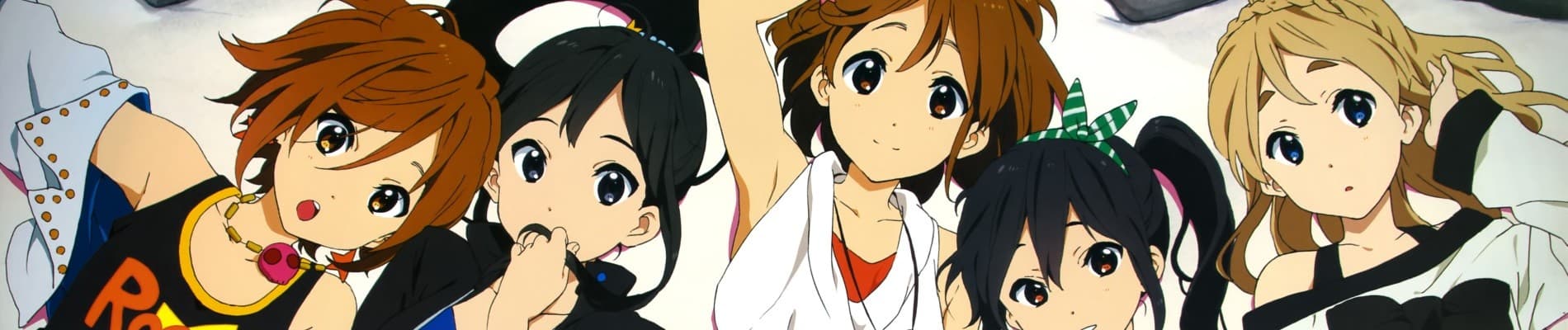
K-ON! Season 2
a review by henghost
a review by henghost
The thirteenth episode of K-On’s second season, “Late Summer Greeting Card!”, sees a swarthier-than-normal Azusa, the youngest member of the Light Music Club, fade in and out of anxious dreams, brought on by the balmy buggy summer. In one, she must save the perennially oblivious Yui-senpai from consuming fatty tempura alongside watery watermelon, only to awake upon realizing it’s already too late; in another, she encounters Mio at a horror movie, except this can’t possibly be her scaredy-cat senpai because she isn’t reacting to any of the onscreen frights, which means . . . And she wakes up again.
The climactic sequence comes when Azusa meets up with the rest of the band to attend a summer festival. They order street food and eat it on nearby steps and laugh at the color of one another’s tongues. Azusa reflects to herself, “My life is definitely better when I’m with them.” Fireworks shoot into the air, and Yui takes Azusa by the hand to lead her to a better vantage point. The frame rate halves, and there’s a POV shot from little Azusa’s perspective as she stares up at the back of her senpai’s head, and she thinks: “So pretty!” -- does she mean Yui or the pyrotechnics? -- “So pretty! Is this real? Or am I dreaming?” And there’s a cut: The Light Music Club has vanished into the crowd (were they truly there to begin with?) and the fireworks have ended.
“Late Summer Greeting Card!” is K-On writ small: a series of absurd and ephemeral pseudo-conflicts, punctuated by sincere and profound love. Youth, after all, is one big dream. The only issue is, as Azusa realizes in her post-festival bath, that morning is just around the corner. “Next year, I’ll be all alone.”
Still, in the meantime there’s plenty of joy to be found. Every aspect of K-On -- from its animation to its music to its character writing -- is calibrated for maximum delightfulness and adorability. It’s there in the opening theme, where Yui hops to the beat and hollers the saccharine lyrics into a can instead of a microphone. It’s there when feminine Mio must play Romeo and masculine Ritsu must play Juliet, and to do so they play each other playing their respective characters. It’s there in the fit of Yui’s tights, and in the flourish with which she plays her paramour Gita. With every fiber of its being, K-On screams, Youth! Beauty! Girlhood! Life!
And it is because of the masterful execution of its happiness that the dead-silent moments between, when everyone must reckon with the fact that it all has to, at some point, end, evoke in the audience that awful terror that comes just before sitting up in bed, dripping with cold sweat. K-On earns its emotional weight. Where other, weaker series might feel the need to implement “stakes” or “conflict” or -- ew -- “plot” to achieve a similar effect, K-On is comfortable with its glacial meandering pace, because it understands that its characters and its style and its sound are just that strong. (And what sound, by the way! You can nine songs from anime on my Spotify: (1) “rose” by Anna Tsuchiya from Nana, (2) “again” by YUI from FMA:B S1, (3) a couple covers of Renai Circulation, and the rest from K-On: “No, Thank you”, “Pure Pure Heart”, “GO! GO! MANIAC!”, “Don’t Say ‘Lazy’”, “Fuwa Fuwa Time”, and “Cagayake! Girls”.)
Yes, K-On is a dream. And I never want to wake up.
40.5 out of 45 users liked this review
