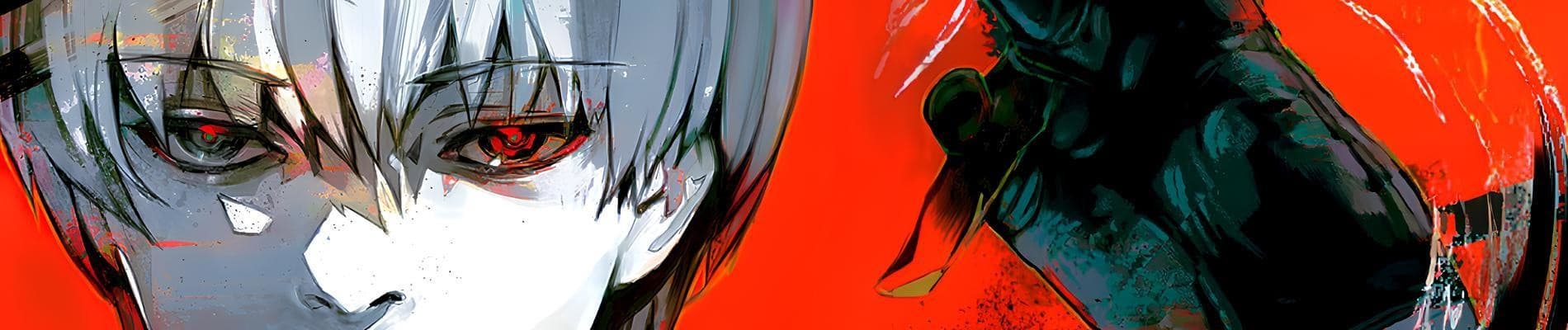
Tokyo Ghoul:re
a review by imnap
a review by imnap
Contains spoilers for "Tokyo Ghoul" and "Tokyo Ghoul:re"
____
#Schadenfreude
The world of Tokyo Ghoul is presented to us through a bird’s eye view. Not one that is lavishly gliding above the glassy skies, but one trapped in a warped cage. Thus, are presented the main themes of the series – the surrounding environment is not as black and white as it may seem, understanding and accepting the self and lastly, justice. This last theme might be the one that Tokyo Ghoul touches upon the least, mostly focusing on it in the original manga’s first half, so I’ll start with that and primarily schadenfreude. Schadenfreude is a complex emotion most of us have admittedly felt at some point, consisting of feeling joy at another’s misfortune. Now you might be wondering what does this have to do with justice? Well, there are three psychological causes for this: aggression, rivalry and finally, justice. Among the numerous examples of this that I could give are Urie’s initial hatred for Kuroiwa, Roma’s obsession with seeing Kaneki suffer and, in an extreme case, Yamori’s hunger for torture, although that falls more under sadism. The list could go on with other characters like Takizawa or Kurona, but that becomes unnecessary when you realize that the entirety of the conflict in Tokyo Ghoul is based around just that. Humans want to get rid of ghouls because their safety is threatened by their existence, and ghouls retaliate because their place in society is non-existent. Both teams thus falling under a false sense of justice, while in reality just being consumed by self-righteousness.

Via schadenfreude the author makes us familiar with the ugliness, unfairness and coldness of the ghoul world right from the very start, something with which we can compare to the real world. This leads me to the next point – the sheer complexity of the world we live in.
____
It's made abundantly clear from the very first arc in the story that things aren’t as simple as they may seem, as it will have you wondering who the real monsters are. The more you read, the more you start pondering this question and the line between villains and heroes gets blurrier and blurrier by the volume. This, ladies and gentlemen, I presume to be social commentary on modern day society, and especially the Japanese one. A rising problem in the world nowadays has become those that don’t abide by the societal norms. In Japan there is virtually only one path you can choose to walk on from the day you were born, and that is the path everyone else has already traversed. Go to school, graduate high school at the top of the class, go to college and so on until you get an office job at a company and work overtime. But what about those that aren’t interested in such a linear path? The people that don’t follow the norm are harshly criticized, ignored and ostracized by even their closest family members. This is true in more countries, but it is especially true in the “Land of the Rising Sun,” mostly because of the “Lost Decade” that has plagued Japan in the 1990’s. Even though the effects of that drastic economic regression can still be felt to this day, it has been over 20 years since then, but the Japanese society refuses to change and adapt to the new, engulfed by their old ways. This has created a divide between the people of old, that see those that don’t follow the norm as threats to society and the newer generations that want to adopt changes, much like the humans in Tokyo Ghoul that ostracize the ghouls, and the ghouls that resent the human world for not being accepted. As such, we can draw the parallel between the fictional modern Tokyo and the real one, including the aforementioned schadenfreude emotion, which gets cultivated in Japanese people from a young age as a byproduct of the sheer amount of rivalry and unhealthy expectations from their parents. Tokyo Ghoul goes to great lengths to show the readers just how putrid its world is, wrapped in a twisted cage from which nobody can escape, and how eerily similar it is to ours from that perspective.

Something of this magnitude and displayed so well couldn’t have come from just an outsider of this problem, but from someone that has lived through this struggle first-hand. This leads me to the final, and most important theme the manga addresses – change, understanding and coming to terms with oneself.
____
#Me, pt. 1
I was never good at school, or even interested in it. I was always causing trouble. After all, why would a kid care about that stuff when I had all of my buddies to have fun with. I loved making others laugh, part of it was for attention and the other was to feel accepted so I never had difficulty making friendships initially. But before I realized it, I lost all of those friendships. Miserable. I didn’t have all that many to begin with, or I just had too many, too shallow. Once I didn’t abide to their wants and needs, once I wasn’t needed anymore, once I had become flawed in their eyes, the tide changed. I was the one ostracized. Or maybe I'm just playing the victim. Back then I had taken for granted just how easy it was for me to have friends, and how fortunate I was to have an active social life. So it hit me. I had become desperate to regain those friendships, to feel wanted, to feel accepted, to feel loved, blind to the fact that all I was doing was distancing everybody around me. As hatred grew inside me, I cursed them all for turning on me, for not accepting me, for laughing at me. A clown with no costume. Miserable. I couldn’t believe how fake and pretentious everyone around me could be. I couldn’t believe how easy it was to ostracize somebody you’ve spent years with. I hated them all. But what I hadn’t realized at that time was that I was empty and lonely. The one I truly hated was myself. I was a failure at school, a failure at home, a failure to my friends and a failure to myself. So I became secluded from the world, and drowned myself in my own frustrations and loneliness, desperately grasping at a way to change. All suffering in the world is born from an individual’s incompetence.
____
#Unravelling Sui Ishida
Sui Ishida is the man behind Tokyo Ghoul and all of the problems it addresses with the world. Once you take a deeper look, it’s clear to see that he put his own experiences and frustrations with society on paper. It’s almost as if he inserts himself into Kaneki, and through that gives us a glimpse into his own psyche and emotions. I had the realization that Tokyo Ghoul and Tokyo Ghoul:re weren’t just mere works of fiction, but something much more personal once I read Sui Ishida’s afterword in the final volume, which reveals multiple details about his life and what he went through.
He opens this up by being frank with the readers about his liberating feelings towards finally finishing the manga and all of the struggle he went through while drawing it. Ishida then goes to paint a picture of his childhood and come up – one that was filled of goodbyes and uncertainty. He goes into detail about his lack of friends due to frequent moving, how he fell in love with manga and the event that impeded said love for more than a decade, his initial success in school, in which he eventually completely lost interest in as his grades were slipping to the bottom, which led to his falling out with his parents, rediscovering his love for drawing and moving to Tokyo to become a mangaka and the fun moments he had while being a manga artist that he appreciates to this day. Sui Ishida closes this afterword off with a diary entry from back in 2009, as a way to mark the maturity he’s gained and confront his past self. It’s easy to draw the parallel between the author and Kaneki once all of this has come to light. Ken grew up as a lonely kid with very few friends and completely immersed in books. Once a normal human that was following the predestined path in Japanese life, suddenly thrown into an unknown world. From the sphere of socially accepted humans to the world of shunned ghouls. Not following the societal norms anymore, Kaneki was forced to adapt and change, but for that to happen he first needed to understand himself. This lies at the core of Tokyo Ghoul, and the author knows it’s an arduous and long process, as shown by Kaneki’s constant development throughout the story, represented in his physical appearance as well. This process involves discovering and rediscovering yourself, as well as the world around you, and Sui Ishida is so well aware of this, because he himself was at odds with the world at some point and may still be. He became one of the ostracized ones that refused to walk the path everyone else did. As mentioned before, he completely lost interest in school which led to him being shunned by his parents and fighting with his father. He also had difficulty finding a job, and ultimately became a mangaka as that was the path that came to mind. Ken Kaneki’s struggle with himself and the ghoul world’s twisted cage are a reflection of Ishida’s own scuffle with himself and of the world that traps and surrounds him, from which he couldn’t escape from even while writing the manga. Maybe Tokyo Ghoul was also part of that very cage that tied him down. In the end he stated that during the last half year of drawing he truly enjoyed himself and later on stated that in hindsight he had fun. Sui Ishida may have been finally liberated from the enclosure and from himself, but as he said in the last part of the diary entry: “I can’t acknowledge myself 100%. But I kinda like who I am. Then I can’t be that bad, right?”
____
#Seasons Die One After Another
As I’ve mentioned in the previous part, Ken Kaneki almost acts as an extension of the author, but I think it’s time I should go more in-depth with the man of the hour’s character, as he is undoubtedly one of the best examples of character development I’ve seen in media and the driving force responsible for Tokyo Ghoul’s main message of change. As already stated, Kaneki starts off as your average bookworm Japanese university student, and throughout the duration of the manga we get to know him better and see him develop from one of the humans that feared and misunderstood ghouls and his ghoul side to somebody that slowly started to learn about themselves and accept both humanity and ghoulkind.
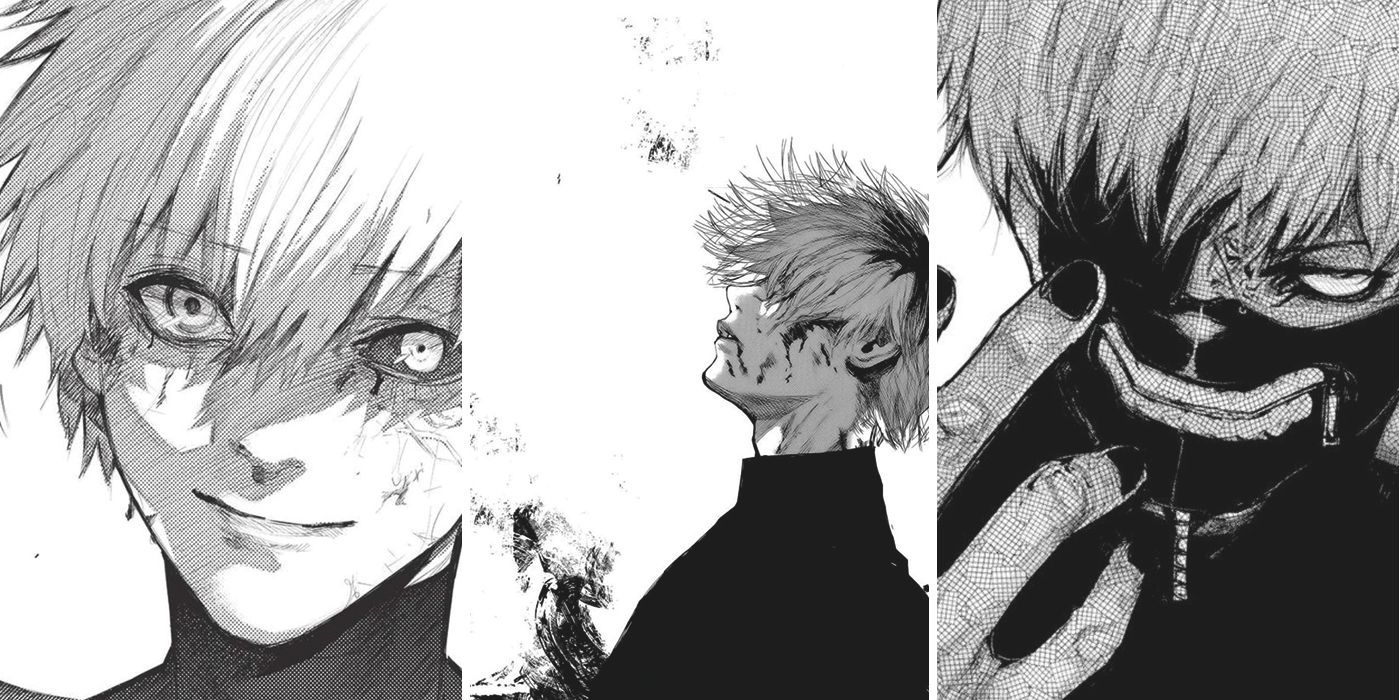
The first striking characteristic of his is his utter kindness, that later on the readers as well as Kaneki realize was just naivety and selfishness. During this first segment of his character, the first event that truly starts tipping off the balance for him is Ryoko’s death. As he and the woman’s daughter, Hinami, witness this horrific sight something inside of him starts changing, although this may not be apparent in the beginning. Kaneki is filled with regret and curses his own powerlessness, which is the first step towards his desperate chase for power so that he can protect that he spends the majority of the series dwelling in. It is later revealed that this aspect of his character has always been there when suppressed memories resurface, hidden deep inside as a result of his parents, one of which abused him and both died when he was relatively young. This birthed in him the need to feel wanted and loved as well as the will to protect those close to him for that same reason. During this time and throughout his whole childhood Hide was his only saving grace, acting like a support beam and stabilizer for our troubled Kaneki. This first segment of Ken’s character is spent focusing on him being introduced to the harsh reality that he is thrown into against his will as well as him slowly coming to terms with his ghoul body. This is all put into effect when Yamori kidnaps Kaneki and tortures him. In this key event, one of the reoccurring motifs in Tokyo Ghoul and the protagonists’ character gets introduced – the centipede. The symbolic meaning of the centipede is derived from its independence. In many cultures, this peculiar insect symbolizes courage, power and leadership – all extremely relevant themes to Kaneki’s character. Faced with repeated physical torture and mental anguish at the hands of the sadistic Jason, accompanied by Rize’s lecturing on how his mother’s philosophy is weak and the reason she, Kaneki and everyone around him will die and Ken’s own realization and frustration towards his powerlessness lead to his first transformation. This unfortunate chain of events that occurs to our protagonist is the one that fully pushes him to the limit and flips the switch making Kaneki fully accept his ghoul side, symbolized by his now white hair. Then he goes on to consume Yamori, who represented strength in his eyes, symbolizing his thirst for power. This second stage of his character is spent on his blind chase to become stronger, which he masks with the front that it’s all for his friends, while in actuality just being his desperate attempt at being needed and not lonely anymore. This is reinforced by his half-kakuja state resembling a centipede, meaning despite all of his struggle and strives, he’s just a half-assed that doesn’t know true strength.

In the end, his selfish attempt at being the tragic hero that saves everyone only serves to go against his loved one’s wishes and distance himself, which he eventually realizes and decides to go back, but his epiphany proves to be too late and his attempt at saving those dear to him fails once again as his efforts are proven futile. Thus, we enter the third stage of our protagonists’ development and an alternative personality entirely – Haise Sasaki. Now with all of his memories lost and on the human side despite being a ghoul births doubt and uncertainty within his mind. This is fortified by the change in his hair color yet again, being a mix of white and black, showing just how unsure Kaneki is of his true self, feeling torn between humanity and ghoulkind without even remembering his life up until that point. You can even see parts of both of his past two stages reflected in his personality traits: kind, caring and docile like black haired Kaneki, but cunning and aware like his previous white haired self. The loss at the hands of Arima and the mental turmoil he went through while in Cochlea as a result of that were the reasons his mind chose to erase his past, and gave him a new life. One that seemed perfect. He had a loving fatherly and motherly figure in Arima and Mado, which he always longed for, a house inhabited by people that were like family in the Quinxes and looked up to him, as well as a stable job seen as doing the right thing in society, as risky as it may have been. It’s easy to see why Haise Sasaki’s mind would refuse to accept Kaneki for such a long time. But despite this fairly perfect life he had now, much like his idolized version of his abusive mother, it was just a fantasy. One that must come to an end. Slowly throughout the duration of this segment in Sasaki’s character his hair would turn blacker and blacker, affirming the idea that his original self is slowly creeping up on him, until he finally accepts and remembers his past self – Ken Kaneki. In this stage of his development and his next one, it feels like the human black haired Kaneki and the white haired Kaneki switched roles. As a result of the resurgence of all of his suppressed memories Ken becomes more unstable than ever, distancing himself deliberately from others in fear of being unable to protect them, instead drowning himself in work and seemingly fully committing to the human side. This is the shortest of the many stages he goes through, and for good reason as he soon enough realizes that he still has those he loves and wants to protect. This leads to Kaneki’s battle with Arima, my favorite fight in the series, in which he assumes his final transformation. This last part of Ken’s character is defined by his comprehension and acceptance of the self. After failing yet again to protect those he cares about, he becomes consumed by his will to get stronger and in a last ditch effort he says “I won’t pull back. I will press forward. Like a centipede.”

This being the apex of his desperate attempt of achieving strength in the series, which only leads to harm those he wanted to protect with said power. During and after this is when our protagonist starts to face himself head on, accepting and bearing all of his sins up until this point, realizing that he can’t protect those close to him all by himself. He comes to terms with his selfish and fucked up self as well as with his past and the memories he wishes he would’ve forgotten. As his character comes to a close I really can’t help but compare Kaneki to Sui Ishida, as he learns to acknowledge, change and love himself as much as he could.
____
#Tragedy Struck
As those that have skipped to the end of the review to see the score might have noticed, despite only giving it high praise so far, the score is far from perfect. That’s because Tokyo Ghoul:re heavily derails in its last leg of the story, and this part of the analysis and review will be focused primarily on me venting about those mishaps, but I’d also like to briefly address some of the stuff I thought Ishida’s done really well besides the things I’ve already talked about. I’d like to start off with probably the most aggravating issue in the last arc, and that is the villain groups. The Clowns were a ghoul group that the author has been building up since the original series and have always been lurking in the background, and this build up was fantastic. The problem arises when we talk about the resolution of their characters and the group overall. It honestly feels like Sui Ishida just gave up on them by the end of it, judging by just how cheap their motivations are and how lackluster they are individually, save for Donato Porpora which had a great character overall, although his send-off was a bit unnatural, considering he suddenly has emotional attachment to Amon.

Roma was initially one of the characters that got my interest the most in the group, but she just ended up getting a very barebones backstory and a fight with Urie in which she was just there as a device to further Urie’s character development. Irimi and Nico are two fun characters that unfortunately never get polished even a bit, especially Irimi since she seemed to have more to her character on first glance. And finally, the man himself Uta. He was probably the character I was most excited to see what the mangaka’s going to do with, but he just had the most forced reasons for the things he has been doing behind Yomo’s back, and was generally just a mediocre conclusion to his character that has been building up since volume one. And speaking of bad motivations, that could apply to the Clowns as a whole. Their whole motivation for all of the horrible things they’ve done was extremely lazy writing on Ishida’s part, as they played the victim card, like any other ghoul could have, and it just feels so boring, insincere and hypocritical. Now moving onto the other final group – V. I don’t really have anything to say, because they were the most generic and empty villain group you could possibly imagine. I’d also like to mention how the Washuu were completely thrown to the side despite playing such a big role in the Tokyo Ghoul world. Other gripes with the series I have towards the finale are how characters always seemed to come back to life for no reason when the author should’ve let them die or even worse is what Ishida did to Matsuri. I don’t remember the last time I’ve seen a character be so heavily slandered and destroyed as Matsuri, although it was a bit funny and definitely unexpected.
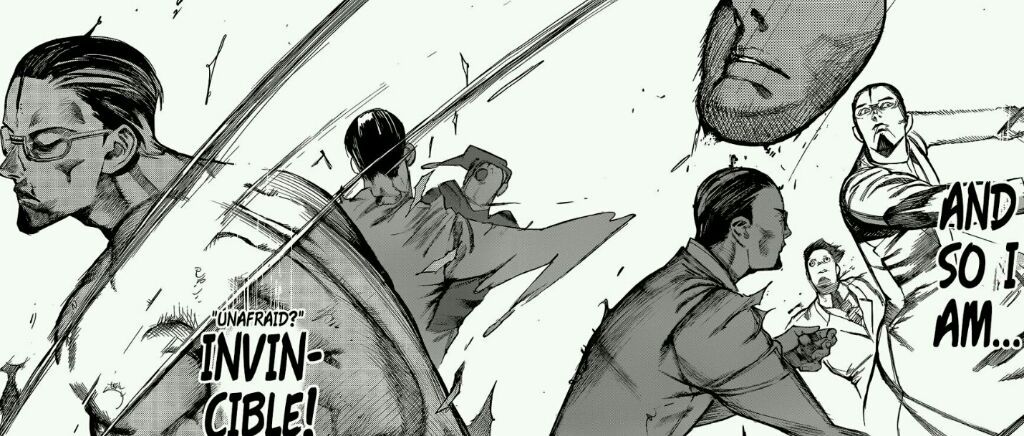
But reintroducing dead characters without a good reason can, and will, severely take from the importance of a certain event. My last noteworthy problem with the series is its final chapter, which was just blocks of text telling the readers what and how every major and minor character is doing, but somehow still didn’t include some text on Akira Mado and Amon, and just felt like a chore to read so much about so many minor characters, but it still had a few amazing moments like Suzuya having his reunion with Shinohara and the last few pages with Kaneki, Touka and their daughter. Both of which hit hard and honestly made me tear up a bit. Saying all this may look like I think the last part of Tokyo Ghoul:re is complete trash, but I couldn’t disagree more. It’s very far from greatness, but it definitely isn’t as bad as it can be. It was just disappointing. These are undeniable issues I have with the series, but of course it’s not all bad as the majority of what Tokyo Ghoul has to offer I think was done effectively, even in its last arc. Some of those things are Urie and Mutsuki’s characters that completely stole the show for me by the end, the other Quinx Squad members were also good, especially Yonebayashi and Shirazu, who despite his short time, had a lasting impact. Eto and Arima are easily some of the best in the series and Furuta, although shaky at times, was an amazing villain through and through with some of the most fun dialogue in the series.

I shouldn't fail to mention Akira and Amon which acted almost like secondary protagonist and heroine in the original series, and another one of the best and most fun characters, Juzo Suzuya. Finally, I’ll mention the spectacular art. Sui Ishida’s art style is easily one of my favorite in the whole medium. This segment of the analysis and review ended up being a lot longer than I anticipated, but I thought it was necessary and only fair that I talk about the series’ flaws, because it does have quite a bit of them. Because of this rather weak last leg of the story, I think Tokyo Ghoul fails to give a proper or more intricate answer to the questions and themes it poses, but that might have just been because Ishida himself doesn’t know yet, but what it does manage to deliver exceptionally well is those themes themselves and how they relate to our normal lives. But no matter how crude and unpolished Tokyo Ghoul may be, I still keep it close to my heart because of how much it helped and supported me during rough times.
____
#Me, pt. 2
So I started changing. I first acknowledged my shortcomings and tried overcoming them. In hindsight though, I may have gone from an extreme to another. I couldn’t help it though – I was desperate. Desperate to change and all the more a liar. Throughout these changes I lost sight of who I am, and distanced myself from everyone around as they distanced themselves from me in an attempt to lie to myself that I didn't need anybody. I thought I learned to be independent. I thought I learned to change. Inside I was still hollow, and on the outside I was but a shell of my dissembling self, but I started making new connections, and rebuilding old ones that have been long turned to dust. For you have to destroy first, to then create. This made me realize something – I still longed for others. And those others slowly filled my hollowest inside, and out of that dissembling shell, a truthsaying butterfly shall rise. I realized I wanted to be around others and support them like I wished they supported me. A couple of years dettached from the events that turned my life so, and under the light of recent ones that I'm still going through, I say to life that I'll destroy again, and create anew something even more beautiful. Thus does my will speak. What the future will bring is uncertain, but I stand here today, together with my past self.
133 out of 143 users liked this review
