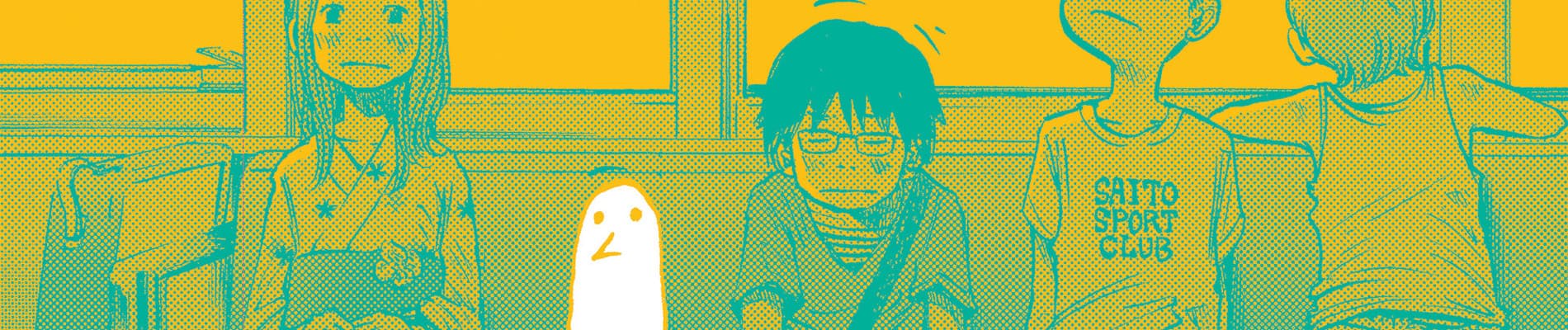
Goodnight Punpun
a review by Random17
a review by Random17
"Oyasumi Punpun" by Inio Asano is a masterpiece of a manga. Due to the complexity and gravity of this work, it is impossible to summarize it both aptly and concisely, but this will be my most wholehearted attempt. Yes there are spoilers.
This is the story of Onodera Punpun, a boy who is portrayed to the readers as a simple, bird-like figure but is perceived as a regular human by the world around him. We are engrossed by a life teetering on the border between absurdity and morbid reality. Supposed "gods" with no divine powers to speak of remind you that there is no supernatural to save the characters from their fates, only themselves. Heartbreak, desperation, death, injury shred the characters into pieces both physically and mentally.
As Punpun grows up, the world changes around him, and as he views those changes with a more mature eye, he grows more distant from this hostile reality. In much of the story, Punpun is a wallflower, passively observing divorces, deaths, love as an intricate world is constructed around him, filled with characters that suffer through their own, distinct lives. Simple emotions–like, dislike–that Punpun associated with other characters during his childhood gradually become more nuanced, yet all eventually morph into disdain. All but one: his feelings for his beloved Aiko, rosy memories that never had the opportunity to be tainted by his adulthood.
Punpun has a rare moment of clarity when he meets Aiko again ten years later and learns that she has moved on with her life. He reflects on how he wasted the last decade, being held back by his attachment to his rose-tinted past. However, when Aiko reveals that her new identity was a ruse, they set off to fulfill their childhood dreams of escaping society together.
To do so, they sacrifice everything: their current lives and relationships, Aiko's mother's life, their humanity, and eventually, themselves. In the end, this is the story about the disillusionment of two people who feel that they did not belong in the society they inhabited, two people who felt so out of place that they become eternally attached to a past where they had someone who understood them and loved them, so attached that they are willing to throw everything else away to continue that past. It is only fitting then, that in the epilogue we learn that Punpun lived: to have died, to have had a final "goodnight", would have been too easy, too satisfying an escape for Punpun.
The epilogue is also narrated from the perspective of a former classmate of Punpun, which is deeply symbolic. Punpun doesn't have a regular face or a regular name because the other people in the story have long forgotten what he looked like or what his name was. Only Punpun (and Aiko) have such a strong attachment to his past. Indeed, the narrating classmate admits that in the end, he could not recall Punpun's name.
The storytelling is complemented by beautiful art. The amazingly detailed scenery and expertly sculpted (albeit visually consistent to put it kindly) character designs contrast with Punpun and his family's flat, simple shape. Yet, Asano manages to convey the most complex and hardest hitting emotions through such a design. Tears don't just trickle down Punpun's face, they blast out in a visceral feeling of dejection. Punpun doesn't just wallow sadly in anguish, he becomes a black hole, devouring any light, any happiness around him and crushing it to bits. When Punpun turns into a tetrahedron one day, his face is plastered with this absentminded smirk, but something, something about that smirk conveys not joy, but loneliness, dejection. The artistic use of Punpun's unique designs is genius and incredibly communicative.
"Oyasumi Punpun" is no story you can indifferently consume. Long and wordy monologues, which I would otherwise dismiss as bland and lazy, catch your fascination and drag it through the tattered battlefield of thoughts and emotions of each character. As you read, these characters become you, as they fall in love, you fall with them, as they get consumed by despair, you get eaten alive, and when you finally get spat out of the other end of this 147 chapter trip through the depths of hell, what remains of you is merely an empty shell. Don't pick this manga up while in an unhealthy mental state.
54 out of 60 users liked this review
