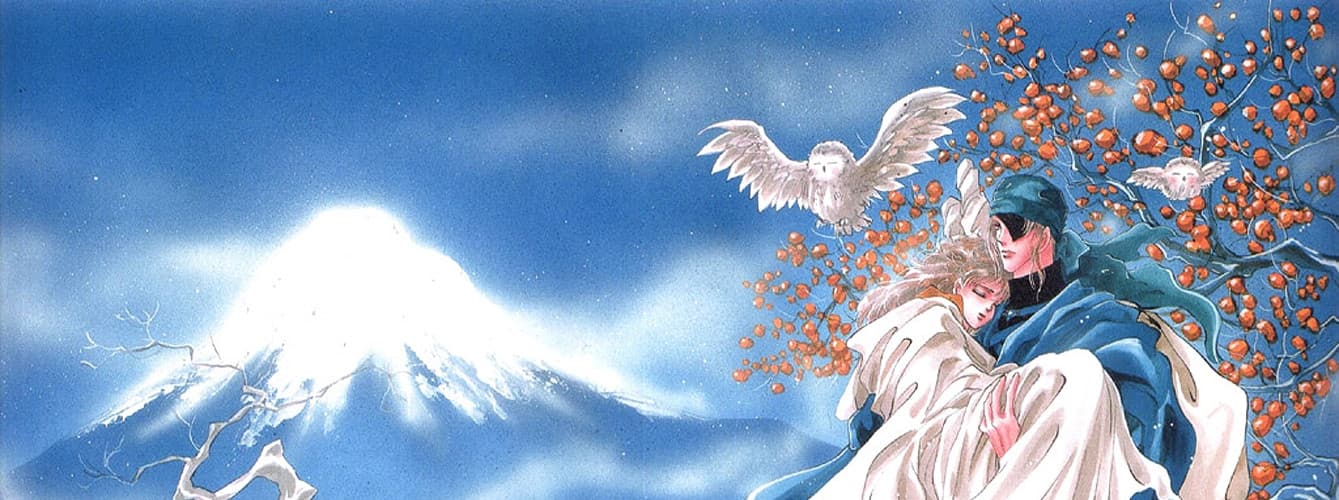
Basara
a review by rabidfairy

rabidfairy
5 years ago·Jun 13, 2021
95
/ 100
a review by rabidfairy
5 years ago·Jun 13, 2021
"Some readers have lamented: ❝Why does she have to go through all this, she's a girl!❞ ... but I think she rises to the challenge [precisely] because she is a girl!
➥ Yumi Tamura (about Basara's amazing heroine, Sarasa)
WARNING & DISCLAIMER: This review may contain spoilers. Review is based purely on my opinion and feelings and should not be taken seriously. Any views or opinions are not intended to malign any specific individual or group of people.

Basara is truly a masterpiece of a series and I hope people will come to rediscover it someday. It has one of the best character ensemble I've read, well written characters—especially the protagonist Sarasa, one of the best well written female mc in fiction I've ever had the pleasure of reading—a strong plot, and a unique art style.
Basara greatly explores the female psyche and how it feels to stand up as a leader in a world dominated by men. After her brother, Tatara (the supposed boy of the prophecy), was killed by the Red King, Sarasa took it upon herself to take his brother's name and pretend to be the "child of destiny". She masqueraded herself as a boy and tries to stand up as a leader of a revolution so that people will accept her without question. The pyschological strain and hardships she went through and how she overcame them all was such an experience to read. It's as if I was suffering with her and experiencing her pain. Not just Sarasa, but there were also other female characters in this series whom felt helpless and were constantly subjected to shame and ridicule by authoritative men for simply being a woman.
I love that the author made the female characters strong and didn't tone down the traits that are inherently feminine (eg. being sensitive and emotional, crying, and being empathic to a fault). It was such a powerful message especially reading it as a woman myself. Rarely do I read fiction where female leadership, and just the overall experience of being a woman gets a really nice representation and I sincerely want to give my thanks to the author for that.
More than that, I loved the politics in this series. The political schemes were intricately done. And seeing all the people in this series, not just the main and supporting characters, but how everyone in the background was essential in Sarasa's revolution against the monarchy and their tyrannic leaders, it was a thrilling experience to read.
There were times wherein the story gets brutal and honest in its depiction of political violence which made it hard for me to read because of how realistic it felt. There were scenes that are very reminiscent of the current government state where I live and of what happens to the people that opposes them and it chilled me right to the bone because the similarity is impeccable.
In the end, everything was resolved by the oppressed working together and it was thoroughly moving! It was hard not to root for their cause and I felt like I was with them cheering them on. And for a girl like Sarasa to lead such a big group of people, it was very inspiring indeed.
I loved how the author made the politics central to the plot and not just focused on the romance. But the romance is deserving of praise as well. Shuri/Red King and Sarasa/Tatara are two vastly different individuals when it comes to the way they lead their people but the two things they have in common are: 1. they both want prosperity for their country and its people and 2. they both love each other but they had no idea that the other is harboring a secret personality, which was one of the major conflict in the story.
How Shuri and Sarasa went from enemies to lovers, the battles they fought and how they went from hating to loving each other was such a difficult trial which both of them overcame nonetheless. In the appendices, we get a glimpse of how Shuri and Sarasa struggled to rekindle their trust and connection with each other. It was good that the author made Shuri suffer first for the atrocities he committed so he can redeem himself.

In war there will certainly be many deaths, betrayals and chaos but Basara showed us that communication, forgiveness, loyalty, friendship, and love will always prevail.
I wanted to talk about the supporting characters in depth but there is a great number of them present in this series that if I talk about them this review will probably go on forever. So I'm just going to list down my top favorite characters:
"Why do they think killing is the only way to make change? Can't the world be made better through creation instead? I want to be someone who created. Is that naive?"

Basara is truly a remarkable manga series in the shoujo category that I hope people will never forget. It has a strong female lead and female supporting characters, morally grey characters, characters with depth and complex relationships, well-written enemies to lovers trope, explores and deconstructs gender, politics, slavery, and trauma, and most of all...it has beautiful androgynous men... (͡ ͡° ͜ つ ͡͡°)

In short, it has a conglomeration of everything I want in a story and more. Elaborate worldbuilding, a massive and intricate political wars, suspenseful action, remarkable character development, and the best of all are the complex character relationships including but not limited to deep childhood friendships, a forbidden romance, found family, vengeful enemies, and faithful servants. Basara has it all. I know for certain that this is one of the stories that will linger with me forever and one that I will surely come back to again and again. I know it's completely impossible but I sincerely hope that a studio will pick up this series again for an anime reboot.
59 out of 63 users liked this review