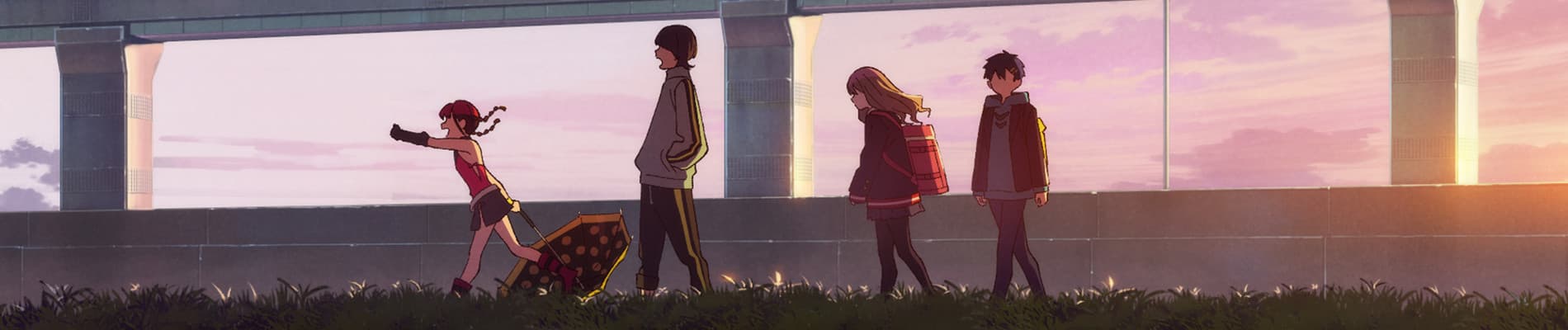


I’ve been wondering what SSSS stood for. Along with this being the biggest reveal in the franchise, I really enjoyed Dynazenon, even more so than I did with Gridman, due to a combination of its directing, powerful and engaging characters, and more succinctly, how the show, despite the giant robot action set pieces, monster of the week formula, mystery and mysticism of the plot, was incredibly human.

Scarred (characters)
One of the most engaging parts of the show was how tightly the character’s lives were weaved together. Dynazenon has 5 main characters, Yomogi, Yume, Koyomi, Chise, and Gauma. With only 1 cour at its disposable along with a varied side cast, it seems quite difficult at first to develop everyone while making a strong and purposeful dynamic, but Dynazenon finds a way. Where other shows might slowly introduce their main cast, episodically building them individually, Dynazenon takes another approach. True to the nature of giant robots that require multiple pilots, Dynazenon introduces all of its characters in the first episode, wasting no time in meandering, making us wonder when the team will assemble. This dynamic of having the cast be up front and directly available to us is exactly how the show carries forth.
This is an ensemble, with each member of the cast serving as a different piece of their giant Kaiju blasting robot, Dynazenon. But what makes these parts shine even further, is their individual problems, development, and characterization that we manage to receive in a tight package filled with symbolism, visual framing and directing, and powerful emotional payoffs. Each of the characters, have a different type of trauma that the show puts at the forefront.

Koyomi and Chise follow along as well, but their problems are interspersed between the main hook of Yume, and although they don’t necessarily intersect, do have strong parallels among themselves. Koyomi is locked behind his past, leaving him shut-in within his home with no prospects of a future, but this is unlocked through a chance encounter over the course of the show, revealing a certain person who has plagued his thoughts throughout his early adult life. Chise, likewise is also locked behind her past. Again, although Chise isn’t as fleshed out as Koyomi, just having her around and be a lighter contrast to him, was a reliable way for the show to present their inner complications.
By the end of the show, almost every character went through major changes in the problems they were dealing with, and it felt very organic. The entire show is spent between the gears of these characters, jumping from Yomogi to Yume, then to Koyomi and Chise, spinning with the dripping oil that was Gauma, the last of our main characters. Gauma, like Chise and Yomogi, wasn’t the strongest character in terms of having a complicated development or arc, but due to how he was written and how enjoyable it was for him to be on screen, that energy was contagious and easily found through my experience. Even if certain pieces of the system are rusted, as a whole, they all functioned beautifully in tandem, reinforcing the ensemble’s strength.

Did the formula, however, shift and were there moments where the fights served to have more than just stupidly awesome fight scenes? Yes. But those moments for me, were fewer than I would have liked. It’s easily the most ridiculous part of the show, how they destroy the city every other day, and although they do address that in a few episodes, where the characters actually react to mass residential destruction, it still, at the end of the day, is a part of the genre that will always be silly.
