WARNING: SPOILERS BELOW
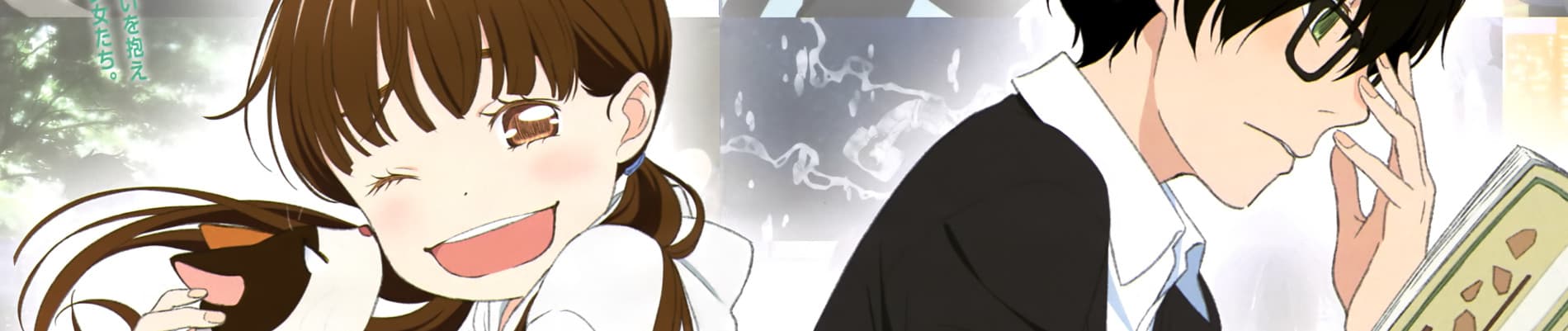
March Comes in Like a Lion. The show that disappointed me in a multitude of ways. Having already seen (and reviewed) the second season of Sangatsu No Lion, this review will be rather short. Indeed, I feel as if everything that the second season does and fails to do, the first season does in almost exactly the same fashion, albeit in a way that manages to be less engaging, more frustrating, and ultimately less deserving of a high rating. Indeed, it’s very hard for me to see this season as anything more than an average show that I wanted to love and was disappointed with time and time again.
Let’s start with the basics. This show, produced by shaft, tells the story of a male Shogi prodigy who learns about relationships as he navigates life as a young professional. This premise is actually really interesting and unique: when was the last time your last MC made it through on professional board game playing? Rei comes from no privileged background, he has no untold prophecies surrounding his birth, and generally avoids some of the tropes surrounding shounen/seinen protagonists. Yet he somehow fits many other tropes: entire family died in a tragic accident at a young age, has a foster family that resents him, lives alone and broods over the city in an isolated training dojo. Maybe I could turn a blind eye to this if the rest of the anime actually came across as the slice of life that MAL has listed in the Genres category, but it doesn’t. Rei’s entire life is one of battle after battle punctuated by angst and attempted comedy scenes.
But no, one says. You’re missing the point: 3-Gatsu is about relationships and learning how to live with others. That, I can say, is true, but the show fails to provide good character development requisite to such themes. The show involves a huge breadth of characters that are shown as little more than skin-deep. I’d like to take the Kawamoto household as an example. Although improved significantly in the second season, Hinata is little more than a source of distraction to both the audience and the MC, with the writers contributing to her character a vapid interest in sweets, shogi, and anything else related to Rei. Surely the death of his wife and daughter, along with the disappearance of his grandchildren’s father and his role as major provider for a sizeable family, would lead to some interesting insight into Someji’s story? Oh no, he only exists for some comic relief and to spur Rei and Nikaido on. Akari’s role as stand-in mother for her own two sisters, along with her own task as provider rather than following her own dreams? Nonexistent, because according to the writers, all she cares about is her own cooking. Even Momo seems to be present only for cute preschooler appearances and to remind Rei about his own departed sister.
This superficiality is particularly frustrating when you realize that Shaft is capable of good character development, but places it in all the wrong places. Every opponent that Rei faces is carefully scrutinized and analyzed with 100% focus that soon dissipates as soon as he inevitably wins the match or loses and returns home to brood. If only the writers could develop the other main characters, or heck, even the protagonist himself, with such intensity! Instead, they are relegated to supporting roles, either to supply filler episodes while Rei does his thing or to provide bizarre, poorly-draw caricature insert scenes that I think are supposed to be funny or something. If you’re like me, you’ll probably laugh just because how out of place they are. Even the actually interesting and round characters – Shimada, Gotou, and Nikaido come to mind – somehow remain endlessly on the fringes, given frustratingly little further development.
I’d like to return now to the main point that I made in the review of the second season, as I think it rings true here too. 3-Gatsu is a superhero anime masquerading as a slice-of-life. Rei behaves so incredibly unrealistically that it’s hard to see otherwise. Neither I nor the vast majority of the people reading this sentence are capable of supporting ourselves, in high school, by playing exceptionally good board games, winning against seasoned veterans while a curated rival spurs us on. Yet we are capable of retreating within ourselves, having difficulty forming and creating good relationships, and dealing with loss and heartache. I feel that Shaft tries to make its viewership identify with Rei through the latter characteristics, but still attempts to show his superhuman powers by means of the former. Perhaps this odd juxtaposition of incredibility and believability is attractive to some people, but I found it hard to live with. I said this before and I’ll say it again: I think this anime would have been significantly better if it was about a normal, unremarkable kid navigating loss and building relationships, without the need to defeat boss after boss in a game of prodigious power and skill. Or, alternatively, not marketed as a slice-of-life at all and given all the free reign of fantasy that so many superhero anime already show.
I think I’ve said all that I want to about the first season of this show. My second season review (first ever on this site!) is a far deeper look into my criticisms of this series and covers in depth some of the same points that I alluded to here. I realize that this show is incredibly well-received, at least on MAL, and giving the show a 5/10 might seem suspect, but in my opinion the show’s many shortcomings surpass its limited strengths.
44 out of 81 users liked this review