SPOILERS BELOW - YOU HAVE BEEN WARNED
Sōzen nariyamanu Music! tozashite ita kokoro hibiku
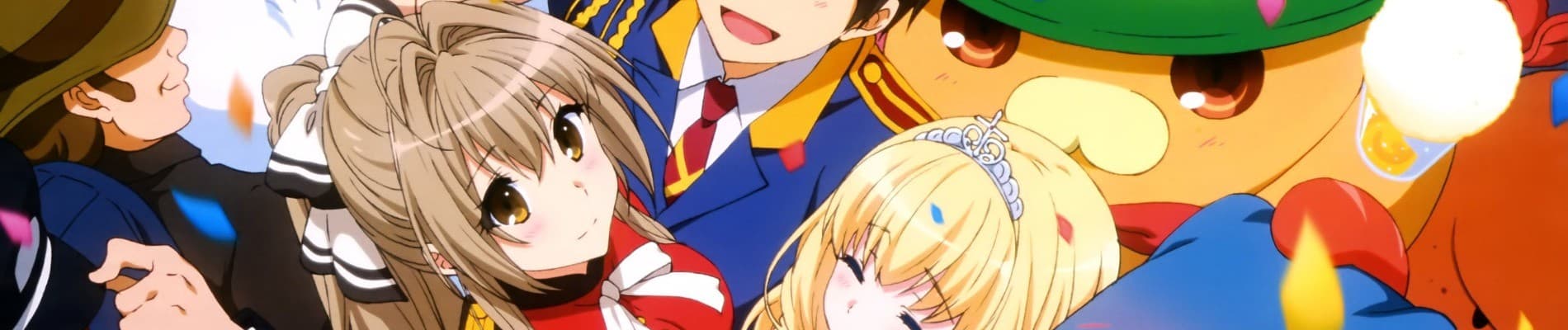
There’s exactly one way to tell if you’ve seen this anime before, and it’s if you know exactly where in the above line is the correct place to clap your hands. Amagi Brilliant Park is another one of Kyoani’s self-aware-almost-to-a-fault anime that laughs in the face of the fourth wall, and its absolutely shameless pop culture references such as the OP above are reminiscent of the studio’s earlier self-aware works such as K-On! and particularly Lucky Star. It also happens to be the studio’s second adaptation of a Shoji Gatoh work, the first being Full Metal Panic.
With that line already established at the beginning of the review, it’s only sensible to talk first about the show’s music. Like many other Kyoani works, the opening is fantastic and absolutely iconic: this is one of the few shows I’ve seen where skipping the OP is never an option. The ED is quite a bit more forgettable, but still above average, while the rest of the show’s soundtrack does not particularly standout but is never intrusively bad either.
Next let’s take a look at the art. To say that Kyoani has come a long way since their earlier Gatoh adaptations would be an understatement. Amagi suffers from none of the occasional animation quality lapses that afflicted Full Metal Panic, and it’s very clear to me that Takemoto really developed his more modern “color and light galore” style in Amagi that his work trended to toward the end of his life. Amagi has a few really brilliant frames, and in general the anime breezes through the art quality checklists. Even some of the frequent action scenes – such as Kanie and Moffle’s fistfights – lend themselves well to the comedic side of the show without being too jarring.
Disappointingly, the characters are more of a mixed bag and probably one of the show’s weakest points. Interestingly, I find both of the MCs to be quite strong: Kanie in particular avoids several of the industry’s most banal tropes by being neither a character your identify with nor a character you aspire to be. He is a narcissist, self-absorbed individual who unfortunately possess the smarts and aptitude to back up his egotistical person. Unlike so many other run-of-the-mill male protagonists, Kanie is unique in his unlikability, and that’s why I like him so much as a character. Next comes the other MC, Sento, who fortunately possesses the same sort of unlikeable uniqueness that behooves Kanie’s character. She is aggressive and unpersonable, and like her male counterpart comes off as self-seeking, going so far as to threaten Kanie at gunpoint and instill him with magical powers in a last-ditch effort to save her park. Yes, before you object, I know that both characters exhibit stereotypical tsundere qualities, and I’m not denying it, but I’m impressed with how nicely the pairing of two characters who literally only care about their own interests works in this show, particularly in the earlier episodes. And even though it is a comedy, the legitimate growth that both of the MCs experience throughout the course of the show when learning to respect and leverage each other’s unique strengths make it seem almost like the premise for a successful and uplifting drama. Almost, were it not for…
…the remainder of the cast. As much as I appreciate the uniqueness of the two main characters, I find the rest of the show’s figures lackluster. Princess Latifa is technically the third MC but possesses none of the unique qualities that set Kanie and Sento apart. She’s a typical “afflicted by some vague curse that grants her eternal youth” type of character, and unfortunately little more beyond that. Part of me wants to think that she only exists to create a weak love triangle, but the sheer absence of her character from any important parts of the already-almost-nonexistent plot make this a shaky assumption. I almost suspect her character exists entirely to give the series the typical “curse is broken yay” and further push the writer’s already-impressive self-criticism of the very genre they adapt in their fairy tale story, but as a character Latifa has relatively little to offer to the show.
The rest of the characters are perhaps worse. First of all – there takes a lot of people to run a theme park, and there’s a lot of them, ranging from the actual humans to the Maple Landers. And in somewhat uncharacteristic-of-Kyoani fashion, they are almost without exception flat, showing little in terms of character development. Again, perhaps this is a tribute back to the oh-so-true Lucky Star motif of the side characters fading into the background, but that purpose isn’t as obvious here. The rest of the cast is either only funny or only a bunch of perverts, without a whole lot of room in-between. And to expound some more on the second category would require its own section: the fanservice.
If you’ve seen my other reviews it’s pretty much clear that I’m not a fan of sexualization in anime for the sake of pleasing the audience. Now Kyoani has used it for more noble purposes in the past, such as to drive character development (see: Haruhi), or is mock the motif in anime as a media (see: Lucky Star), but such doesn’t seem to be the case in Amagi. Devoting not one but two (with several more sporadically) of the more prominent side characters to the sole purpose of making crude jokes and statements gets stale quickly. Amagi suffers from the same curse that afflicted the studio’s first adaptation of a Gatoh work in Fumoffu, with both Bonta-kun works showing so much comedic promise without the need to constantly sexualize its characters. It’s honestly kind of gross, and drops my rating (and watch-time…) of this show by a considerable amount.
Amagi Brilliant Park is first and foremost a comedy, and thankfully one that none of the show’s writers attempt to disguise as another mediocre drama or romance. And, when the show isn’t suffering from its typical “how do we pervert this” tendencies, it’s really funny. Perhaps a better way of phrasing it would be to say that Amagi is a fun anime to watch. Will you gain anything redemptive from its mainly-episodic storylines? A little – there’s a few episodes where the character development-thirsty side of the writers can’t help but show, and those are wonderful. But will you laugh? You better. And will you clap on-time during every OP? You don’t have a choice.
42 out of 74 users liked this review