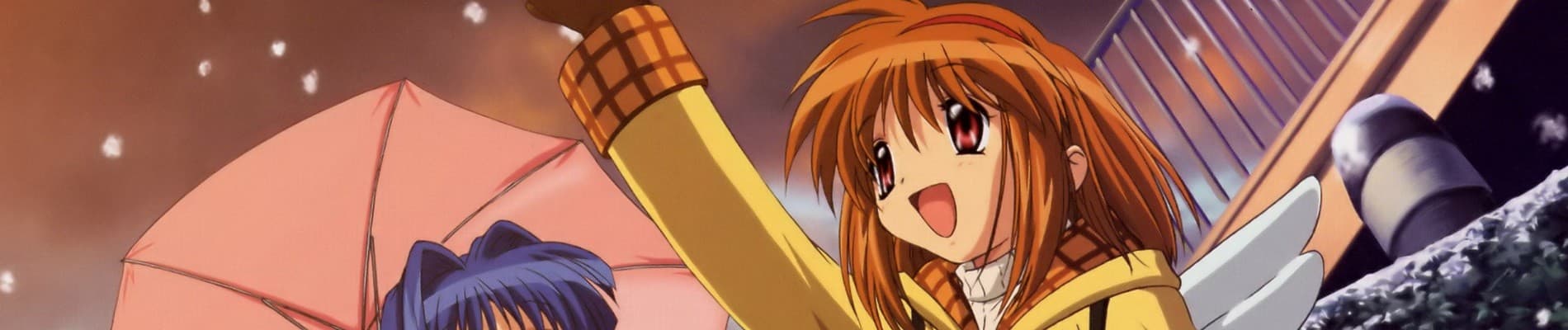
Kanon (2006)
a review by YuiHirasawa39
a review by YuiHirasawa39
MAJOR SPOILERS BELOW – 1999 VN, 2002 ANIME, 2006 ANIME
Kanon 2006 is the second adaptation of the 1999 Visual Arts Key novel. This game has had not only one, but two adaptations, all within the same decade. I first viewed the Toei-produced, 13-episode adaptation, a series that I appreciated for its source material accuracy and despite its lacking art style. And finally, I have now finished the KyoAni 2006 adaptation, which will form the substance of this review.
First, I’d like to recap my reading of the game’s storyline. Kanon follows a typical branching plotline, a VN mainstay. Each of the five routes (Makoto, Mai, Shiori, Ayu, Nayuki) are mutually exclusive. While no source material explicitly treats it as such, the theory of “one true route” (Ayu) is present here. Unlike its successor, Air, in which the “one true route” is made incredibly evident, things are less so here in Kanon. Another stalk difference between the two games are the sheer number of routes – five in Kanon (six if you count Sayuri, which you totally should), and only three in Air (discounting Summer, which is no more than a kinetic novel) and the final Air route (Misuzu, with relatively little overlap with Kano and Minagi). I’ve heard Air praised for its focus on more detail in less routes, in which Kanon supposedly exemplifies the opposite. However, I feel that the integration between routes is actually better in Kanon than Air – which, of course being a matter of personal preference, also fits Kanon’s story better.
So, the routes itself. I’ve explained their content previously, so I think it’s likely best to jump to the climaxes here. In the game, completing any route (and even the bad ends, unbelievably!) involve a common scene, in which Ayu appears for the last time to Yuuichi and announces that she has found her lost item, after which she disappears. In the game, most bad ends occur directly afterward, or in the case of any successful completion of the other four, the corresponding ending plays out. The only case in which this scene does not occur is Ayu’s route itself. Like I mentioned earlier, it’s not exactly a mystery that her route is the “true” one, but I actually feel that this scene’s inclusion has a bit of a deeper meaning, one that we’ll get into next.
I’ll reference my review of Kanon 2002 for its contribution to the franchise next. Toei, having only 13 episodes to work with, focused on three of the routes’ completion in three consecutive episodes – Mai, Shiori, Makoto in 8, 9 and 10. Interestingly enough, Nayuki and Ayu’s routes are completed somewhat simultaneously at the end of the show (albeit without the former’s romantic element). As I mentioned in that review, I felt that Toei decided upon this as a consequence of Ayu’s third wish – Akiko’s healing rather than Mai’s demons, Shiori’s health, and Makoto’s humanhood.
Kanon 2006 takes a bit of a different angle, which will become far more apparent later on. From the very beginning, I was struck by just how integrated this interpretation was. Even from the first few episodes we see all of the cast appear. Thanks to the extra length, KyoAni chooses to develop more of the routes simultaneously, all up until around episode 8, where Makoto’s route becomes the focus until its conclusion at episode 10. Mai’s route develops and ends at episode 15, which is followed by Shiori’s at episode 18. Again, we see simultaneous development of Ayu and Nayuki’s arcs, which carry on until episode 24. At first glance, this seems extremely similar to the 2002 adaptation, albeit with more episodes dedicated to each heroine, but I actually feel that this is not the case, for several reasons.
Like I mentioned, I feel that the 2006 takes a much more integrated approach to the VN’s conclusion. In the source material, none of the routes can coexist, with the only similar element being the aforementioned Ayu scene. I feel that KyoAni chose to use this scene as basis of their integrative interpretation. Significantly, each of the arc “endings,” in 8, 10, and 15 – are left somewhat uncompleted. They are uncomplete not in the technical sense but in the speculative sense. Even since playing the game for the first time, I’ve read Ayu’s final wish as being the single force that brings about the successful route conclusion that Yuuichi desires. In Makoto’s arc, it is her humanhood and reversal of abandonment. In Mai’s, it is the defeat of internal and external demons. In Shiori’s, it is the restoration of something deeply hoped for. In Nayuki’s, it is the saving of a family and the return of unrequited love. Ayu disappears after finding her lost item because her final wish has been achieved: Yuuichi’s happiness within whatever route the player completes.
However, the 2006 adaptation leaves these up to question. None of the first three heroines are brought to the same quality of conclusion as they should be. Makoto is reconciled with Yuuichi but her personhood remains in question. Mai’s external demons may be gone, but her internal demons are being pushed out. Shiori is reunified with Kaori but her health remains in question. Everything is held in suspense as the final few episodes play out – to whom will Ayu’s final wish go to? In the case of the 2002 anime, I argued it actually went to Nayuki, effectively saving Akiko’s life. In the case of the 2006, it is tantalizingly, delightfully unclear right up until the end. Even her final wish – after Yuuichi refuses to grant her initial request to forget about her – is a line lost to the wind.
And what is the conclusion? The final episode. The episode of “Key Magic” that the internet so seems to hate. In this case, however, I find it much more satisfying than either the original material or the game at all. Indeed, we don’t know what Ayu’s final wish actually was, but we expect it is, as before, for Yuuichi’s happiness, which involves the redemption of all he cares about. And it is for that very reason why this adaptation is by far a superior piece of media than the 1999 VN. The true ending is this general redemption, which itself redeems the original game. I feel that this very realization is what induced the gut-wrenching feeling that I experienced during the climax, and one way in which the 2006 interpretation is far superior to the 2002, which sought to come to a crudely-similar conclusion in its OVA.
How, then, does this come about? In Makoto’s case, her humanhood is restored through the appearance of the human Makoto, an interpretation entirely missing from both the game and the 2002 adaptation. Makoto’s acceptance of the desperate Yuuichi into her home mirrors his acceptance of Makoto the fox into his house as a child. In Mai’s case, she comes to closure with her own thoughts and pushes out the demons that prevent her from accepting Sayuri. Furthermore (and I kind of like this unconventional interpretation) it may also be suggested that her tears are what revive Ayu at the end of the show. And of course, in the case of Shiori, she regains not only her relationship with her sister, but also her meaning in life and desire to preserve rather than sacrifice it. In the 2006 adaptation, it’s incredibly obvious that Ayu’s arc brings this all together. Like I mentioned before, this series is excellently integrated.
And that of course brings us to discuss the final two arcs – Nayuki and Ayu. They, too, are intimately connected. Both Nayuki and Yuuichi suffer harsh loss of those they care about, each feeling that their memories are being pushed out in the cruelest of fashions. And it’s only here that things become slightly confusing. Yes, Nayuki’s arc is the incestuous one, which Toei carefully toes around throughout its 13-episode series and brings to highly-awkward conclusion in the OVA. KyoAni, on the other hand, does better. It frames the paradigm of unrequired love as not romantic love, but human support through suffering. Yes, the show makes it clear that the tension is still there, but as in every route outside Ayu’s, that it is one-sided. It’s actually in Nayuki’s route that I criticize this series the most. I feel that Akiko’s accident and its influence on Nayuki was downplayed by Yuuichi’s obsession with remembering Ayu. The seven years of rejection is pushed to the side, and dare I say it, too easily resolved with their reconciliation at the end of the penultimate episode.
Up to now, this review has failed to follow my usual style, so I’ll revisit some of the normal elements here. The music, to nobody’s surprise, is killer. Although I appreciate the effort of Toei to create a new OP and ED, “Last Regrets” and “Kaze no Tadoritsuku Basho” are absolutely the correct choices here. Maeda’s compositions, also from the original game, are prevalent in full, along with several excellent arrangements. The animation, from the mid-2000s era of KyoAni, is absolutely delightful, and absolutely extinguishes any of the meme accusations of the 2002 adaptation.
I would also here like to give some appreciation for the voice acting. The cast remains mostly the same from the 2002 adaptation. Yui Horie, dare I say it, performed even better this adaptation as compared to the last. However, the largest and most important change was the altering of Yuuichi’s voice actor to the esteemed Tomokazu Sugita, better known for his recent appearance as Kyon from The Melancholy of Haruhi Suzumiya. Sugita, with no disrespect meant, was much better suited for this role, and really helped to bring more life into who was formerly just a faceless VN protagonist.
Finally, some loose ends to tidy up. I don’t want to finish this review without giving thought to some unique takes that KyoAni made on the story. Firstly, the roles of Amano and Kaori as supporting characters are much better here than in the 2002 adaptation. The introduction of the human Makoto, while a bit of an unexpected and perhaps unnecessary move, is characteristic of what I would expect from the studio at the time. Finally, its general adaptation of what was originally an erotic VN into a meaningful, heart-wrenching drama was what sold this anime for me.
I talked a little bit before about redemption, and I guess now is the time to say that redemption is what characterizes this series’ development and conclusion. I feel like episode 14, which is perhaps the best single episode of any show I’ve ever seen, illustrates this best. With Pachelbel’s greatest work playing in the background, Sayuri explains the principle of a Canon and how its repeating imitations vary from, yet follow after, what came before. In this adaptation, the Canon is rebuilt – each of the heroine’s arcs are redeemed into the flow of life that Yuuichi so desires. I find it beautiful and oddly moving.
So how I do I conclude this? Yes, this show is excellent. No, I have not yet fully figured out the question I posed in my Kanon 2002 review – what have become of the memories? Again with the extremely odd omission of Shiori, each of heroines share experiences with Yuuichi seven years ago. In the game, these memories seem to be mutually exclusive. Do these memories really exist? Or are they being spontaneously generated while Yuuichi deepens his relationship with each of his friends? I have yet to discover how KyoAni addresses this issue, but the hint I currently have comes within the remnants of the dream that we are given brief glimpses into. Is the dream Yuuichi’s reality? Or has this final, redemptive ending just one from which he’s about to wake up?
“Dream. I was in a dream.”
15 out of 16 users liked this review
