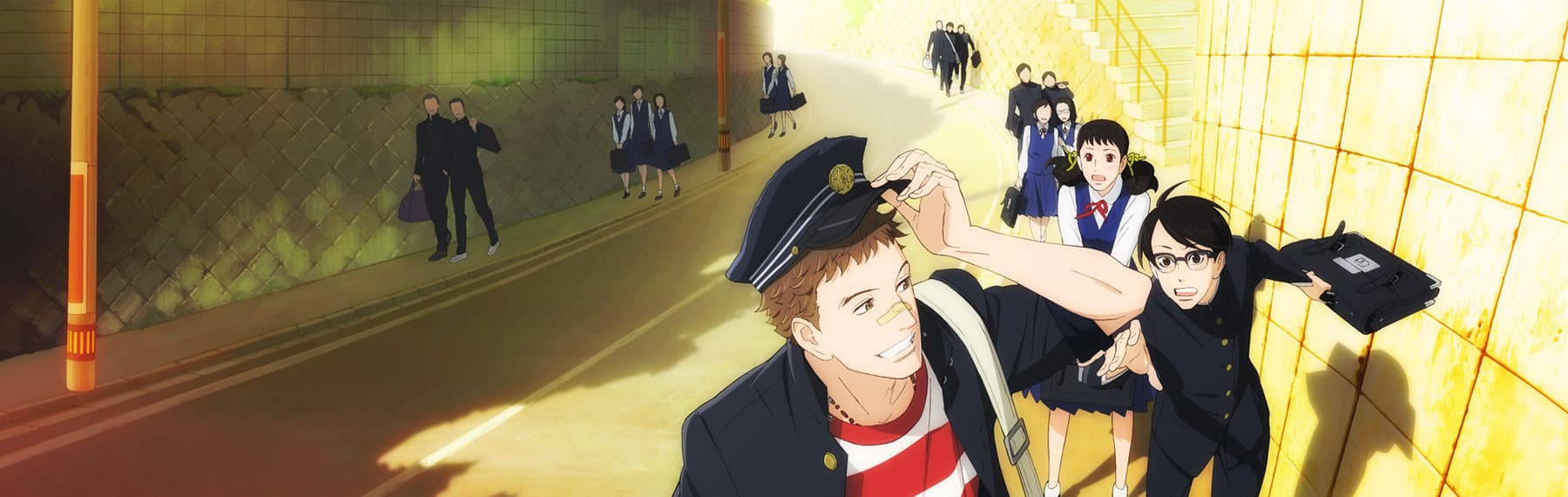
As I expose myself to more and more anime, I begin to question my original notion – do I seem to follow the trend when it comes to rating shows? I originally sensed a diversion from the popular opinion when watching and reviewing Sangatsu no Lion, but I’m noticing it yet again when reviewing Sakamichi no Apollon. A show that I thought was acceptable in some areas, amazing in just one, and lackluster in several others should yield average reviews, correct? Well, the opposite seems to be true. Kids on the Slope is extremely positively received on MAL, with a score of 8.39 at the time of writing. I do consider “average” to be a 5, which happens to be the score that I’ve given this show myself.
Let’s get the obvious out of the way first. This soundtrack is a Yoko Kanno and is the single best part of the entire show in my personal opinion. Who would have thought that the mastermind behind so many other incredible soundtracks would create such incredible jazz pieces? The most notable aspect of the soundtrack is its subtlety. Unlike many of her other more popular pieces, no part of this soundtrack overtly commands attention – but that isn’t the point. The soundtrack is an underlayment, a quiet yet powerful stream that may be most noticeable during the performance scenes but continues steadily forward regardless of what’s showing on screen. You may not notice it, but after watching this show it’s difficult not to look back upon it positively. It was the refrain (and you’ll know it when you hear it) that stuck with me best about this anime, rather than the plot or characters. The most disappointing part about the soundtrack is that the rest of the show really failed to live up to it.
So, then, what of the animation? Actually, I didn’t find it objectionable; actually, it was quite pleasing in some places. While this show isn’t exempt from the common curse of a few badly animated scenes (schoolkids jumping out of windows comes immediately to mind), for the most part, I rarely found the animation distracting. Beautiful? No. The church scenes were the closest the animation might have come to this, but the rest wasn’t too far behind.
So, then, with an amazing soundtrack and decent animation, what’s not to like about this show? As most shows do, Kids on the Slope fails for me in the area of plot and characterization. In summary, the show is a mediocre drama with forgettable characters that is neither realistic nor fantastical. The plot drags on at points and is rushed to completion at others, characters are either overdeveloped or undercooked, and even the theme of resolution is teased but insufficiently dealt with at the end. I hate to say so many poor things about a show without presenting some evidence for my opinion, so let’s look at some specific examples next.
It’s no mystery that the show has three main characters – Sentarou, Kaoru, and Ritsuko. Even MAL identifies this correctly. The major theme is that of relationships, involving the aforementioned three and the major supporting characters, Junichi and Yurika. My largest frustration with this show comes with the trite way in which these relationships are developed. Sentarou and Kaoru have a rocky start due to difference in upbringing and character, but find commonality around their passion for music. That’s it. Despite so many other scenes trying to portray otherwise, I can’t seem to locate a legitimate deeper connection between the two main male characters besides jazz. Am I misreading this? Maybe, but it’s very hard not to see their relationship developed any further. Sure, Kaoru may resolve his frustration with Sentarou’s defection to the rock band as the two play in front of the school, but it’s hard for me to see him valued as a person rather than just a decent drummer. On a related note, I also found it rather difficult to find anything redemptive in Kaoru’s character as a whole, not just with relationship to Sentarou – he starts the series as an aloof (perhaps even depressed) friendless smart kid and ends it as an aloof friendless doctor. I never saw him truly developing throughout the series, despite the various scenes to suggest the contrary. Sentarou less so, but to a related extent also lacked true character development. His portrayal as a “tough guy who actually really cares about his siblings and his bird” seemed almost patronizing as it failed to reveal any complexities beyond his character. Also, I felt myself becoming frustrated with the way his love interests were portrayed, particularly with respect to Yurika – it seemed to be shown as nothing more than an infatuation that spurred the fighting nature of this character until passing. On a related note, I also struggled to see much depth in Ritsuko’s character either. I keep on asking myself “what was her purpose?” Provide a friend for Kaoru as he adjust to a new life? Sure, but not in a particularly meaningful way. Mediate between her two friends’ personal spats? Sure, but perhaps at the expense of meaningful character development between the two. Provide the third leg of the ubiquitous love triangle. YES. Anything else? Not really. I hate to rag on her character like this, as she was probably my favorite of the main three, but I really struggled to see much purpose behind her.
I suppose now is an appropriate time to mount my soapbox and complain about the rest of the relationships and how they pertain to the plot. I felt like Junichi’s role in the entire series was trite and boring at best, and hilariously distracting at worst. Sentarou becomes frustrated at a friend for stealing the attention of his crush, with no meaningful resolution besides some punches and some heavy-handed jazz scenes. This wouldn’t really be a problem if I didn’t see either one coming out of it completely unchanged. Both disappear into Tokyo in episode 9 and are more or less forgotten both by the plot and by Sentarou, who seems suddenly unaffected by both his friend and his love interest’s vanishment. Brother Jun’s involvement and backstory with the Communist Youth also seemed like a bizarrely disjointed way to explain his guilt – perhaps it’s a political statement being made, but I found it extremely separated from the plot of the rest of the anime. I was also frustrated with the way in which Yurika’s character was developed – her parents’ obsession with arranged marriage and hints of abuse are actually interesting and could have served as a more nuanced platform for her relationships with Sentarou and Junichi, but we get very little else about this besides one or two scenes. Speaking again of supporting characters, we’d be remiss not to mention Seiji, who I find unable to identify as a “supporting character” so much as he’s a comedic and convenient figurehead. He seems to be nothing more than a source of friction between two vertices of the love triangle, and seems to be cast to the wayside as soon as this purpose is fulfilled.
While I’m on the soapbox, I’ll rant briefly about the way this show was concluded. Sentarou, wracked with guilt, disappears. Kaoru reveals his satisfaction with this “friend’s” disappearance and in doing so loses his relationship with Ritsuko, and disappears also to Tokyo. The final reunion scene, eight years in the future, shows a meaningful moment of redemption as the two friends reconnect and talk through their differences given their newfound maturities, explaining how what they learned from each other influence their chosen career paths and restore some of the broken trust that arose between them so much earlier. Oh wait, none of this happens. They play jazz together, because again, that’s their only point of connection, and somehow run into Ritsuko with no further purpose at the base of the slope. Honestly, other than the bizarre window jettisoning and the arise of the Communist Youth scenes, the final episode is the only one I truly remember due to its sheer unsatisfactory nature. Low separations following personal disagreement without communication are common and can intensely strain interpersonal relationships – I speak from experience. But the suggestion that years of aloofness can be resolved through some really good piano and drum playing is incredibly banal. It’s not redemptive, it doesn’t tie up the plot or the characters, and it certainly doesn’t help the taste in my mouth.
Anyway, on to the conclusion. The soundtrack is excellent – that’s to be expected. The animation and art are adequate, even good, for the most part. But the characters are superficial, the relationships aren’t meaningful, and the plot is disjointed. If you’re a real jazz fan, go for it – the most important part for you will probably be the soundtrack, and that doesn’t really disappoint. But if you’re watching for meaningful relationships and well-developed plot, I regret to recommend you look elsewhere.
40 out of 73 users liked this review