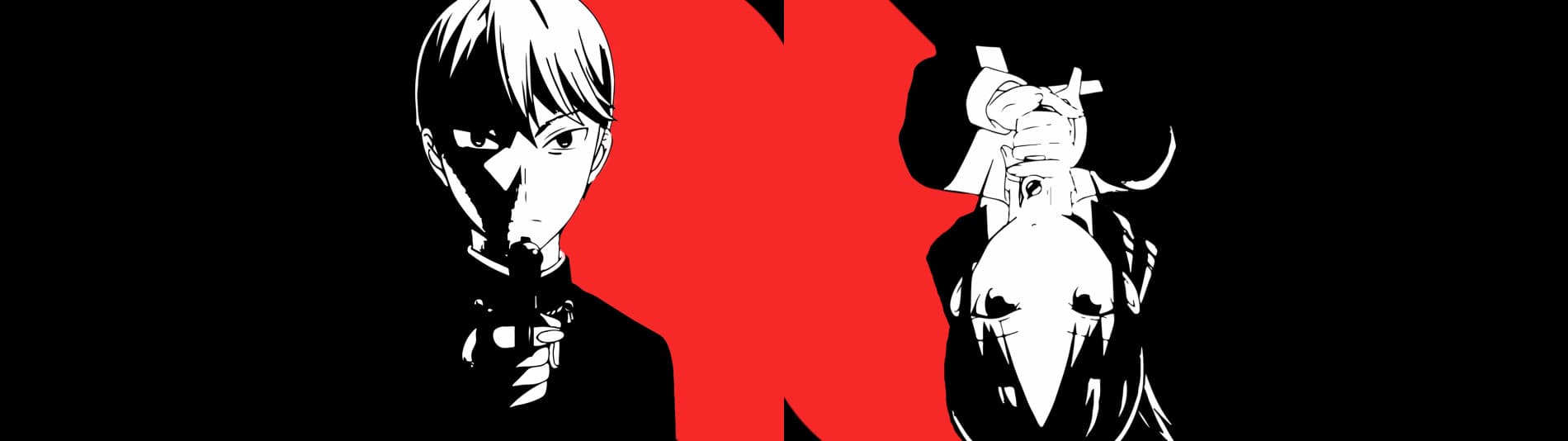
Kaguya-sama is the first anime I’ve ever seen that I watched even vaguely close to its release, enough so that the type surrounding the release of its final few episodes is still fresh in the public’s eye. It’s also the first review I’m writing for an anime that isn’t by Kyoto Animation, and one that has been reviewed with amazing positivity on MAL (8.46 at the time of writing). I started this show by chance rather than by choice, seeing the first two episodes that happened to be selected for viewing at my school’s anime club. I picked up the show again several months later, in a typical case of “KEY works are making me sad again and I need some comedy in my life” blues. In typical fashion, I’ll discuss the visuals, and music, and the characters before starting my assessment of the show.
First – the music. As always the OP and ED form a substantial basis for my overall show rating, as they do wonders to set the tone of the show and draw it to a conclusion with every episode’s passing. The opening, thankfully, absolutely does not disappoint. It’s catchy both musically and in animation style, and it is clear that a lot of thought and development went into making it enjoyable to watch time and time again. It gets stuck in your head, and rightfully so – perhaps the only better thing is watching Masayuki Suzuki perform it live. The ED is much more mediocre, while not exactly bad, while I refuse to comment on Chikatto Chika Chika (seriously, if you’re looking for the fandom that seems to have evolved out of that song, you’ve come to the wrong place). Overall – excellent OP, all-right ED, and generally unobtrusive yet unremarkable soundtrack.
Next, let’s talk about the art. Unfortunately, the best way I have to describe the art is “uninspired.” It’s never distracting and retains decent consistency, with the insert scenes generally more appropriate to driving the context than not. But it’s not remarkable – at no point in the anime did I ever want to pause and think to myself “that would make a good desktop background,” nor did I ever step-through a scene to appreciate animation subtleties. I realize that I have perhaps too high of standards, and I do appreciate how the backgrounds are generally complete and the color tends to accentuate the setting (typically a rich kids’ school) fairly well. Not bad.
Moving on to the characters, let’s first get the obvious out of the way. I do absolutely consider the narrator a character, and I do not hesitate to say that he is my favorite in the entire show. With the oversaturated comedy genre, the best that a studio can hope is to make something really unique: either soundtrack (barring the OP, Kaguya-sama doesn’t achieve), the art (definetely fails), or the characters, and it somehow manages on this final point through the narrator. The narrator sets the tone of the show, gives exposition and context, and declares the overall winner (or loser) of the day’s war. Kaguya-sama stays true to the “Love is War” aspect of its title, but goes so far as to assign an official arbitrator and judge of to whom is granted the victory. I’ve read criticisms of the narrator in the past – “Why? What’s the point of saying who won? He talks too much and it annoying!” I, however, respectively disagree – the mediocrity of the other characters and the uniqueness of the narrator’s place make him stand out. The narrator is my favorite part of the anime, and I appreciate what A-1 has done with him. If it’s worth anything, he’s much of the reason why my rating is as high as it is.
I wish, however, I could laud the other characters to the same degree. The two mains – Kaguya and Miyuki – are locked in a war of brains and pride, both attempting to trick or coerce the other into admitting their love for the opposite. I don’t have an issue with this motif: as a matter of fact, its ridiculous degree really helps improve the comedy of the series, and I don’t believe it behooves the anime to stray from it throughout the entire series. My struggle comes with the characters themselves. Kaguya is a typical tsundere, desiring strongly to hide both her true feelings for Miyuki and even her want to make and remain friends with her peers. However, there’s little to suggest any subtleties to her character beyond this, and it’s never apparent to me that the studio is referencing her ambivalent qualities in a self-aware sort of way. Her only other character traits seem to be summed up in being extremely smart, capable, rich, and innocent – again, nothing new, unique or subtle. Frustratingly, several episodes do attempt some further exposition on her character, attempting to draw out some redemptive character traits, but these are frequently thrown to the wayside when the tsundere comes back into play. Consequently, it’s hard to see her “love” for Miyuki being any more than an obsession or a desire to possess him in the same way that she possesses money, smarts or beauty, and her treatment of Chika and Yuu help to further this standpoint.
Miyuki, on the other hand, possesses far more redeeming qualities than his female counterpart. He, too, is extremely proud and intelligent, but lacks the high upbringing of Kaguya and possesses much more obvious care for those around him. While perhaps considered a Tsundere, Miyuki is better described as feigning indifference rather than cold. He considers Yuu a friend rather than an object (similarly, though to a lesser extent, Chika as well), and seems to legitimately care for his sister and family. He is proud but more a good person than a bad, and I found myself rooting for him to win the daily wars more than his female counterpart. Unfortunately, he also suffers from the same issue of flatness, with little being described or developed in his character.
Finally, we move to the two supports, Chika and Yuu. If Kaguya and Miyuki are flat, Chika is perfectly two-dimensional. Her point is to provide comedic relief, which she does to a certain extent, but most of the comedy comes more in how she interacts with the other members of the student government rather than by virtue of her own character. She is an airhead – not a bad thing, as we see in other anime – but easily tricked and manipulated by Kaguya, and more or less seen as a nuisance by Miyuki. I can’t wrap my head around the fandom’s obsession with her. Yuu, on the other hand, I found much more interesting, because he often voices concepts foreign to the other members of the party (his reference to Stockholm Syndrome was the single funniest part of the anime), and is not obsessed with his smarts in the same way that Kaguya and Miyuki are. Yuu, along with Chika, is the pervert of the group but unlike Chika actually shows some legitimate character development that isn’t immediately discarded by the next scene. Good? No, but more interesting than the others.
At last, we settle on the plot and story. Like I said earlier, the anime is a story of war and the battles that progress between the two characters. As a comedy, it does quite well. Sure, the jokes are repeated and self-explanatory, but unlike so many other comedies it leans more heavily on crudeness rather than visual fanservice that I can’t help but appreciate it more. Many of the comedic moments come from bouncing the characters’ conflicting personalities off of each other, with Kaguya and Miyuki going to extreme degrees to gain even the smallest of perceived “advantages” over the other. In that way, it is indeed a criticism of the “huge confession” trope – after just a few episodes, it’s clear that a confession isn’t going to happen from other side, and even the tiniest victories mean everything to the main characters! Insightful? Not really, but definetely entertaining.
However, the series begins to struggle a bit near the end, where the writers decide to diverge from the purely-comedic roots and attempt to follow a bit of a drama development in the final few episodes. At first, it seems acceptable, as this isn’t foreign to other parts of the series, but it quickly becomes forced rather than spontaneous. Furthermore, the drama development is focused too late in the series to bring new insights to the comedy and leaves the viewer wondering why the writers would switch focus so close to the end. The end of the anime is frustrating since it neither develops the characters meaningfully or continues on the comedic status quo satisfactorily.
So overall, I give this anime a weak recommendation, assuming you enjoy the opening as much as I did, and if you can put up with the mediocre characters for some decent comedy and lackluster drama. Some people are obsessed with this anime (just look at the Kaguya_sama subreddit, wowza), and I think that’s cute. Do you know what I’ve really confessed my love to? Narration by Yutaka Aoyama. Oh, yeah.
48.5 out of 77 users liked this review