Lucky☆Star
a review by YuiHirasawa39
a review by YuiHirasawa39
The strange thing about reviews is that they ca never assume their eventual audience. Is it someone who has heard of the anime and wants to figure out if it’s worth their time? Is it someone who has watched the show either partially or fully and now now looks for validation of their opinions from online strangers? Is it someone who picked up the show, found it unbearable and cast it to the side, just to revisit the reviews and see if there’s something worth watching further on in the series? Although there are certainly each of those types – and surely many more – reading these reviews right now, I’m going to focus entirely on the last group, because this is the group that describes me best. Lucky Star, along with Nichijou, was the very first KyoAni work that I really couldn’t get into within the first few episodes. All of the critical analysis that I applied to all of the other studio’s works failed to grasp strongly on Konata and her friends, and I found myself struggling to find meaning in the show’s plot. I put Lucky Star to the side for a while, and only later decided to revisit it – and I’m so glad I did.
As usual in my reviews, I will talk about several of the general categories that form my rating of the show, and only then revisit what made me return to the show, and why my opinion of it has changed so drastically from the beginning.
First of all, let’s talk about the music. Some people might hate it, but it’s hard to deny that the opening is one of the most iconic that KyoAni has produced. It screams cliché and moe (both topics I’ll discuss in depth later on) and has an uncanny ability to stick rather strongly in one’s head. The endings (yes, plural) are perhaps some of the funnies parts of the show, which as primarily a comedic slice of life, leans upon for part of its charm. The EDs, even moreso than the opening, embrace a lot of references to other soundtracks, and references to the studio’s other works. The music is entertaining and rightfully so, and the rest of the soundtrack, while pretty much what you would expect from a lighthearted slice of life, does its job well. Really the only uncanny thing about the BGM is its similarity in my mind to music from Animal Crossing (???) which surely isn’t a bad thing.
Next, let’s look at the art. Like I normally say, with a KyoAni work there’s not a lot to be concerned about. The scenes rarely suffer from the inconsistencies that sometimes plague other studios, generally adopting the same style that characterizes the OP, except when the time calls for it. The exception to this can be found in the OVA, which deserves its own review. Lucky Star also features many insert scenes that adopt art styles shamelessly copied from other works and genres, which generally do more to emphasize the point than distract, which I definetely appreciate. Significantly, however, the show never pretends to be a serious, plot-driven story for which art style and consistency can either assist the storytelling or ruin the illusion, and insert scenes are thus far more appropriate for an anime that doesn’t take itself seriously.
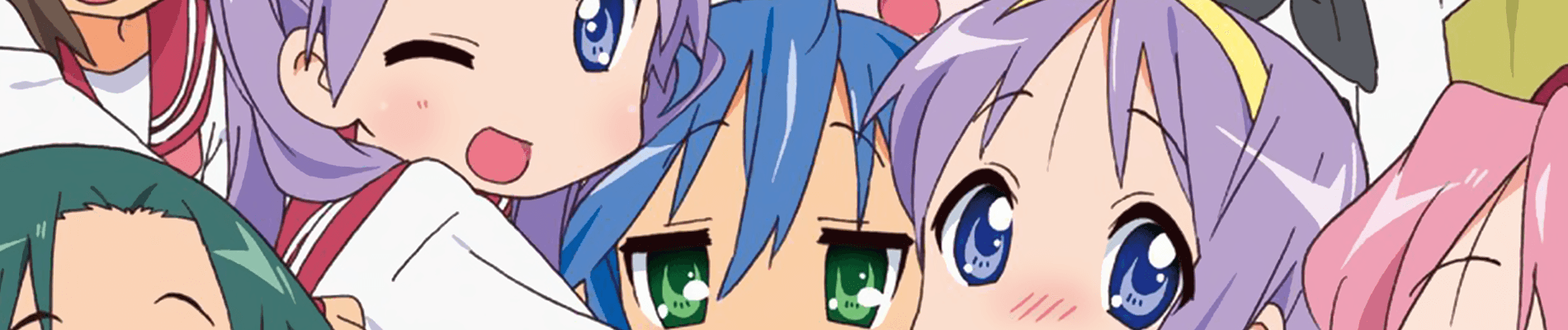
Moving swiftly forward, let’s discuss the characters. The anime centers around four highschool girls and their day-to-day actions, conversations and thoughts. Nothing describes a moe slice of life better than listening in on the lunchtime debates of the correct way to each a chocolate cornet, and similar conversations are not alien to this anime. It is the characters themselves, and the particular way in which they are portrayed, that make this anime so unique and enjoyable.
If you’ve heard of one character in the show, it’s almost certainly Konata. The blue-haired Japanese anime freak who prefers manga and video games to studying or anything else. Absolutely everything about her character reflects the “nerdy gamer” trope seen in SoL or isekai anime: copying her smart friends’ homework, falling asleep in class, pulling all-nighters to play MMOs, the works. Other aspects of her life reflect common tropes as well – small stature, mother’s passage as a child, general misunderstanding of general life skills and common sense – the list goes on. Her interests, while causing her to be lauded by some parts of internet culture as an otaku status symbol, draw the frustration of some of her friends when then interfere with the more responsible parts of life. One of the major things that turned me away from this anime the first time concerned the absolute triteness of her character – I could see no depth, no subtlety, and very few other redeeming traits that made her an interesting figure or even capable of becoming one.
If it’s not Konata, it’s probably Kagami, and she’s where we’ll turn next. If Konata represents the lazy otaku, Kagami represents the hardworking tsundere. She’s studious and serious, endlessly frustrated by Konata and her own sisters due to their lack of ambition and general easygoing disposition towards life. The vast majority of conflict within the anime (if you could call it conflict) regard Kagami’s clash with the general laziness that constantly seems to surround her – or so it seems. Yes, Kagami is probably the most stereotypical tsundere that has graced KyoAni studios, and for good reason. Many of the interactions in the show almost seem designed to emphasize this character trait, showing both her cold and warmer sides even from the earliest episodes. The phrase “It’s not like I like you or anything, baka!” is hopelessly obvious in her interactions with others, particularly Konata, and when I first picked up the show I struggled and failed to find anything else. It’s worth saying here that Lucky Star’s author is, too, named Kagami.
The internet apply describes Kagami as the spice and her younger twin Tsukasa as the sugar. Tsukasa is Kagami’s opposite and takes on the third trope of the SoL world – airheaded, unconcerned student who possesses neither the academic focus of her older sister nor the absolute nerdy infatuation of their friend. If Konata and Kagami are 2D characters, showing only one flat character trait, Tsukasa is one-dimensional, showing very little at all. Perhaps aptly so, her only real strength is cooking and sleeping, feeding her love of cute and tasty things that seem to characterize so many other SoL figures. I’ve used the word “trite” several times so far in this review, and I don’t think a better word can be found to describe Tsukasa. She also happens to be my favorite character, but now’s not the time for that.
The fourth and final member of the main cast is Miyuki, who also sums up the final vertex of the SoL stereotype quadrilateral. She’s smart, competent in both academics and athletics, well-mannered and very proper. She is the book-reader, the rich girl, and the tall one, all rolled up into a single figure. Unlike Kagami, she is the accepting and meaningful one, never frustrated by the laziness, ambivalence, or dreaminess of her three friends. If it sounds like I somehow managed to complete the cast description with yet another flat character, you’d be absolutely right. Miyuki may possess some more of the typical SoL characteristics than the rest of the main cast, but very little about her is unique or impends future growth.
So if you’ve read this far, you’re probably noticing a trend in what I’ve said. The music is cliché, the art style arguably so as well, and all of the characters are flat and lack uniqueness. Why, then, would you ever want to watch an anime that falls into all the traps that make so many others in the genre so mediocre? What’s the point of seeing something that just spews tropes, sound, and fury? The answer is more subtle than I originally thought, and that’s what we will talk about now.
If you’ve heard of Lucky Star in pop internet culture, you probably know that it is absolutely filled with references. Being a Haruhi fan, the endless SOS Brigade mentions almost themselves made this anime worth seeing. And it’s not just Haruhi – other KyoAni works ranging from Kanon to FMP are all referenced, many more than once. Japanese pop culture is also a major focus of this show’s musings, and the EDs I mentioned earlier are never hard to identify for even casual fans of the genre. But that’s not why I feel that this show is so brilliant – any studio can make a show that references things in the real world. But not even studio can make a show that is so incredibly, blatantly self-aware.
The show’s self-awareness first becomes pretty obvious when you take a look at the four main characters. They possess no other traits than those that are stereotypically true of SoL characters, but rather than augmenting those traits to make something unique or attempting to hide them, KyoAni emphasizes them and makes them the single most consuming features of the four leads. There really is nothing other to Kagami than her tsundere nature, but that’s the entire point. What better way to point out industry tropes than make a character so incredibly flat that it’s painfully obvious? If you’re reading this review and have at least some exposure to anime in general, it isn’t hard to think of one or two characters where the studio tries so hard to make them unique while failing due to their fundamentally stereotypical character. KyoAni, rather than making their characters unique, is fully aware of how easy it is to fail at doing so, and instead pivots in the opposite direction, instead making characters so fundamentally one-sided that they reveal the triteness of other, more subtle characters.
Similar themes are seen in the progression of the plot. Slice-of-life is frequently criticized for having no plot, being boring, or being unrealistic. In the first – Lucky Star has absolutely no plot, switching from conversation to unrelated conversation so quickly and confusingly not on accident, but on purpose! On the second – does a conversation about how many postcards that you’ll need to submit to win a magazine contest drive forward the story or build the characters? No, it doesn’t, and that’s exactly the point. On the third – the story follows four neon-haired female main characters, with the only recurring male being the cartoon characterization of one of the voice actors. Unrealistic? It’s supposed to be unrealistic!!
The MAL Rewrite of this anime describes the character’s conversations as being such that “no subject is safe from their musings.” What it fails to capture is that the same is true for meta critism of the anime genre as a whole. Overworked and unappreciated anime producers? We got that. The weirdness when you realize that the same voice actor covers characters from different anime? Oh yeah, Lucky Star has that too. The struggle of male MCs ending up much less popular than the females? Referenced by unhappy caricatures of their own voice actors. The issue of creating side characters? Probably decrying the fact that they seem to be the background in another character’s story. She looks 14 but is actually 40? Oh yeah, that’s there too.
And with that, we wrap back around to why I dropped it and when I picked it back up. Lucky Star’s charm and enjoyment comes in the fact that it mocks over-analyzers like yours truly. There’s nothing to analyze about the plot or the characters, because the studio actively stripped everything extraneous to making their genre criticism as poignant as it could be. The anime became that much more enjoyable for me when I realized that I was supposed to watch it mocking not only the tropes that it references, but also mocking myself for watching something so stereotypically SoL. As an American I identify with the indoctrinated transfer student from the states who knows nothing more about Japan than its pop culture tropes, and I can laugh at myself knowing that even the anime I watch realizes it’s true.
I know that this isn’t like any of my other reviews, and I think it’s fitting for an anime this unique. Lucky Star is self-critical, and you should be too.
7.5 out of 9 users liked this review
