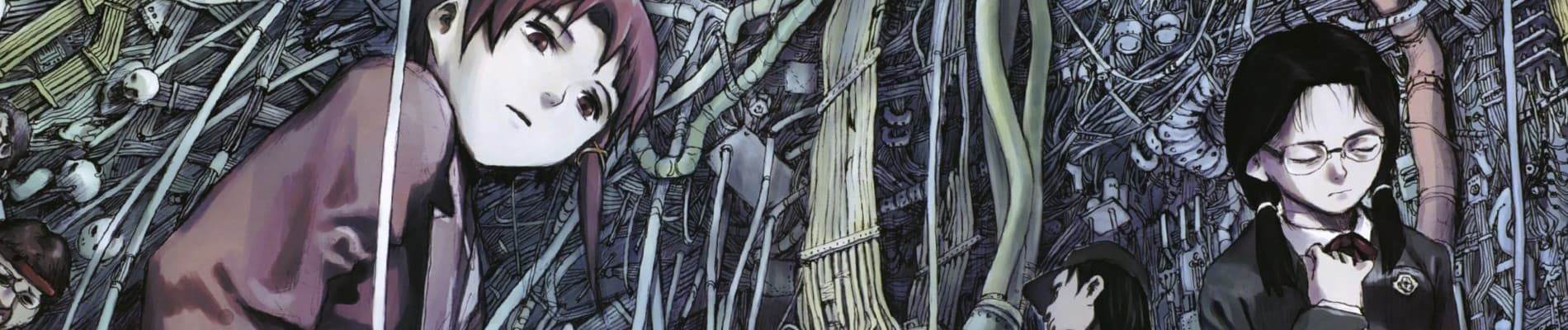
This is a review that is a long time coming. Before I begin, I feel like I need to preface this in a specific way. I do not claim to understand this show – even in a superficial sense. I realize that there’s a lot of well-researched and reasoned theories around Serial Experiments Lain, and I’m not targeting any one of those in this review. This is merely my thoughts about the show, its motivations, effect and legacy. I, like so many others, don’t seem to understand it either.
Speaking of that lyric – I’ve been listening to Duvet for a very long time. Much before I knew what show it was from, what it stood for, or even what the genre of psychological horror. Even up to when I heard that we were going to watch this anime in weekly installments in my college anime club, I was originally unmotivated to see it. I’m not at all into the horror genre. However, I held a certain modicum of respect for the show. I knew that it was widely positively received, and I certainly appreciated Nakamura and the show’s influence on the Haruhi series. Once I learned that the show focused very little on jumpscares or the “shock” horror motif, I decided, albeit with some trepidation, to watch the show in its entirety. I can say, with some hesitation, that I’m glad I did.
After consideration I’ve decided to follow my casual, rather than formal, format for this review. Serial Experiments Lain has been widely discussed and picked apart by individuals far more intelligent than I, with much greater exposure to its interactions with contemporary and modern anime. Instead, I’m going to look at the parts of the show that stood out to me, my experience watching it over the course of several months, and ultimately my interpretation of some of its thematic moments.
First of all, it should be said that I absolutely fell in love with the show’s art within the first few episodes – almost love at first sight. I think the scenes on Lain’s street are probably among the most powerful in the show, and not just for the ubiquitous power lines. The use of void color to contrast with the washed-out nature of the abandoned road, the way that camera angles are used to accentuate the physical and nonphysical players, and the use of light to show emphasis all give an uncanny sense of nonbeing. Perhaps my very favorite moments from this setting are the few times Lain steps through her front door into the light that is somehow both foreboding and welcoming. It’s very hard to describe, and perhaps its just the sheer contrast of the greyscale-heavy landscape with the colorful, light shows that I usually prefer. The artists use this very effectively. Nothing is wrong with the way that her street is portrayed, but something just feels…off. Trust me, it’s not just the power lines – just as their accentuated buzzing heightens your sense of hearing, the overwashed lights and darks play with your sense of sight and depth. It is seriously impressive for a show that was released, at this point, 22 years ago.
What I really appreciate about the use of the art is the way that it draws contrast between the expected and the supernatural. However, it’s not done in the way that one might initially expect. I can say, with some confidence, that the writers never intend to give their audience a false sense of normalcy, of pedestrian security that this show it set in a normal world to begin with. The case of Chisa’s suicide, arguably the incident that spurred Lain’s descent into the Wired, is somewhere between the normal and the unreal. Again, the topic of what inspires Lain’s journey has been thoroughly discussed not only in these reviews but elsewhere across our own wired, and I’m not hoping to get too deep into it here. Mainly, I want to point out that this show never once seeks to hide its abnormality from its audience. It’s baked right into the title of the first episode – it’s Weird.
Describing the plot of Serial Experiments Lain is a tremendous challenge for me. The obvious explanation, of course, is easy enough to roll through. Lain, through increasing interaction with the Wired, discovers two alternative personas beyond her reserved corporal self. Her interactions with Eiri and the Knights of the Eastern Calculus all culminate in her realization that she is none other than god – the god of the Wired, which itself is closely lined with the real world. In an attempt to reverse her antagonistic persona’s harassment of her best friend, Lain concludes the series by apparently deleting her memory from the world, which invalidates the events of the series so far. But I’m not overly happy with just that plot explanation by itself.
And why? Perhaps I’m just frustrated with the seeming lack of explanation. I never felt content with why the Knights were murdered, with whether or not the Office Worker did it, or even with my own interpretation that Lain is the perpetrator. I’m unhappy with never knowing why Karl and Lin suffer from their terrible fate, albeit in a different way. I’m dying to know how Eiri’s entrance into the Wired is somehow inferior to Lain’s, and if he is a legitimate demigod or just a clever impersonator. All of this, however, pales in comparison with how much I feel we don’t get regarding Lain’s relationships, and that’s where I’ll turn next.
Let’s look at the obvious first. Lain’s family merely exists to “Play House,” and although this explanation is relatively tame compared with some of the others that we get throughout the show, it’s one of the ones that frustrate me the most. It’s not exactly a mystery that even from a non-supernatural sense, her family is highly dysfunctional. Lain’s mother Miho and sister Mika are both distant, certainly in a figurative sense, due to their apparent and unexplainable disdain for her. However, I also like to note that they’re also quite distant from a physical perspective. Miho’s response when seeing her younger sister in the middle of a busy intersection is to remark on her stupidity and walk away, distancing herself in whatever way possible. Miho is similar – even if she was a real human, it’s hard for me to see a meaningful relationship between mother and daughter. The only member of Lain’s “family” who shows any sense of connection toward her is Yasuo, her father, who is arguably the one responsible for introducing her to the Wired in the first place. By his own admission, he dislikes “playing house,” but seems to be the only one of the three who actually takes his job seriously. Their final separation, in the final episode, confirms this.
And next it’s time to turn to Lain’s friends. I did note initially that the entire plot seems to be sparked off by Chisa’s suicide – a girl she hardly knew, yet now writing notes to her from the other side. It’s easy for me to see Lain’s apparent connection with someone she only superficially interacted with as evidence of how much deeper the Wired goes. However, I also think there’s weight to the argument that Lain hopes to reverse the situations that led to Chisa’s death – by deleting herself, does she hope to divert Alice’s focus onto her peer? Alice, of course, is most interesting to me of them all. I never played Alice in Cyberland, or watched the OVA, but it’s apparent to me that Alice provides the alternate side of the Lain narrative. After all, she seems to be the only one who retains any connection to Lain after she erases her memory from humanity, despite her apparent misunderstanding of the technology that permitted it. It’s also arguable, from episode 12, that it’s Alice’s existence that manages to push Eiri out, rather than Lain’s power alone.
It’s among these relationships that one of the central dogmas of the show arises. The Freudian nature of Lain’s self-discovery becomes one of the most significant and complex parts of the show. The dominating Lain – sneering at her onlooking self. The confident Lain – assembling computers on her bedroom floor. The opening Lain – reserved and quiet. The Id, the Ego, the Superego. The three sides of each one of us, brought to light in the human world, the wired, and the liminal space in between. Konaka shows that when one Lain betrays Alice by spreading awful rumors, the second will try to reverse the damage, while the third is pulled taught between them. The same is true for Lain’s family – it’s not hard for me to see how each aspect of her personality evokes a different response from those meant to be closest to her.
Okay, so I’ve ranted for a while on the art, the relationships, and even the person herself. But the most significant aspect for me about this show is how it explores the topic of person. I said it earlier, but there’s several clear influences that we see reflected from Lain into Haruhi – and not only the obvious of a questionably self-aware female god, but also the use of light to show clarity and the power of perspective, among others. But one of these most powerful influences is that of names and being named. The god’s name – “Lain” – is spoken with significance throughout the series. Characters seem to be obsessed with the word “Lain.” So many of the lines either end with it or start with it, often accentuated slowly and deliberately, even such that a non-native speaker such as myself can’t help but notice.
As far as I’m able to tell, Lain is named after Ronald David Laing, a 20th century psychiatrist who criticized conventional methods for “treating” schizophrenic patients, such as shock therapy and sedation. Laing, known for his founding of the infamous Kingsley Hall in London, a haven for schizophrenic patients with none of the forced sedation and repressive techniques common in the medical world at the time. While the details of Laing’s stance and works are somewhat obscure and controversial, it seems that he saw psychosis as not a mental defficiency but a spiritual or sensational experience in which individuals worked out their own experience with reality. Now I haven’t researched Laing extensively, nor do I propose to understand his complete disposition towards mental illness, but it seems to me that his opposition to cruel techniques such as electroshock and lobotomy was unique in his era, as was his disposition that mental illness was not fully understood.
In Lain’s case, throughout the show, I could not help myself but see endless connections to a psychological explanation to the absurdities. Lain, disdained by her mother and sister, reaches out into a world where she finds people who seem to care about her. The death of someone she knew pushes her deeper into her own self and reliance on the Wired and her experiences in it. It’s not hard for me to see the obscure disappearance of her family from her own house one night as representative of the mental and physical distance that they keep from her, or her experience watching a live shooting as parallel to the games she plays online. Even her experience of herself as god, and seeing passer-by worship her figure in the sky, doesn’t seem unreasonable given the intense psychological distortion that Lain experiences. Most satisfying to me, however, about this explanation is episode 9, “PROTOCOL,” otherwise known as the alien episode. My brother’s explained this episode to me as being an expert troll of the community due to the absolute absurdity (come on, when else should E.T. show up in a psychological horror anime about the internet), but I’ve never been totally satisfied. I’m not saying that psychological experiences and extraterrestrial experiences are the same thing, but I think it’s worth noting that one’s sense of imagination may be heightened when introspective. Most importantly, I believe that Laing pioneered the school of thought that such an abnormal experience such as alien encounter is not necessarily a sign of schizophrenic disorder. I’m not sure.
By this time, this review has gotten far too rant-y, so it’s time to wrap things up. Did I love this anime? In the first few episodes – yes, absolutely. I saw so many metaphors in the light and shadow even before Lain got deep into the wired, and they delighted me. But by the time things started to escalate, I found the show harder and harder to follow. The narrative that I tried to draw out seemed more and more contrived. Now that’s not a bad thing – again, this show is definetely Weird – but I found it harder and harder to follow a single theme or motif as the show progressed. Like I mentioned earlier, I wish we had more about the other characters, and more about Lain’s relationships, but alas, only 13 episodes restrained us. I’m not sure if any more episodes would have helped with a satisfying conclusion, or even that a satisfying conclusion is appropriate for a show like this.
So take this review and rating with a grain of salt. Half of me wants to give it a 7, the other me an 8. Again, I don’t want to portray myself as an expert, or even as someone who has read up extensively on other perspectives. I haven’t even played the PS1 game (though I plan to, for sure). Do I appreciate this anime, for its unique story and characters? Absolutely. Do I appreciate it for its legacy on anime like Haruhi? By all means. Do I really know enough to understand it? No way.
11.5 out of 15 users liked this review