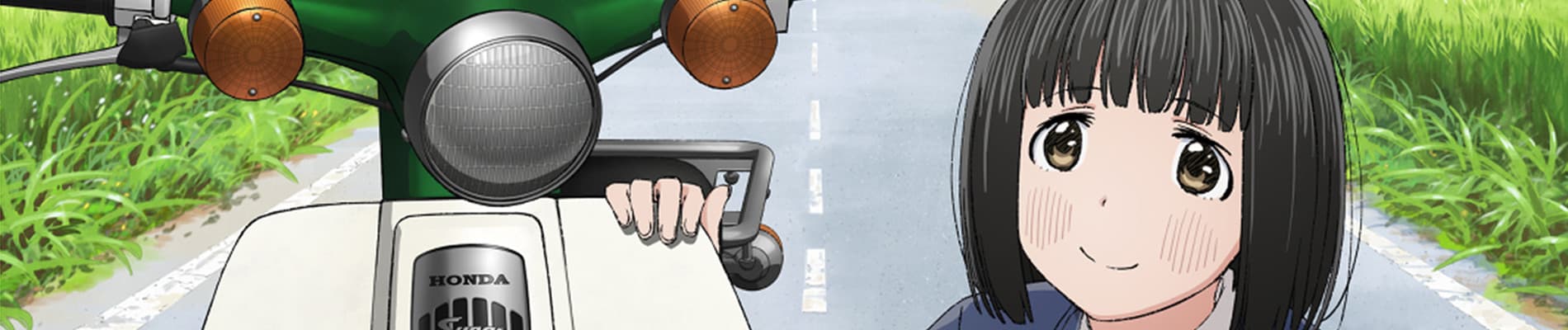
Super Cub ended up being my favorite series of the 2021 spring season. This has been one of the best individual seasons for new anime that I can remember, so I have a bit of a job to do to explain why I think so highly of a show that is partly a paid ad for Honda, and in most other ways an unassuming slice of life drama. The short version is that it is both a very well-made show, and it was also the right show at the right time for me personally.
Super Cub is based on a series of light novels by Tone Koken and Hiro, which so far includes 7 main novels and one side volume (I own the first six books and the side story, but the most recent volume has been backordered for months). The series has also been serialized as a manga, which is up to 5 tankoubon volumes so far. Neither the light novels nor the manga have been officially translated into English and it seems unlikely that they ever will. So the anime is likely to be the only version of the story that most non-Japanese people will see.
The good news is that for the most part the anime does a model job of adapting and condensing the novels. The manga is a more literal telling of the story than the anime, and in one very significant case does a much better job (which I'll get to in a bit), but for the most part the anime flows better and hits all the important story and (importantly) emotional beats of the novels it covers.
The story is fairly simple: Koguma is a plain, unremarkable girl going to a high school in Yamanashi Prefecture (the same part of Japan where another excellent iyashikei series, Laid-Back Camp, takes place). In her own words, she has, "no parents, no money, no friends, no hobbies, and no goals for the future." She lives on a meager government subsidy in a 1DK apartment in a drab apartment building on the outskirts of Hokuta (the anime never bothers to explain what happened to her family, which is a bold but good choice because it doesn't really matter to the story). She is taciturn at school and a diffident student, and her main struggle is the bicycle ride to and from school.
One day, tired of panting her way up the hill before her school and getting passed by fellow students on scooters, she stops at a motorcycle dealership on her ride home. In one of innumerable moments in the show where we are shown rather than told things, there is a long, mostly static shot where Koguma studies motorcycles while the manager / mechanic at the dealership studies her. He wheels a Super Cub out from the garage, explains that it's more or less cursed, and offers it to her at a discount so steep that even with her limited money she can afford it. He even throws in a pair of riding gloves and a helmet as a "promotion" and a free servicing. None of this is presented as a special kindness, but it seems clear that he is more interested in something he sees in Koguma than making a sale. She takes the bait, buys the Super Cub, and we have a show.
The story is, essentially, a love story between a girl and her motorcycle (nobody could possibly be surprised that Honda sponsored the original light novel series, as the way that the characters rhapsodize about Honda light motorcycles is indistinguishable from advertising copy). Or, more properly, about the ways in which her world enlarges and her life grows richer after she has her bike. She (literally) breaks out of her rut, she makes human connections, she sees new places, and her world grows a little more colorful.
Across 13 episodes, very little happens. She learns to maintain and accessorize her motorcycle, starts hanging out with another girl at school who has her own tricked out bike (a customized Super Cub that was originally a Japan Post delivery bike that I seriously covet), goes on a school trip with her class, goes to see the cherry blossoms in the south when spring starts after a long winter, and starts going to the coffee shop run by the family of another classmate.
One dramatic thing does happen, and this is the only thing – along with the relentless and occasionally immersion-breaking Honda boosting – stopping me from giving this show a perfect score (something I almost never do). In the penultimate episode of the show, Koguma's classmate Shii ends up crashing her bicycle into a mountain river in the middle of winter and it's up to Koguma to rescue Shii-chan with her Super Cub. The anime's story departs from the LN and manga pretty significantly here, for no particular reason I can tell, and it ends up mangling the characters' motivations, has them acting very out of character, and has them take risks that would in all likelihood get one or more of them killed in the real world. It really doesn't make sense and all I can figure is that the anime's writers and director didn't know how else to fit everything into 23 minutes.
Koguma is a bit of a cipher, and her two companions (she doesn't think of them as friends, which is consistent with her personality, but kind of ridiculous given that one of them obviously has a crush on her and by the end of the series she's practically married to the other) are also both fairly eccentric in their own ways. Reiko is a pitch-perfect portrayal of a monomaniacal nerd whose entire life revolves around motorcycles and Super Cub culture, and Shii is almost as devoted to bringing the culture of the Southern (European) Alps to the Southern (Japanese) Alps. The three of them are mostly unified by their collective obsessiveness, and they're so out there that they're not even outcasts at their school – they're just off doing their own thing (although when Koguma rolls up to the ryokan on her Super Cub during the school trip at the same time as the bus carrying the rest of her classmates, her classmates are completely dumbfounded that this nerdy nonentity is also somehow the biggest badass in the class (that's actually Reiko, but none of them know about her attempt to conquer Mt Fuji on a 125cc delivery bike)).
The show's reliance on showing not telling really serves it well here – it allows these three girls to be nerdy and brusque and occasionally hilariously cruel and narcissistic, but in a very natural and believable way. I had no trouble believing that these three awkward loners were literally ride or die for each other by the end of the season, and by telling the story with such a light touch it also really allowed me to see how these three are all essentially very lonely girls who are very hungry for connection.
It also allows the show's very understated humor to shine through. In reality, Reiko would be a tremendously challenging friend, because if it's not related to Super Cubs (or, uh, guns), she really cannot be bothered. Shii's the most normal of the three, but her parents are themselves gigantic nerds (her mom seems to be LARPing an LA housewife from the 1950s and drives a pickup truck; her dad has an obsession with European breads that rivals post-COVID tech bros in its intensity) and she's small for her age and awkward. Koguma is socially stunted and also extremely pragmatic and congenitally unimpressed, which leads to her being alternately extremely cool (see above) and a huge dick, completely unintentionally in both cases. She's one of the best portrayals of a neurodiverse individual I've seen in a very long time, and is extremely funny. I want to be her friend.
A lot of people are likely to disagree with me, but I honestly think Super Cub featured some of the best animation and music this season. There was a lot of good animation in this season's shows, from SSSS.Dynazenon's excellent integration of CG and hand-drawn animation to Vivy's ridiculously tight and fast-paced action sequences. Super Cub's animation was not like that – the show did not have a big budget, and the story is defined by how little actually happens.
That said, it did a lot with what little it had. While the integration of CG and regular animation was not as flashy as Dynazenon's, the carefully (and literally) on-model rendering of the motorcycles and bicycles give them a presence befitting the show's most important supporting characters. Backgrounds are frequently reused but subtly changed to show the passage of time and the changing seasons. Like Laid-Back Camp, the show leans very heavily on the natural beauty of Yamanashi and Japan's Southern Alps, but the style is more "rustic beauty" than "travel brochure."
The show's use of color is exquisite, and one of the primary means the show uses to portray the emotional state of the characters. The default color palette of the show is very subdued and naturalistic (and, in my opinion, all the more beautiful for it), but when Koguma is excited or happy, the colors suddenly become much more saturated and everything gets brighter. It's such a simple trick but it packs a serious emotional punch, and even though they reuse the trick throughout the show it never seems cheesy or manipulative.
They also keep the rough, thick lines of the character designs in the light novels (although the characters look different from their LN equivalents) and this both serves to keep the "cel-shaded" CG from looking out of place but also gives the show as a whole a more rough-hewn, handmade vibe.
Finally, the soundtrack is great. Both the opening and ending themes are cute laid-back pop songs and match the overall easygoing vibe of the series. The show uses classical music – in particular Debussy's Clair de Lune and a few Beethoven pieces in thematically appropriate ways, and it really cements the show as one of the most delicate and chill in the last few years. It's top-tier iyashikei vibes all around.
I can't really pretend to be objective about this show. The first four episodes are one of the best portrayals of a certain kind of loneliness I've ever seen, and after the last, lonely year, the show just hit me like a truck. The very slow development of what is actually a surprisingly ambiguous set of relationships was consoling on a level I can't even really describe. The sheer level of aesthetic refinement in the show combined with how unhurried the show did its thing made it the show I most looked forward to watching each week. And Koguma herself is one of the most well-rounded main characters I think I've ever seen. She's kind of grumpy and selfish, she's incurious and not particularly charming, and despite her loneliness she's not particularly eager to put herself out there. But she's kind, courageous, persistent (or stubborn), and the kind of person who knows when a friend needs something and just does it.
If you liked Laid-Back Camp or A Place Further Than the Universe, if you're somebody who doesn't need a lot to happen (or wants for things to not happen), if you're a fan of unconventional presentation, if you like extended, naturalistic studies of interesting characters, you need to watch this show.
30.5 out of 36 users liked this review
